


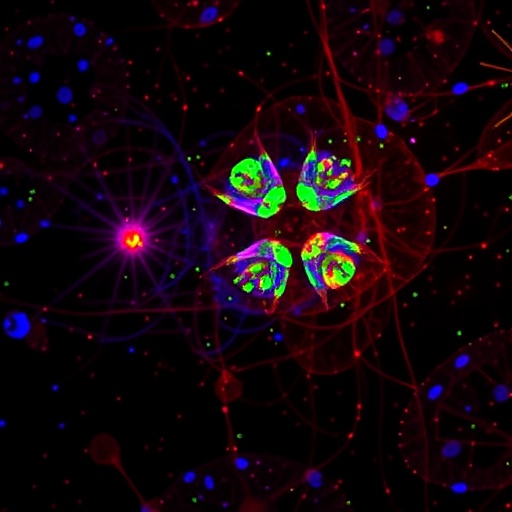
In a groundbreaking study that promises to reshape our understanding of Alzheimer’s disease, researchers have unveiled a novel mechanism by which microglial cells may exacerbate disease progression. The investigation, conducted on the widely utilized 5×FAD mouse model of Alzheimer’s, identifies CD31, a cell surface receptor traditionally linked to endothelial biology, as a critical suppressor of amyloid-beta (Aβ) clearance by microglia. This discovery sheds new light on the complex interplay between immune cells of the brain and amyloid pathology, charting a potential new course for therapeutic intervention.
Alzheimer’s disease, characterized by the accumulation of toxic Aβ plaques and neurofibrillary tangles, is a progressive neurodegenerative disorder that affects millions worldwide. While the role of microglia—the brain’s resident immune cells—in Alzheimer’s has been extensively studied, their dualistic nature remains enigmatic. On one hand, microglia can facilitate clearance of pathological proteins, but on the other, they can drive harmful neuroinflammation. The revelation that microglial CD31 dampens Aβ clearance offers a tangible molecular target to tilt this delicate balance in favor of neuroprotection.
The team employed the 5×FAD mouse model, which rapidly replicates amyloid pathology akin to that observed in human Alzheimer’s patients. By using sophisticated genetic and biochemical tools, they demonstrated that microglial CD31 expression is upregulated in these mice. More critically, microglia exhibiting higher CD31 levels displayed a marked reduction in phagocytic activity against Aβ aggregates. This suggests that CD31 acts as a molecular brake preventing the efficient engulfment and disposal of amyloid deposits by microglial cells.
Further mechanistic studies revealed that the binding of CD31 interferes with signaling pathways essential for cytoskeletal rearrangement and the engulfment process, notably modulating the activity of Syk kinase and actin remodeling proteins. This molecular blockade handicaps microglial motility and their capacity to surround and internalize Aβ fibrils, which are crucial steps in plaque clearance. Importantly, when CD31 was genetically ablated specifically in microglia, Aβ clearance significantly improved, correlating with a substantial reduction in plaque burden.
These findings suggest that microglial CD31 represents a previously underappreciated immune checkpoint within the central nervous system. Similar to immune checkpoints in oncology that restrain T cell activity, CD31 appears to negatively regulate microglial phagocytosis. This positions CD31 blockade strategies as an intriguing parallel to cancer immunotherapy but designed to invigorate microglia’s protective functions in neurodegeneration.
The pathological consequences of unchecked CD31-mediated inhibition were manifested clearly in the aging 5×FAD mice, which exhibited exacerbated amyloid pathology along with worsened cognitive deficits as assessed by behavioral paradigms. Neuroinflammatory markers associated with dysfunctional microglia were elevated, indicating that CD31 not only suppresses beneficial clearance but may tip microglia towards a maladaptive, disease-promoting state.
This study, therefore, provides compelling evidence that targeting microglial CD31 could have multifaceted benefits: enhancing amyloid clearance, mitigating neuroinflammation, and ultimately preserving synaptic integrity and neuronal survival. It opens a new avenue in Alzheimer’s research centered around modulating innate immune checkpoints rather than focusing solely on amyloid production or aggregation.
In addition to its molecular and cellular insights, the research team utilized advanced imaging techniques, including in vivo two-photon microscopy, to visualize microglial dynamics in real time. These live imaging experiments corroborated the inhibitory role of CD31 on microglial motility and phagocytic synapse formation with Aβ plaques. Such high-resolution visualization underscores the transformative impact of integrating state-of-the-art technologies in unraveling complex neuroimmune interactions.
Another key strength of this study lies in its translational potential. By identifying CD31 as a modulator of microglial function, pharmaceutical development can now pivot toward generating specific inhibitors, antibodies, or small-molecule modulators of CD31 signaling. These interventions could be delivered via brain-penetrant methods, possibly in combination with other anti-amyloid or anti-tau therapies, to synergistically combat Alzheimer’s pathology.
Given that CD31 is also expressed on endothelial cells, future investigations will need to delineate its distinct roles in vascular versus immune components within the central nervous system. Nonetheless, the selective targeting of microglial CD31 or downstream effectors may achieve therapeutic specificity while minimizing off-target effects.
This discovery also enhances our understanding of microglial biology in neurodegeneration beyond Alzheimer’s. Since microglial dysfunction is implicated in various neurological disorders, including Parkinson’s disease and multiple sclerosis, CD31-mediated regulation could represent a broader immunoregulatory axis relevant across multiple conditions.
The authors highlight that the research was conducted with rigorous controls and validated with complementary approaches, strengthening the validity of their conclusions. They also caution that translating findings from mouse models to human disease always entails challenges but remain optimistic that human studies will confirm microglial CD31 as a viable target.
Importantly, this paradigm-shifting work emphasizes the notion that not all microglial activation is beneficial—immune checkpoints like CD31 may impose brakes that, if unregulated, prevent microglia from effectively combating proteinopathies. Thus, modulating these checkpoints could recalibrate innate immunity within the brain.
As the Alzheimer’s research community grapples with the complexity of the disease, interventions that harness intrinsic cellular machinery such as microglial CD31 hold promise for achieving disease modification. This work not only deepens our understanding of Alzheimer’s pathophysiology but also inspires novel therapeutic strategies aimed at harnessing the brain’s own defenses.
Future studies will likely probe the interplay between CD31 and other microglial receptors involved in clearance and inflammation, such as TREM2 and CX3CR1, potentially uncovering synergistic targets. Clinical translation will benefit from biomarker development to monitor CD31 pathway activity in patients and assess therapeutic efficacy.
In summary, the discovery that microglial CD31 suppresses Aβ clearance and exacerbates Alzheimer pathology revolutionizes our approach to neurodegenerative disease treatment. Harnessing this knowledge could lead to groundbreaking immunomodulatory therapies capable of halting or reversing disease progression, offering new hope to millions afflicted by Alzheimer’s worldwide.
Cite Scienmag News
Cassandra Pierce. (June 6, 2026). Microglial CD31 Hinders Aβ Clearance, Worsens Alzheimer’s. Scienmag. https://scienmag.com/microglial-cd31-hinders-a%ce%b2-clearance-worsens-alzheimers/
Cassandra Pierce. "Microglial CD31 Hinders Aβ Clearance, Worsens Alzheimer’s." Scienmag, 6 June 2026, https://scienmag.com/microglial-cd31-hinders-a%ce%b2-clearance-worsens-alzheimers/. Accessed 4 September 2026.
Cassandra Pierce. "Microglial CD31 Hinders Aβ Clearance, Worsens Alzheimer’s." Scienmag. June 6, 2026. https://scienmag.com/microglial-cd31-hinders-a%ce%b2-clearance-worsens-alzheimers/


