

Friday, September 4, 2026
Science
No Result
View All Result
  • Login
  • HOME
  • SCIENCE NEWS
  • CONTACT US
  • HOME
  • SCIENCE NEWS
  • CONTACT US
No Result
View All Result
Scienmag
No Result
View All Result
Home Science News Technology and Engineering

Microbeads with adaptable fluorescent colors from visible light to near-infrared

July 12, 2024
in Technology and Engineering
Denise Maddox
By Denise Maddox Scienmag Editorial Profile - Mechanical Engineering
Reading Time: 3 mins read
0
Microbeads with adaptable fluorescent colors from visible light to near-infrared
66
SHARES
598
VIEWS
Share on FacebookShare on Twitter
ADVERTISEMENT

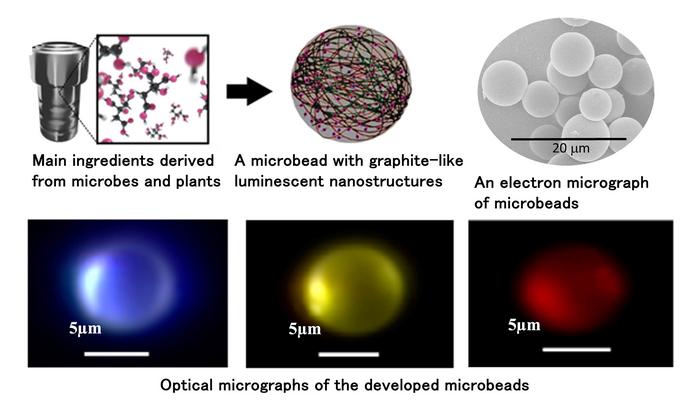
1. A research team at NIMS has successfully developed an environmentally friendly, microspherical fluorescent material primarily made from citric acid. These microbeads emit various colors of light depending on the illuminating light and the size of the beads, which suggests a wide range of applications. Furthermore, the use of plant-derived materials allows for low-cost and energy-efficient synthesis.

Figure.

Credit: Tadaaki Nagao
National Institute for Materials Science

1. A research team at NIMS has successfully developed an environmentally friendly, microspherical fluorescent material primarily made from citric acid. These microbeads emit various colors of light depending on the illuminating light and the size of the beads, which suggests a wide range of applications. Furthermore, the use of plant-derived materials allows for low-cost and energy-efficient synthesis.

2. Conventional luminescent devices commonly utilized thin films of compound semiconductors containing metals or sintered inorganic materials with rare earth elements. However, in a circular economy, there is a demand for fluorescent/luminescent materials that do not use rare earth elements, which have unstable supply chains, or metal elements with significant environmental impact. The microbeads we developed aim to provide low-environmental-impact fluorescent materials using abundant, easily obtainable plant-derived materials as the main ingredients.

3. The research team, led by the Nano-Photonics Group at the Research Center for Materials Nanoarchitectonics (MANA), developed microbead-type luminescent materials synthesized by heating citric acid and polyamino acids, which are used in soft drinks and food additives. These spheres utilize the fluorescence from soot- or graphite-like nanostructures within the heat-denatured, aggregated polyamino acids to emit red, blue, and yellow light, as well as near-infrared light invisible to the naked eye. By leveraging the light confinement effect of the microbeads, they have demonstrated that a single bead can emit various colors of light (different wavelengths of light).

4. In addition to emitting various colors of light, the fluorescence wavelength and light intensity distribution (fluorescence spectrum) of these microbeads vary significantly according to their shape and size. These unique fluorescence spectra for each bead can be used like authentication tags or barcodes. This capability allows for identifying individual beads using light, leading to applications such as color-changing paints, anti-counterfeit inks, and fluorescent probes that can identify and track individual beads in biological systems.

***

5. This research was conducted by a team consisting of Tadaaki Nagao, Group Leader of the Photonics Nano-Engineering Group at MANA, NIMS Postdoctoral Researcher Barun Kumar Barman (formerly a JSPS Postdoctoral Fellow), JSPS Research Fellow Hiroyuki Yamada, Researcher Keisuke Watanabe, Atsushi Goto, Group Leader of the Solid-State NMR Group at the Center for Basic Research on Materials, Principal Researcher Kenjiro Hashi, Principal Engineer Shinobu Ohki, and Engineer Kenzo Deguchi from the High Magnetic Field Characterization Unit of the Research Network and Facility Services Division at NIMS. This research was supported by a grant from the Japan Society for the Promotion of Science (JSPS).

6. The results of this research will be published in the June 13, 2024, online issue of the journal Advanced Science.


Journal

Advanced Science

DOI

10.1002/advs.202400693

Method of Research

Experimental study

Subject of Research

Not applicable

Article Title

Rare-Earth-Metal-Free Solid-State Fluorescent Carbonized-Polymer Microspheres for Unclonable Anti-Counterfeit Whispering-Gallery Emissions from Red to Near-Infrared Wavelengths

Article Publication Date

13-Jun-2024

Subject of Research: Technology and Engineering

Article Title: Microbeads with adaptable fluorescent colors from visible light to near-infrared

Article References: Original research article

Image Credits: AI Generated

DOI: Not provided

Keywords: Not provided

Cite Scienmag News

Denise Maddox. (July 12, 2024). Microbeads with adaptable fluorescent colors from visible light to near-infrared. Scienmag. https://scienmag.com/microbeads-with-adaptable-fluorescent-colors-from-visible-light-to-near-infrared/

Denise Maddox. "Microbeads with adaptable fluorescent colors from visible light to near-infrared." Scienmag, 12 July 2024, https://scienmag.com/microbeads-with-adaptable-fluorescent-colors-from-visible-light-to-near-infrared/. Accessed 4 September 2026.

Denise Maddox. "Microbeads with adaptable fluorescent colors from visible light to near-infrared." Scienmag. July 12, 2024. https://scienmag.com/microbeads-with-adaptable-fluorescent-colors-from-visible-light-to-near-infrared/

Share26Tweet17
Previous Post

What flavor is that neutrino? Adding flavor helps to track neutrino movement in astrophysical systems

Next Post

Severe droughts limit Amazonian communities’ access to basic services

Related Posts

Anti-swelling biphasic conductive hydrogels enable 3D-printed implantable bioelectronics
Technology and Engineering

Anti-swelling biphasic conductive hydrogels enable 3D-printed implantable bioelectronics

September 4, 2026
Shape-memory polymer nanocoatings redistribute stress in brittle battery cathodes
Technology and Engineering

Shape-memory polymer nanocoatings redistribute stress in brittle battery cathodes

September 4, 2026
Exciton interactions enable spin control for bright spin LEDs
Technology and Engineering

Exciton interactions enable spin control for bright spin LEDs

September 4, 2026
Scientists melt diamond at 1 TPa using shock compression experiments
Technology and Engineering

Scientists melt diamond at 1 TPa using shock compression experiments

September 4, 2026
Wireless contactless well plate tracks cardiac organoid and 3D tissue contraction
Technology and Engineering

Wireless contactless well plate tracks cardiac organoid and 3D tissue contraction

September 4, 2026
QFRS: Standardizing reporting of forecasting, evaluation, and trading claims in quantitative finance
Technology and Engineering

QFRS: Standardizing reporting of forecasting, evaluation, and trading claims in quantitative finance

September 4, 2026
Next Post
Severe droughts limit Amazonian communities’ access to basic services

Severe droughts limit Amazonian communities' access to basic services

  • Mothers who receive childcare support from maternal grandparents show more optimized

    Mothers who receive childcare support from maternal grandparents show more parental warmth, finds NTU Singapore study

    27656 shares
    Share 11059 Tweet 6912
  • University of Seville Breaks 120-Year-Old Mystery, Revises a Key Einstein Concept

    1061 shares
    Share 424 Tweet 265
  • Bee body mass, pathogens and local climate influence heat tolerance

    682 shares
    Share 273 Tweet 171
  • Researchers record first-ever images and data of a shark experiencing a boat strike

    546 shares
    Share 218 Tweet 137
  • Groundbreaking Clinical Trial Reveals Lubiprostone Enhances Kidney Function

    531 shares
    Share 212 Tweet 133
Science

Embark on a thrilling journey of discovery with Scienmag.com—your ultimate source for cutting-edge breakthroughs. Immerse yourself in a world where curiosity knows no limits and tomorrow’s possibilities become today’s reality!

RECENT NEWS

  • Study Validates Brief Anger and Aggression Questionnaire Among Minnesota Inmates
  • Physical Activity Tied to Better Physical Reasoning in Young and Older Adults
  • Previewing distractors shapes how alerting affects conflict in attention tasks
  • Rural Upbringing Linked to Childhood Mental Health Outcomes in Australia

Categories

  • Agriculture
  • Anthropology
  • Archaeology
  • Athmospheric
  • Biology
  • Biotechnology
  • Blog
  • Bussines
  • Cancer
  • Chemistry
  • Climate
  • Earth Science
  • Editorial Policy
  • Marine
  • Mathematics
  • Medicine
  • Pediatry
  • Policy
  • Psychology & Psychiatry
  • Science Education
  • Social Science
  • Space
  • Technology and Engineering

Subscribe to Blog via Email

Enter your email address to subscribe to this blog and receive notifications of new posts by email.

Join 5,151 other subscribers

© 2025 Scienmag - Science Magazine

Welcome Back!

Login to your account below

Forgotten Password?

Retrieve your password

Please enter your username or email address to reset your password.

Log In
No Result
View All Result
  • HOME
  • SCIENCE NEWS
  • CONTACT US

© 2025 Scienmag - Science Magazine

Discover more from Science

Subscribe now to keep reading and get access to the full archive.

Continue reading