

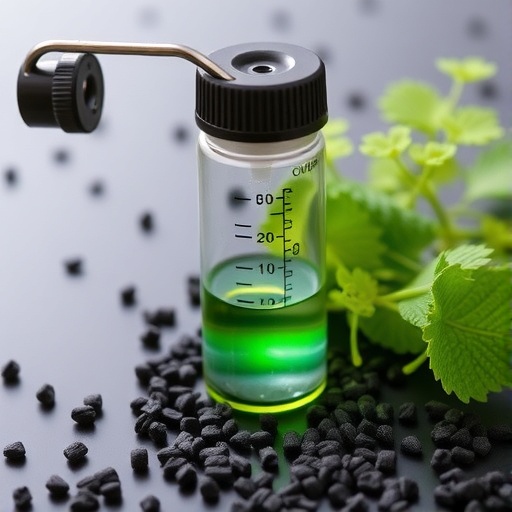
In a remarkable breakthrough combining marine biotechnology and materials science, researchers have engineered an innovative biochar material derived from nickel-enriched marine microalgae, ushering in a new era of enzyme-free electrochemical sensing for hydrogen peroxide detection. This advancement holds the promise to revolutionize multiple industries by delivering a rapid, sensitive, and sustainable alternative to traditional enzyme-based sensors. The core of this technology lies in cultivating Picochlorum eukaryotum, a species of marine microalgae, in a nickel-supplemented growth medium, followed by precise pyrolysis to transform the biomass into a conductive, porous carbon structure embedded with uniformly dispersed nickel nanoparticles.
Hydrogen peroxide (H₂O₂) has long been recognized for its dualistic nature in science and industry. As a versatile oxidizing agent, it finds expansive applications ranging from disinfectants in healthcare to oxidants in chemical manufacturing. Nevertheless, in biological and environmental systems, elevated hydrogen peroxide concentrations can denote oxidative stress or contamination, necessitating highly sensitive and rapid sensing mechanisms. Despite decades of sensor development, challenges persist due to the instability and environmental sensitivity of enzyme-integrated sensors. This newly reported biochar sensor pivots away from biological enzymes, exploiting the catalytic potential of nickel nanoparticles anchored within a stable carbon matrix to achieve sensitive detection with enhanced durability.
The scientific team employed an innovative bio-fabrication method. By nurturing Picochlorum eukaryotum in nickel-supplemented aquatic media, the algae bioaccumulate nickel ions intracellularly. Subsequent pyrolysis under controlled thermal conditions converts this biomass into a biochar exhibiting a hierarchical porous architecture. This porous carbon framework not only preserves the nickel in catalytically active nanoparticulate form but also provides an extensive electrochemically active surface, effectively fostering electron transfer processes crucial for the oxidation of hydrogen peroxide molecules during sensing.
Conventional electrochemical sensors often rely on embedded enzymes like horseradish peroxidase, which, although initially selective and sensitive, suffer from rapid degradation, stringent storage conditions, and pH sensitivity. The newly developed biochar eliminates these concerns by relying solely on the intrinsic catalytic activity of nickel nanoparticles. These metal sites facilitate direct electron transfer in the oxidation of hydrogen peroxide without auxiliary biological catalysts, markedly improving sensor lifetime, performance consistency, and operational conditions. Notably, the biochar achieves a detection limit as low as 0.39 micromolar and a swift response time near two seconds under physiological pH.
The sophistication of this biochar lies in its uniform metal dispersion, attained through in vivo metal enrichment during algal cultivation rather than post-synthesis metal impregnation. This controlled bioaccumulation ensures homogeneous distribution of catalytically active sites, avoiding the aggregation issues commonly seen in physically mixed catalysts, which invariably leads to performance deterioration. The resulting structure combines high conductivity, mesoporosity, and robust catalytic sites, collectively producing an electrochemical sensor with remarkable sensitivity, selectivity, and reproducibility.
Furthermore, the sensor’s performance has been rigorously validated in complex real-world matrices, including seawater, milk, and fruit juice, simulating conditions encountered in environmental monitoring, food safety analysis, and medical diagnostics. High recovery rates in these multifaceted samples affirm the sensor’s robustness and potential to transcend laboratory confines into practical application domains. Its stability across repeated sensing cycles and resistance to interference from coexisting chemical species emphasize its operational reliability.
This research not only pioneers a sustainable path for sensor material synthesis by leveraging rapidly renewable biological resources but also provides a blueprint for integrating biosourced metals within carbon matrices. The cross-disciplinary approach unites principles of marine biology, materials chemistry, and electrochemistry, achieving a functional material that is environmentally benign and cost-effective. The choice of nickel, an earth-abundant and relatively inexpensive transition metal, further underscores the economic feasibility of scaling this technology.
Excitingly, the implications of this study extend beyond hydrogen peroxide detection alone. The approach of biologically mediated metal enrichment before carbonization presents a versatile platform for fabricating biochar materials doped with different metals tailored to catalyze a variety of electrochemical reactions. This could herald the development of an entire family of enzyme-free biosensors targeting gases, biomolecules, or pollutants with customized selectivity and sensitivity profiles.
The researchers envision that coupling such biochar-based sensors with miniaturized analytical devices or integrating them into smart monitoring networks could transform diagnostics and environmental analytics. By marrying sustainable material development with cutting-edge sensor technology, this innovation provides a viable alternative to conventional nanomaterial synthesis techniques, which often involve complex chemical routes and toxic reagents.
Ultimately, this study exemplifies the potential of nature-inspired materials engineering to address pressing technological challenges. The strategic utilization of marine microalgae as a biological template and metal accumulator embodies a circular, green chemistry approach that aligns with global sustainability goals. As industries and scientific communities increasingly seek eco-friendly and efficient sensing solutions, such biological electrochemical interfaces may soon become foundational tools across sectors transcending health, environment, and industry.
This groundbreaking research paves the way for future investigations exploring different microalgal species, metal types, and pyrolysis parameters to diversify material functionalities and optimize sensor performances further. The principles demonstrated underline an emerging paradigm in sensor design: exploiting biological systems not only as passive subjects of study but as active participants in material synthesis and functionalization.
In summary, the creation of nickel-enriched biochar from Picochlorum eukaryotum represents a milestone in the quest for sustainable, high-performance, enzyme-free electrochemical sensors. The fusion of marine biotechnology with green material processing holds immense promise for next-generation biosensors, setting a new standard for sensitivity, stability, and environmental stewardship in chemical sensing technologies.
Subject of Research: Not applicable
Article Title: A novel biochar from Ni-fed Picochlorum eukaryotum for use as a high-performance enzyme-free electrochemical sensor of hydrogen peroxide
News Publication Date: 27-Jan-2026
Web References:
DOI link to article
References:
Gan, H., Tang, Y., Yang, S. et al. A novel biochar from Ni-fed Picochlorum eukaryotum for use as a high-performance enzyme-free electrochemical sensor of hydrogen peroxide. Biochar 8, 17 (2026).
Image Credits:
Credit: Hongyu Gan, Yun Tang, Shuyuan Yang, Keren Liu, Manna Huang & Yiqian Wan
Keywords:
Fuel cells, Hydrogen fuel, Hydrogen storage, Energy, Catalysis, Sensors, Biosensors


