


Researchers at Virginia Tech are paving the way for a revolutionary shift in manufacturing, particularly in the realm of military logistics. A profound predicament has long burdened naval forces: the languishing fleet of submarines immobilized due to malfunctioning or aging components. These parts often require bespoke manufacturing, leading to lengthy waits as they are shipped thousands of miles from specialized machinists. However, the research led by Prahalada Rao, an associate professor in the College of Engineering, aims to redefine this procedural norm through the integration of artificial intelligence in additive manufacturing.
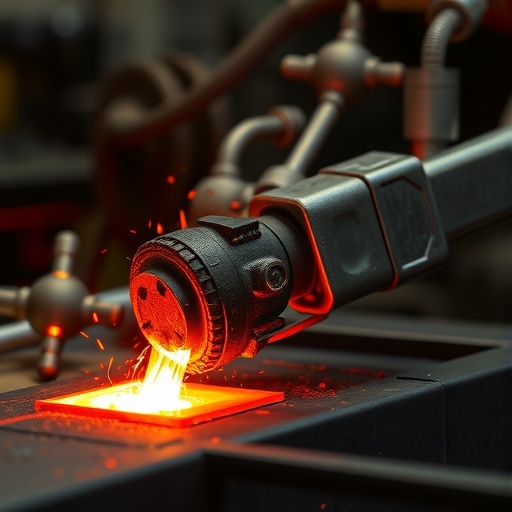
In a recent publication, Rao explored the implications of employing advanced AI techniques to monitor wire-arc additive manufacturing – a process often summarized as 3D welding. This innovative approach not only facilitates real-time detection of defects but also enables immediate corrective actions during the production of critical components. The study, which appeared in the journal Materials and Design, asserts that utilizing such technology could significantly shorten the waiting times for replacements while enhancing the overall reliability of the naval fleet.
Additive manufacturing represents a paradigm shift from traditional machining methods which can take months to yield a single part. This conventional approach has remained ingrained in military practices, largely due to the reliance on small machine shops that possess the necessary skills. However, the time-consuming and material-intensive nature of these operations often leads to unnecessary waste and inefficiency, especially when defects are only identified after extensive work has been done.
With the dwindling number of such machine shops since the Cold War, the urgent need for alternative manufacturing solutions has become evident. Many experienced craftsmen have exited the field, leaving behind a gap in specialized skills. Additive manufacturing not only addresses this issue by expediting production but also allows for the creation of complex components that traditional methods cannot effectively produce.
Rao’s team is particularly focused on two progressive techniques: wire-arc printing and laser-wire printing. Wire-arc additive manufacturing stands out due to its efficiency; it can deposit vast amounts of material swiftly compared to other methods such as laser powder bed fusion. While the latter may produce a limited volume of material, wire-arc techniques can achieve production rates of up to 50 kilograms daily, making it a game-changer for military applications where readiness is paramount.
Yet, the complexity of ensuring flaw-free parts remains a significant hurdle. Rao’s innovative solution incorporates machine learning algorithms that analyze the “melt pool” – a crucial aspect of the additive manufacturing process. By observing the characteristics of the melt pool, the AI learns to differentiate between acceptable and defective prints. This proactive approach allows for immediate interventions, increasing the likelihood of producing a flawless part.
This shift towards smart manufacturing represents an advancement towards what is referred to as Industry 4.0—a contemporary state where technology and production processes are synergized. The traditional “mom-and-pop” machine shops of the past are evolving into high-tech facilities capable of adapting to the fast-paced requirements of modern manufacturing. This transformation is not merely theoretical but is already being materialized in the labs at Virginia Tech, where cutting-edge equipment and methodologies are being utilized to educate the next generation of engineers and manufacturing professionals.
Rao emphasizes the importance of quality control in this rapidly evolving field. The mantra of “faster, better, cheaper” encapsulates his mission to enhance manufacturing processes. By minimizing defects and eliminating the time wasted on rework, Rao aims to ensure that what is produced is not only efficient but also of higher quality. The addition of new technologies and training facilities further illustrates Virginia Tech’s commitment to nurturing expertise in manufacturing.
The lab where Rao conducts his research is rife with innovative equipment, including upgraded systems that support the latest in additive technologies. The Learning Factory at Virginia Tech serves as a vital resource for students, providing them with hands-on experiences using machines they are likely to encounter in their future careers. Rao believes that equipping students with practical knowledge on these advanced systems is critical for preparing them to navigate the forthcoming landscape of manufacturing.
Collaborative endeavors within Virginia Tech Made highlight the multidisciplinary approach being adopted. The center encourages partnerships across various fields, working with industry and government to tackle pressing challenges in manufacturing. This collaborative environment fosters not only innovation but also empowers students to cultivate essential skills that are increasingly relevant in a technology-driven economy.
The implications of this research extend well beyond the military sector. The potential applications of AI in additive manufacturing can revolutionize various industries, enhancing the production of everything from aerospace components to consumer goods. As manufacturing processes continue to evolve, the integration of intelligent technologies will undoubtedly reshape the landscape, addressing long-standing challenges surrounding efficiency and quality assurance.
The timeliness of this research cannot be overstated; as global supply chains face ongoing disruptions, finding faster and more reliable means of production has never been more critical. Rao’s infusion of artificial intelligence into manufacturing aligns perfectly with current industry needs, heralding a future where production is more responsive to demand and less susceptible to delays.
In conclusion, as Virginia Tech researchers delve into the intersection of artificial intelligence and additive manufacturing, the potential to redefine traditional manufacturing paradigms becomes tangible. Through innovations like those pioneered by Rao and his team, we may soon witness a transformation in how critical components are produced, ushering in a new era of efficiency and reliability for the industrial sector.
Keywords
Additive manufacturing, Industrial production, Manufacturing industry, Computer science, Artificial intelligence, Adaptive systems, Aeronautical engineering, Aircraft construction, Aviation, Fabrication
Cite Scienmag News
Denise Maddox. (October 7, 2025). Metal: Melted and Mastered in Groundbreaking Scientific Discovery. Scienmag. https://scienmag.com/metal-melted-and-mastered-in-groundbreaking-scientific-discovery/
Denise Maddox. "Metal: Melted and Mastered in Groundbreaking Scientific Discovery." Scienmag, 7 October 2025, https://scienmag.com/metal-melted-and-mastered-in-groundbreaking-scientific-discovery/. Accessed 4 September 2026.
Denise Maddox. "Metal: Melted and Mastered in Groundbreaking Scientific Discovery." Scienmag. October 7, 2025. https://scienmag.com/metal-melted-and-mastered-in-groundbreaking-scientific-discovery/


