


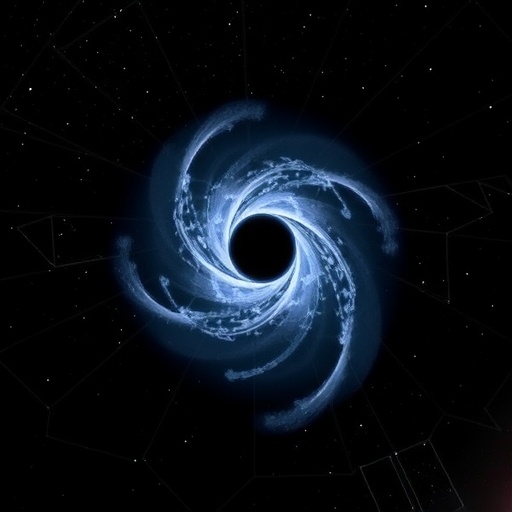
A groundbreaking international collaboration of astrophysicists, including key researchers from Yale University, has developed a pioneering method to detect and map merging supermassive black hole binaries using gravitational waves. These colossal pairs of black holes, which gradually spiral towards each other and eventually merge, emit gravitational waves—ripples in spacetime—that can be captured to reveal their precise locations across the cosmos. This innovative detection system promises to transform our understanding of the universe, analogous to the epochal advances made when astronomers first harnessed X-rays and radio waves to probe celestial phenomena.
The project is led by the North American Nanohertz Observatory for Gravitational Waves (NANOGrav), a consortium that has devised a sophisticated new protocol for pinpointing individual continuous gravitational wave sources. Traditionally, gravitational wave astronomy has focused on cataclysmic, transient events like black hole mergers detected by LIGO and Virgo. However, NANOGrav’s approach is distinct in targeting the continuous, low-frequency gravitational waves emitted by supermassive black hole binaries, which orbit each other over much longer timescales. This innovative detection framework is a monumental step towards producing an expansive gravitational wave map of the universe’s most massive and enigmatic mergers.
Chiara Mingarelli, an assistant professor of physics at Yale and a prominent voice within the NANOGrav collaboration, emphasized the importance of this achievement. “Our findings provide the scientific community with the first concrete benchmarks for developing and testing detection protocols for individual, continuous gravitational wave sources,” she stated. This protocol combines a rigorous theoretical foundation with practical detection methodologies, enabling researchers to not only detect but also localize these supermassive black hole pairs that until now have remained elusive in direct observations.
Central to this methodology is the use of pulsars—rotating neutron stars that emit incredibly precise radio pulses. These cosmic timekeepers serve as a galaxy-scale detector array for gravitational waves. Fluctuations in the timing of pulsar signals induced by passing gravitational waves provide indirect evidence of gravitational wave backgrounds. Building upon previous work, the team has now refined techniques to isolate the signals of individual binaries within this background noise, which marks a significant advancement in gravitational wave astronomy.
One of the pivotal theoretical premises that informed this groundbreaking search is the demonstrated correlation between supermassive black hole binaries and quasars—exceptionally luminous regions powered by matter accreting onto central black holes. Earlier research led by Mingarelli and colleagues revealed that galaxy mergers resulting in black hole binaries are five times more likely to be identified in quasar-hosting galaxies. This insight allowed the team to focus their gravitational wave searches on 114 active galactic nuclei (AGN), zones within galaxies where supermassive black holes are actively accreting material.
Through their targeted search, the researchers identified two exemplary supermassive black hole binary candidates named SDSS J1536+0411 (“Rohan”) and SDSS J0729+4008 (“Gondor”). These monikers pay homage to both their discoverers and popular culture, referencing the beacons lit in J.R.R. Tolkien’s “The Lord of the Rings” saga—a symbolic nod to signals guiding allies in times of need. Rohan, named after Yale student Rohan Shivakumar who conducted the primary analysis, and Gondor further embody the collaborative spirit and imaginative zeal fueling this research frontier.
The detection of these two systems marks not only a scientific milestone but also sets a foundation for comprehensive gravitational wave cosmology. By anchoring the gravitational wave background map with confirmed black hole binaries, astrophysicists gain a new tool for probing galaxy evolution, black hole dynamics, and the behavior of spacetime under extreme gravity. This fresh perspective is poised to revolutionize our understanding of cosmic structure formation and the final stages of galactic mergers.
Previously, in 2023, NANOGrav announced the first direct detection of a gravitational wave background, signaling the presence of slowly merging supermassive black hole pairs emitting continuous gravitational radiation. This discovery suggested that Earth-bound detectors could observe a background field of low-frequency gravitational wave energy—a monumental leap forward from detecting isolated and transient events to perceiving the steady hum of black hole mergers throughout the universe.
NANOGrav’s research integrates sophisticated data analysis techniques, synthesizing pulsar timing arrays with quasar variability measurements to enhance detection sensitivity. The interdisciplinary collaboration combines observations from radio astronomy, gravitational wave physics, and high-energy astrophysics, showcasing the power of cross-domain synergy. This fusion of methods enabled the isolation of the distinctive gravitational wave signatures from SDSS J1536+0411 and SDSS J0729+4008 amidst the complex astrophysical foreground.
The collaborative nature of this project is highlighted by its diverse team, including prominent Yale faculty like Priyamvada Natarajan and Paolo Coppi, alongside graduate students and undergraduates contributing crucial data analysis and theoretical insights. This blend of experienced researchers and emerging scientists underscores the democratization of big data astrophysics and the critical role of mentorship in advancing frontier science.
The NANOGrav project benefits from a combination of robust funding sources, including the National Science Foundation, the Gordon and Betty Moore Foundation, and Canadian institutions such as the National Sciences and Engineering Research Council of Canada and the Canadian Institute for Advanced Research. This sustained support facilitates continuous monitoring of pulsars and comprehensive follow-up investigations aimed at expanding the gravitational wave source catalog.
Looking ahead, the team plans extensive observational campaigns to discover additional supermassive black hole binaries. These efforts will refine the gravitational wave background map and provide critical empirical data to test fundamental physics theories, including general relativity under extreme gravitational fields. The ability to trace the precise locations of cosmic beacons powered by the universe’s most massive objects heralds a new era in multi-messenger astrophysics.
As Chiara Mingarelli noted, “Our work has laid out a roadmap for a systemic supermassive black hole binary detection framework. We carried out a systematic, targeted search, developed rigorous protocols—and two targets rose to the top as examples motivating follow-up study.” These results open up avenues for future theoretical explorations and observational breakthroughs that promise to deepen humanity’s cosmic perspective.
In summary, this revolutionary approach to mapping the universe’s gravitational wave landscape through the detection of supermassive black hole binaries represents a paradigm shift. It moves beyond the first detections of violent, transient gravitational wave events and steps into the realm of continuous, persistent signals that carry rich information about the cosmic dance of galaxies and their central black holes. The amalgamation of advanced pulsar timing, quasar observations, and targeted search protocols paves the way for a new scientific frontier where gravitational waves become a primary tool in unraveling the mysteries of the universe.
News Publication Date: 5 February 2026
Web References:
- https://doi.org/10.3847/2041-8213/ae3719
- https://iopscience.iop.org/article/10.3847/1538-4357/adce05
- https://news.yale.edu/2023/06/28/astrophysicists-present-first-evidence-gravitational-wave-background
Cite Scienmag News
Grant Pearson. (April 14, 2026). “Merging Black Holes Detected and Mapped by New Beacon System”. Scienmag. https://scienmag.com/merging-black-holes-detected-and-mapped-by-new-beacon-system/
Grant Pearson. "“Merging Black Holes Detected and Mapped by New Beacon System”." Scienmag, 14 April 2026, https://scienmag.com/merging-black-holes-detected-and-mapped-by-new-beacon-system/. Accessed 3 September 2026.
Grant Pearson. "“Merging Black Holes Detected and Mapped by New Beacon System”." Scienmag. April 14, 2026. https://scienmag.com/merging-black-holes-detected-and-mapped-by-new-beacon-system/


