

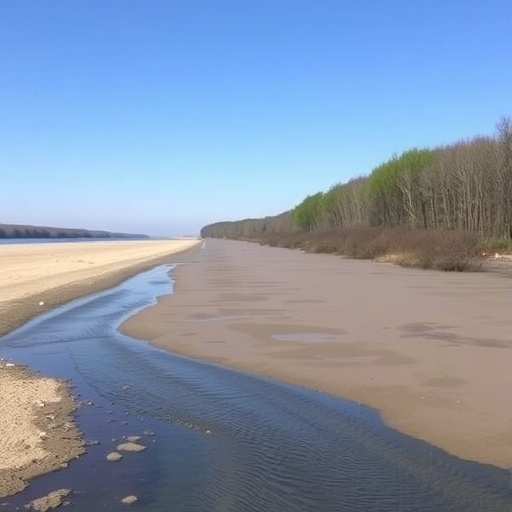
The Elbe River, a critical waterway flowing through central Europe, has a long history of industrial activity and environmental contamination. Researchers have been probing into the sedimentary records of this legacy-contaminated river to unravel the intricate story of total mercury levels over time. A recent study by Hahn, Breuer, and Wiederhold sheds fresh light on the temporal trends and spatial variations of mercury in these sediments. By employing cutting-edge analytical techniques, this research highlights the persistent legacy of mercury and its implications for ecological health and human safety.
Mercury is a notorious pollutant found in many aquatic environments, and its presence in river sediments is of particular concern due to its potential bioaccumulation in the food chain. This phenomenon raises alarms about the broader ecological impacts, particularly concerning fish populations that are primary consumers of mercury-contaminated sediment. The authors meticulously examined various sediment cores from the Elbe River to evaluate how mercury levels have changed over time and across different locations along the river.
Utilizing sophisticated sampling and analytical techniques, the study assessed sediment samples that span several decades. The results indicated significant temporal trends in mercury levels, revealing periods of marked increase and decline that correspond with historical industrial practices. The historical timeline is essential, as it correlates with shifts in regulatory frameworks and pollution control measures introduced in Germany over the years. These insights are crucial for understanding the long-term efficacy of environmental policies aimed at reducing pollution.
Spatial variations were another critical focus of the research. The Elbe River flows through various regions, each with distinct industrial histories and environmental policies. Therefore, the mercury concentrations were not uniformly distributed. Some areas demonstrated alarmingly high levels of mercury, particularly regions adjacent to former industrial sites. These findings underscore the need for targeted remediation efforts and suggest that localized pollution is still a significant issue in certain stretches of the river.
Furthermore, the authors delved into the relationship between mercury levels in sediments and upstream activities. Industrial discharges, urban runoff, and historical mining activities contributed significantly to the mercury found in sediments. Employing a combination of geochemical analyses and historical assessments, the researchers successfully mapped out the sources of mercury, providing a clearer picture of how human activity influences environmental contamination.
One of the most enlightening aspects of this study was its implications for public health. High mercury levels in river sediments can lead to increased concentrations in aquatic organisms, particularly fish. This poses a health risk to local communities that rely on these fish as a food source. By highlighting the spatial distribution of mercury, the research raises awareness of the potential health risks in specific regions, calling for public health advisories and potential restrictions on fishing in contaminated areas.
Moreover, the persistence of mercury in the sediments is a stark reminder of the long-lasting impacts of industrial pollution. Unlike many contaminants, mercury does not degrade easily, leading to its accumulation in ecosystems over time. The study emphasizes that even after regulatory measures have been implemented, the legacy of past contamination can continue to affect environmental health for decades or even centuries. This reinforces the need for long-term monitoring and comprehensive environmental assessments to mitigate future risks.
The findings from Hahn, Breuer, and Wiederhold’s research have significant implications not only for the Elbe River but also for other legacy-contaminated waterways worldwide. Many rivers across Europe and beyond share similar historical contamination issues, making the insights gained from this study universally relevant. Environmental scientists and policymakers can leverage these findings to develop better strategies for managing contaminants in rivers that have faced industrial exploitation.
In light of the ongoing dialogue about environmental restoration, the study contributes vital data to a growing body of literature focused on sediment contamination and its long-term impacts. Addressing sediment pollution is a complex endeavor that requires multi-faceted solutions, including better waste management practices, enhanced regulatory oversight, and community engagement. By highlighting mercury’s historical trends and current concentrations, the authors undoubtedly provide a valuable resource for future environmental health initiatives.
In conclusion, the study represents a crucial step in understanding how mercury pollution has shaped the sedimentary landscape of the Elbe River and the implications for the broader ecosystem. As we continue to examine the impact of industrialization on our waterways, this research serves as a clarion call for increased vigilance and proactive management of our aquatic environments. Ignoring the legacy of contamination is not an option if we aim for a healthier future for both the environment and public health.
Research such as this reinforces the necessity for ongoing investigations into the adaptation of regulatory frameworks designed to address persistent pollutants. Comprehensive environmental assessments and community education must go hand-in-hand to foster a collective understanding of the delicate balance between industrial development and ecological integrity. As the study of the Elbe River illustrates, attention to historical contexts and contamination legacies is crucial in effectively combating the challenges posed by pollutants like mercury.
The efforts of Hahn, Breuer, and Wiederhold exemplify the importance of melding scientific inquiry with practical environmental management solutions. By prioritizing the investigation of hazardous substances in sediment, we can take meaningful steps toward restoring our rivers and safeguarding the health of future generations while appreciating the lessons from the past to inform our actions today.
Subject of Research: Temporal trends and spatial variations of total mercury in sediments of the legacy-contaminated river Elbe (Germany)
Article Title: Temporal trends and spatial variations of total mercury in sediments of the legacy-contaminated river Elbe (Germany)
Article References:
Hahn, J., Breuer, L. & Wiederhold, J.G. Temporal trends and spatial variations of total mercury in sediments of the legacy-contaminated river Elbe (Germany).
Environ Monit Assess 198, 56 (2026). https://doi.org/10.1007/s10661-025-14881-y
Image Credits: AI Generated
DOI: https://doi.org/10.1007/s10661-025-14881-y
Keywords: Mercury pollution, Elbe River, sediment analysis, environmental health, legacy contamination, ecological impact, industrial history, public health risks, regulatory measures, bioaccumulation, environmental monitoring.


