

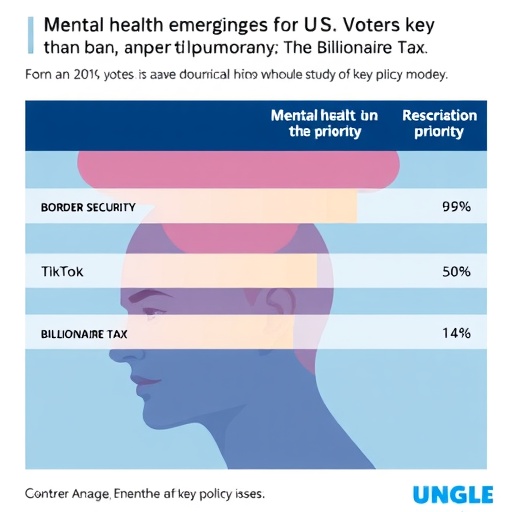
In the evolving political landscape of the United States, the salience of various policy issues dynamically shapes voter priorities and electoral outcomes. A recent comprehensive study published in PLOS One sheds new light on the prominence of mental health as a critical issue for American voters. This research rigorously benchmarks mental health against a spectrum of other pressing policy issues, including border security, the regulation of social platforms like TikTok, and fiscal policies such as the Billionaire Tax. Astonishingly, it reveals that mental health concerns eclipse these traditionally heated topics in terms of voting importance, a finding that challenges common narratives predominantly focused on security and economic taxation.
The investigation utilized a sophisticated voting simulation embedded within a nationally representative survey module, providing empirical validation of voter preferences. By introducing a hypothetical voting scenario, the study exposed respondents to a curated array of policy issues, compelling them to prioritize based on perceived personal and societal impact. This methodological innovation allows for an enhanced understanding of issue salience beyond anecdotal or media-driven representations, lending statistical weight to mental health’s emergent prominence in the American political psyche.
Delving into the data analysis, the study employs advanced econometric models to isolate the effect of mental health as a voting issue while controlling for demographic variables and political affiliation. The models indicate a statistically significant higher valuation placed on mental health relative to other contentious issues. This quantitative approach underscores a crucial shift in voter goals, potentially signaling a new era where psychological well-being becomes a central axis in political campaigns and policymaking debates.
Furthermore, the research contextualizes these preferences within the broader social and economic milieu shaped by the COVID-19 pandemic and the escalating discourse surrounding mental health awareness. The pandemic’s aftermath has amplified public consciousness about mental wellness, with increased advocacy for expanded mental health resources and destigmatization. This societal shift suggests that voters’ heightened prioritization in the survey reflects a realignment of public values, where mental health initiatives may determine political capital and electoral success going forward.
This study also captures the heterogeneity of voter groups in their valuation of mental health. Subgroup analyses reveal that younger voters, as well as those directly affected by mental illness within their families, disproportionately elevate mental health in their voting calculus. Contrastingly, traditional factions emphasizing national security or economic interventions show a lesser, though still meaningful, emphasis on mental health. Such insights offer political strategists a nuanced map of the electorate’s evolving preferences, indicating where campaign resources and policy platforms could be most effectively targeted.
Critically, the research design ensures that confounding effects from election cycle noise or transient media influences are minimized. The internal funding by the Truman School of Government & Public Affairs at the University of Missouri, coupled with transparent declaration of no conflict of interest by the authors, strengthens the credibility and impartiality of the findings. This rigorous academic approach not only enriches the body of political science literature but also provides actionable intelligence for policymakers wrestling with issue prioritization in an increasingly complex electoral environment.
Given the ascendancy of social media regulation debates and immigration policies in the political spotlight, the elevation of mental health issues represents a paradigm shift. It suggests that voters are moving beyond binary frames of security and economics to incorporate humanistic and health-centric considerations into their political decision-making. This insight challenges political analysts and media commentators to reassess the narratives they propagate and focus more attentively on the psychosocial dimensions of public policy.
Moreover, the implications extend far beyond electoral politics. The findings underscore a pressing need for policymakers to integrate mental health more fully into legislative agendas, budgeting priorities, and public health planning. The growing voter demand captured in this study could catalyze increased funding for mental health services, reforms to healthcare accessibility, and educational campaigns to reduce stigma. Without responsive policy measures, political actors risk alienating a significant and vocally concerned voter bloc.
Technically, the survey methodology exemplifies the use of conjoint analysis in political psychology, where respondents evaluate complex scenarios with multiple attributes, mirroring the multifaceted nature of real-world decision-making. This analytic framework enables disentangling the relative weights voters assign to competing policy dimensions, facilitating a granular comprehension of public opinion. The study thereby contributes methodologically to the domain by demonstrating effective application of quantitative social science tools to pressing political questions.
In the broader context of public discourse, this research arrives at a critical moment when mental health narratives have gained global traction but remain underrepresented in tangible political commitments. By quantifying voter attitudes with precision, it bridges a knowledge gap between public demand and political responsiveness. The evidence presented can serve as a persuasive impetus for civic leaders, advocacy groups, and health professionals to reframe mental health from a peripheral concern to a central pillar of democratic governance.
Finally, this work invites future investigations to explore longitudinal trends in issue salience and to examine how tactical framing by politicians might further influence mental health prioritization. It raises compelling questions about the interplay between media representation, public health outcomes, and democratic participation, carving a fertile path for interdisciplinary research. Ensuring mental health’s sustained visibility on the political agenda will require continued vigilance and innovative scholarship informed by studies such as this.
Subject of Research: Importance of mental health as a voting issue compared to other policy issues in the U.S.
Article Title: Who cares about mental health? Benchmarking the issue importance of mental health for American voters
News Publication Date: 18-Mar-2026
Web References: http://dx.doi.org/10.1371/journal.pone.0342486
Image Credits: Thor_Deichmann, Pixabay, CC0
Keywords: Mental Health, U.S. Voters, Policy Salience, Political Priorities, Voting Behavior, Public Health, Survey Methodology, Political Science, Conjoint Analysis, Election Issues, Democratic Governance


