

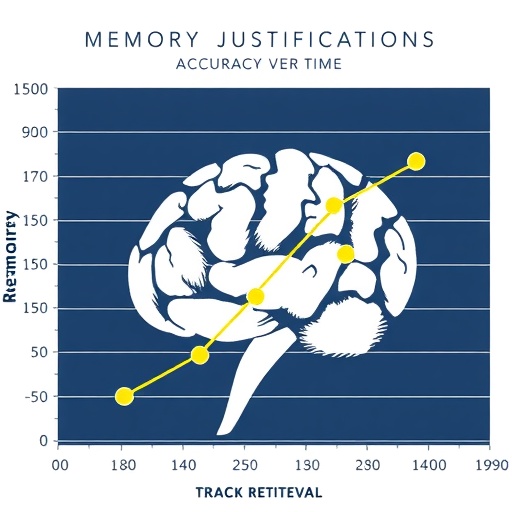
Memory Justifications: Unlocking the Secrets of Accurate Retrieval Across Time
In the rapidly evolving landscape of cognitive psychology, a groundbreaking study published in 2025 by Gamoran, Raz Groman, Gilead, and colleagues challenges long-standing assumptions about memory accuracy and its validation mechanisms. This pivotal research, appearing in Communications Psychology, investigates the nuanced relationship between memory retrieval and the justificatory processes individuals invoke to validate their recollections. Its findings pave the way for a profound rethinking of how memory works, specifically focusing on the dynamic nature of memory justification as a reliable gauge of retrieval accuracy over extended periods.
For decades, cognitive scientists have grappled with the inherent fallibility of human memory, which is often susceptible to distortions, biases, and outright inaccuracies. Traditionally, testing memory accuracy has relied heavily on objective measures—such as comparing recalled facts against documented evidence or experimental stimuli. However, these objective standards often fail to capture the subjective introspective cues that individuals use when evaluating their own memories. Herein lies the innovation of Gamoran and colleagues’ approach: emphasizing the potential diagnostic power of memory justifications, that is, the reasons and rationales people provide when they claim to “remember” something.
Memory justifications are, in essence, the explanations or reasoning a person offers to support the truthfulness or validity of their memory. For example, recalling a face at a party and justifying it by stating “I recognize their voice and the place we met before” goes beyond mere affirmation—it involves an internal evaluative process. The new study explores whether such justifications remain firmly tethered to accuracy or drift away as time elapses.
A core pillar of the research involved longitudinal experiments tracking participants’ memories across multiple time points. Rather than just measuring the success or failure of memory retrieval, the researchers meticulously documented the justifications participants provided during the recall process. By analyzing these verbalized cognitions with advanced qualitative and quantitative methods, the study unveiled remarkable patterns that link robust justifications with higher accuracy, even after considerable delays.
One of the most striking revelations from the research is the notion that memory justifications do not erode as time passes; rather, they maintain predictive validity. This runs counter to the common assumption that memory weakens and becomes less trustworthy solely due to the passage of time. Instead, the justificatory process appears to be a meta-cognitive mechanism that aids individuals in monitoring and validating their own memories, acting as an internal checkpoint.
Delving deeper, the researchers identified several types of justifications that correlate with retrieval accuracy. Sensory-based explanations—such as referring to visual details, sounds, or tactile impressions—were often linked to more verifiable memories. Similarly, contextual justifications involving semantic or situational details added layers of reliability. For example, remembering “I saw her at the café where we always meet on Thursdays” contained richer, more confirmable elements than vague affirmations like “I think I saw her there.”
The practical implications of these findings for various real-world domains are profound. In forensic psychology, where eyewitness testimony can make or break cases, understanding the validity of memory justifications could transform the way testimonies are evaluated. Instead of simply probing whether a witness is confident or shaky, judicial systems might integrate analyses of the justifications witnesses offer as a more objective barometer of truthfulness.
Moreover, in educational psychology, these insights can redefine strategies for studying and knowledge retention. Encouraging students not only to recall information but to provide reasoned justifications for their memories might enhance durability and accuracy of learning. This could also inform therapeutic interventions for individuals suffering from memory impairments or distortions, offering techniques that bolster justificatory processes to safeguard recall.
The neuroscientific underpinnings of memory justifications remain an exciting frontier highlighted by this research. While the study itself focused primarily on behavioral and psychological measures, it opens avenues for exploring which brain regions and neural pathways facilitate this meta-cognitive validation. Early hypotheses suggest the involvement of prefrontal cortical areas known for executive functions and reflective thinking working in conjunction with hippocampal memory systems.
Another layer of complexity revealed by the study is individual differences in the utility of memory justifications. Not all people engage their justificatory faculties equally or effectively. Personality traits, cognitive styles, and perhaps even cultural backgrounds may shape how justification processes operate and how trustworthy they truly are over time. This acknowledgment invites further investigation into tailoring memory support strategies for diverse populations.
Critically, the researchers caution against over-reliance on memory justifications without corroborative data. While justifications offer significant predictive value, they are not infallible. Cases of confabulation or motivated reasoning can produce plausible-sounding but inaccurate justifications. As such, the study advocates for an integrative approach merging subjective justificatory cues with objective verification methods.
In synthesizing decades of memory research with this novel justificatory perspective, Gamoran and colleagues challenge the dominant paradigms that cast memory as merely a passive repository susceptible to decay. Instead, memory emerges as an active, self-evaluative process, where individuals continuously interrogate their recollections, imposing order and meaning that facilitate accuracy retention.
As this research reverberates through cognitive science communities, it is poised to spark a paradigmatic shift not only in how memory accuracy is measured but also in designing cognitive tools and technologies that assist memory validation. Imagine future applications where artificial intelligence can parse not only what you remember but how persuasively you justify it, thereby assessing reliability in real-time.
This innovative conceptualization of memory as an interplay between retrieval and justification resonates with broader debates in epistemology and consciousness studies. It underscores that knowledge is not static but evolves with ongoing evaluation and reflection—processes intrinsic to how humans navigate a world rich with information and ambiguity.
In conclusion, the landmark study by Gamoran, Raz Groman, Gilead, and their team heralds an exciting frontier in memory research. By illuminating how memory justifications serve as valid indicators of retrieval accuracy across time, it offers new tools and perspectives with far-reaching implications. From courtrooms to classrooms, from clinical settings to everyday life, embracing the power of justificatory processes promises to enhance our understanding and harnessing of human memory in profound ways.
Subject of Research: Memory accuracy and justificatory processes in retrieval across time.
Article Title: Memory justifications provide valid indicators of retrieval accuracy across time.
Article References:
Gamoran, A., Raz Groman, Z., Gilead, M. et al. Memory justifications provide valid indicators of retrieval accuracy across time. Commun Psychol (2025). https://doi.org/10.1038/s44271-025-00378-4
Image Credits: AI Generated


