

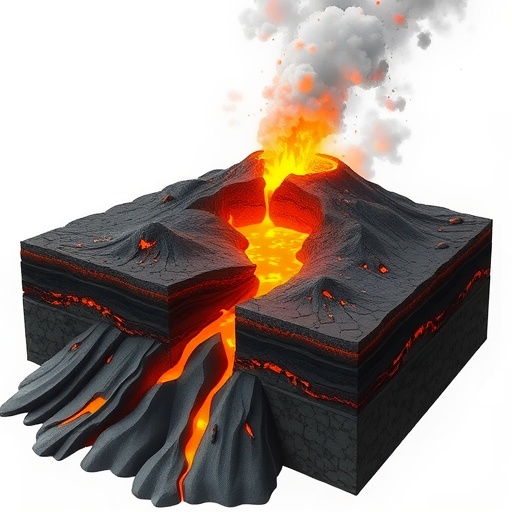
In a groundbreaking study poised to deepen our understanding of oceanic crust formation, researchers have unveiled novel insights into the processes shaping the upper crust at mid-ocean ridges, with a focus on the enigmatic Axial volcano. This investigation, spearheaded by Wu, H., Xie, W., and Singh, S.C., and colleagues, reveals intricate interactions between melt sills and lava flows, offering a fresh perspective on how Earth’s oceanic upper crust accretes over geological timescales.
Axial volcano, located on the Juan de Fuca Ridge in the Pacific Ocean, has long been a natural laboratory for studying submarine volcanic activity and crustal growth. Unlike terrestrial volcanoes, oceanic volcanoes like Axial develop beneath the immense pressure of the overlying seawater, creating unique conditions that influence magma emplacement and crustal accretion. The latest research leverages advanced geophysical imaging, combined with sophisticated modeling techniques, to dissect the mechanisms by which magma intrudes and solidifies within the upper crust.
At the heart of this study lies the concept of “melt sills” — horizontal magma intrusions that propagate laterally within the existing crust. These sills serve as fundamental building blocks in the layered construction of the oceanic crust. By capturing seismic signals generated by magma emplacement and solidification, the team was able to determine how these sills interact dynamically with surface lava flows that erupt onto the seafloor. This interplay not only influences the physical architecture of the crust but also affects thermal and mechanical properties critical for crustal stability.
One of the study’s salient findings is that the intrusion of melt sills beneath the crust acts as a feeder system, supplying fresh magma to overlying lava flows. This vertically integrated plumbing system challenges previous notions that treated sill intrusion and surface lava eruption as largely separate processes. Instead, the evidence points toward a coupled mechanism where sills inject magma laterally and vertically, facilitating successive lava flows that build up the uppermost layers of the oceanic crust.
The detailed seismic tomography conducted at Axial volcano illuminated subsurface structures previously obscured by technical limitations. These high-resolution images exposed a labyrinth of magma-filled chambers and conduits, revealing not only the presence of multiple melt sills but also their spatial distribution and temporal evolution. This granular view into crustal magma transport mechanisms vividly demonstrates the complexity and heterogeneity of volcanic accretion zones beneath the ocean floor.
Thermal modeling conducted by the research team highlights how interactions between newly emplaced sills and existing crustal material govern cooling rates and solidification patterns. When magma sills intrude into the hot, partially molten crust, the thermal gradient affects crystallization sequences, influencing rock textures and compositions. These chemical and physical changes are pivotal in determining the strength and seismic characteristics of the newly formed upper crust.
Another critical implication of this research lies in its contribution to our understanding of seafloor spreading dynamics. The oceanic crust’s formation through incremental sill injections and corresponding lava flow effusions informs models of how divergent tectonic plates generate new lithosphere. By clarifying the relationship between intrusive and extrusive magmatism, these findings refine predictions about crustal thickness, porosity, and permeability—factors that control hydrothermal circulation and, ultimately, deep-sea ecosystems.
Moreover, the coupling of melt sill activity and lava flow sequences sheds light on volcanic eruption cycles at fast-spreading ridges like the Juan de Fuca Ridge. Magma supply rates, intrusion frequency, and eruption timing appear to be intimately linked, hinting at feedback loops within the sub-volcanic magma reservoir. Understanding these feedbacks is essential for assessing volcanic hazards and interpreting the nature of seismic signals that precede eruptions.
Intriguingly, the interplay between melt sills and lava flows may also influence the geochemical signatures found in oceanic crust samples. By studying rock compositions in conjunction with seismic data, the researchers suggest that episodic sill injections can create compositional layering within the crust, reflecting variations in magma source and crystallization conditions. These geochemical insights further unravel the complex magmatic history encoded in oceanic crustal rocks.
The study’s multidisciplinary approach incorporates petrology, geophysics, and numerical modeling to build a comprehensive picture of crustal accretion processes. Such integrative research is crucial for moving beyond simplistic paradigms that have dominated mid-ocean ridge volcanology, opening new pathways for investigation that consider the crust as an evolving, dynamic system shaped by multiple interacting processes.
Looking forward, the team envisions extending this research to other mid-ocean ridge systems worldwide, comparing volcanic and magmatic behaviors across different tectonic settings and spreading rates. These comparative studies will help determine whether the processes observed at Axial volcano represent a universal mechanism of oceanic crust formation or if unique local factors lead to divergent accretion styles.
The authors also point toward the potential for improving geodynamic and seismic hazard models based on their refined understanding of melt sill behavior. As deep ocean monitoring technologies improve, capturing real-time magma movements and eruption precursors will become increasingly feasible, aiding early warnings and risk mitigation in oceanic volcanic regions.
This study not only delivers a micro-scale view of magma emplacement and cooling within the oceanic upper crust but also has macro-scale implications for plate tectonics, chemical cycling, and marine geology. It underscores how minute geological processes, occurring kilometers beneath the seafloor, resonate through the broader Earth system, influencing everything from seafloor morphology to ocean chemistry.
Ultimately, Wu and colleagues have provided a critical piece of the puzzle regarding how the Earth’s outer shell renews itself continuously through intricate magmatic interactions. Their findings illuminate the hidden architecture beneath the waves, showcasing the elegant complexity of oceanic crust formation driven by the dance between melt sills and lava flows at one of the world’s most active submarine volcanoes.
This landmark contribution enriches the broader geoscience narrative, offering new tools and conceptual frameworks for scientists striving to comprehend the restless, fiery processes forging our planet’s oceanic crust from the depths below.
Subject of Research: Oceanic upper crustal formation processes; interaction of melt sills and lava flows at Axial volcano
Article Title: Oceanic upper crustal accretion by melt sill and lava flow interaction at Axial volcano
Article References:
Wu, H., Xie, W., Singh, S.C. et al. Oceanic upper crustal accretion by melt sill and lava flow interaction at Axial volcano.
Nat Commun (2026). https://doi.org/10.1038/s41467-026-70033-x
Image Credits: AI Generated


