

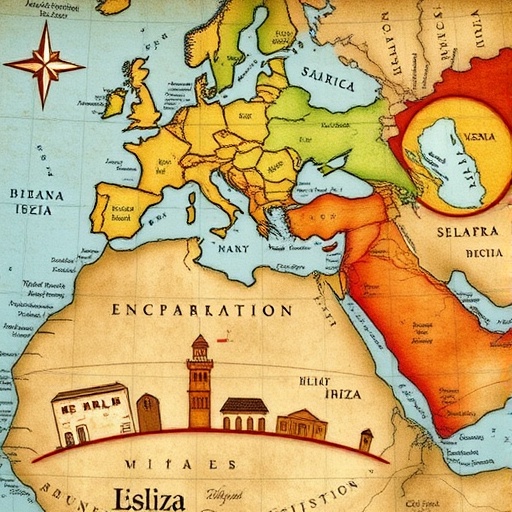
Medieval Ibiza, often stereotyped as a tranquil Mediterranean island, emerges from recent ancient DNA analyses as a vibrant hub of genetic and cultural interchange during the Islamic period. A groundbreaking study, led by researchers from the Centre for Palaeogenetics—a collaborative effort between Stockholm University and the Swedish Museum of Natural History—has unmasked the extraordinary diversity embedded within the island’s medieval population. This work, published in the prestigious journal Nature Communications, leverages advanced genomic tools to trace lineage and pathogens, revealing Ibiza’s critical role in historic networks interlinking southern Europe, North Africa, and the Sahel region beyond the Sahara.
Delving into the past, the international research team analyzed ancient DNA extracted from thirteen individuals interred in an Islamic cemetery dated between the tenth and twelfth centuries CE. The genetic data illuminate a complex mosaic of ancestries, ranging from predominantly European lineages to North African origins. This admixture traces back to the Muslim ascendancy of Ibiza in 902 CE, aligning closely with historical accounts documenting two primary waves of demographic change: firstly, the Umayyad expansion that inaugurated settlement on the island, and secondly, the Almoravid conquests that heralded fresh influxes in the early twelfth century.
The DNA sequences reveal not only European and North African connections but also compelling evidence of sub-Saharan African ancestry in two individuals. These findings resonate with medieval Arabic chronicles discussing trans-Saharan military expeditions and slave trade routes, but now provide direct biological proof of Ibiza’s entanglement in these expansive and sophisticated long-distance networks. One individual’s genome pointedly traces back to people from Senegambia, while the other exhibits genetic markers linked to southern Chad, affirming the breadth of cultural and demographic interactions mediated through the Sahel.
According to Ricardo Rodríguez-Varela, the study’s lead author and a researcher at Stockholm University’s Department of Archaeology and Classical Studies, these genomic revelations underpin a more nuanced understanding of Islamic Iberia’s demographic composition. “Our results demonstrate that communities in Islamic Iberia were not insular but part of an expansive network stretching into western and central Africa’s Sahel,” he explains. This biological connectivity corroborates written historical sources and paints a vivid picture of intersectional societies shaped by migration, trade, and cultural exchange across formidable geographical barriers.
Methodologically, the team employed cutting-edge genomic techniques including genotype imputation and haplotype-based local ancestry inference. These sophisticated statistical methods allowed them to reconstruct the timing and nature of gene flow events with remarkable precision. Their analyses suggest the primary North African genetic influx into Ibiza occurred merely two to seven generations prior to the individuals’ lifetimes, situating the main admixture episode in the late ninth century CE. This temporal estimate harmonizes with the historical timeline of Islamic incursions into the western Mediterranean, evidencing a relatively rapid genetic and cultural transformation.
Beyond population genetics, the researchers harnessed metagenomic approaches to screen for infectious pathogens within the ancient samples. Remarkably, one individual was identified as carrying Mycobacterium leprae, the causative agent of leprosy. This represents the first genetically confirmed case of leprosy from medieval Islamic Iberia. Intriguingly, this individual’s burial adhered to orthodox Islamic funerary rites without indications of social ostracism or differential treatment, paralleling patterns documented within contemporary Christian communities in the region.
Zoé Pochon, a co-author and metagenomics expert at Stockholm University, highlights the significance: “The integration of pathogen DNA analysis with ancient genomic data provides a dramatically expanded perspective on disease ecology and societal attitudes in the medieval Mediterranean world.” The discovery challenges assumptions about stigma surrounding leprosy during the period and suggests communal norms may have transcended religious divides.
Phylogenetic reconstruction situates the M. leprae genome near the root of a lineage prevalent across Europe from the seventh to thirteenth centuries. This lineage’s close relation to an early-diverging strain isolated in medieval Italy reinforces the hypothesis that Ibiza was a critical nexus within broader epidemiological and trade networks bridging the Mediterranean basin and continental Europe. These findings underscore how population movement facilitated not only human genetic flux but also the spread of infectious diseases, conveying profound implications for understanding the historical dynamics of disease transmission.
The study’s insights collectively illuminate how medieval Ibiza functioned as a genetic and cultural crossroads rather than an isolated periphery. Through integrating genomic data with archaeological and historical narratives, the research delineates a transformative epoch when Islamic and Christian spheres of influence in Iberia profoundly intermeshed. Anders Götherström, senior author and leader of the archaeogenetics group at the Centre for Palaeogenetics, asserts that “ancient DNA offers a unique lens into the lived realities underpinning epochal historical events, revealing the intimate biographies beneath geopolitical shifts.”
This comprehensive research advances the field of archaeogenetics by combining high-resolution genetic analyses with metagenomic pathogen screening, thereby forging a multidimensional reconstruction of medieval identities and health. It advances our understanding not only of demographic history but also of disease ecology and social interactions in regions where diverse cultures intersected. The findings herald a new era where genomic technologies decode the complexities of human history embedded within archaeological remains, challenging simplistic narratives and spotlighting the intertwined nature of migration, commerce, and health.
Collectively, these results compel a reassessment of the Mediterranean’s medieval past, portraying Ibiza as a microcosm of dynamic interactions spanning continents and cultures. The robust evidence for sub-Saharan African presence within Islamic Iberian populations affirms the Sahel’s crucial role in shaping medieval Mediterranean societies—a factor often marginalized in historical discourse. By integrating genetic evidence, historical documentation, and archaeological context, this study provides a compelling and nuanced account of how people, pathogens, and cultures converged at the crossroads of civilization.
In conclusion, the investigation of medieval burials from Ibiza opens vibrant new avenues for understanding the genetic and pathogenic diversity that characterized the Islamic Mediterranean world. Through meticulous genomic scrutiny and interdisciplinary collaboration, the study rewrites historical conceptions, revealing a richly interconnected world marked by migration, adaptation, and shared human experiences. As ancient DNA research continues to expand, studies like this exemplify the transformative power of genetics in unraveling the intricate tapestry of our collective past.
Subject of Research: Human tissue samples
Article Title: Analysis of medieval burials from Ibiza reveal genetic and pathogenic diversity during the Islamic period
News Publication Date: 26-Mar-2026
Web References: 10.1038/s41467-026-70615-9
References: Nature Communications
Keywords: ancient DNA, medieval Iberia, genetic diversity, Islam in Iberia, sub-Saharan ancestry, Mycobacterium leprae, leprosy, trade networks, archaeogenetics, Sahel, genomic admixture, pathogen genomics


