


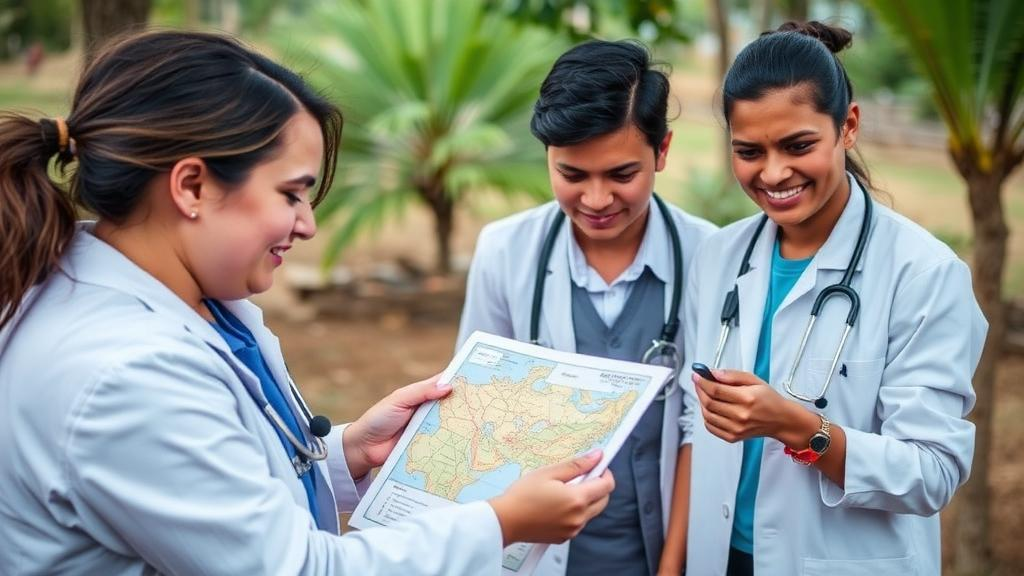
When first-year medical students in India are sent into villages to learn how health, livelihood, and environment intertwine, the tools they carry matter as much as their stethoscopes. A new study published in BMC Medical Education suggests that a set of field techniques borrowed from rural development practice, known collectively as Participatory Rural Appraisal, may offer exactly the kind of hands-on training that classroom lectures struggle to replicate. The research, conducted by a team from Symbiosis Medical College for Women in Pune along with collaborators in Mysore and Dehradun, examined how Phase-I MBBS students perceived the usefulness of these tools during a community-based learning exercise in a rural health setting.
Participatory Rural Appraisal, often abbreviated as PRA, is a systematic yet adaptable methodology that has long been used in development work to gather insights into the realities of rural communities. Rather than extracting data through one-way surveys, PRA emphasizes a bottom-up approach in which local residents and professionals learn collaboratively. Its toolkit includes visual and conversational techniques such as social mapping, seasonal calendars, twenty-four-hour activity calendars, cob-web diagrams, focus group discussions, and key informant interviews. Information gathered through these techniques is cross-checked through triangulation, meaning that findings from different key informants and direct observations by the field team are compared and reconciled to build a more reliable picture of community life.
The study was embedded within the Family Adoption Program, a component of India’s Competency Based Medical Education framework introduced by the National Medical Commission, which requires medical students to engage longitudinally with families in an adopted village. A total of 135 first-professional-year MBBS students participated, after 15 additional students took part in a pilot phase and were excluded from the main analysis. Before entering the field, the students received structured training in PRA methods through lectures, role plays, and hands-on sessions led by mentor faculty. They then carried out house-to-house family health data collection using structured questionnaires, and subsequently applied the PRA tools in the community under faculty mentorship, supported by medico-social workers and field staff from the institute’s outreach program.
To assess how students experienced this approach, the researchers administered a self-administered, Google-form-based questionnaire after the field implementation, with informed consent obtained from every participant. Perceptions were captured on a Likert scale, and the resulting data were analyzed using descriptive statistics, with categorical variables expressed as frequencies and percentages. The study received ethical approval from the Ethics Committee of Symbiosis Medical College for Women, Symbiosis International (Deemed University), and was conducted in accordance with the Indian Council of Medical Research’s National Ethical Guidelines for biomedical and health research involving human participants.
The results reveal a clear hierarchy in which tools students found most usable in the field. The cob-web diagram topped the list, used and rated feasible by 68.2 percent of students for collecting information from villagers. The twenty-four-hour calendar followed at 57.8 percent, then focus group discussions at 41.5 percent, social mapping at 38.5 percent, and the seasonal calendar at 36.3 percent. These figures suggest that visual, diagram-based techniques that can be drawn and discussed with families in an informal setting may be easier for novice students to deploy than more structurally complex methods, although the study’s perception-based design means the numbers reflect student experience rather than measured learning outcomes.
Beyond feasibility, the students’ overall verdict on the methodology was strikingly positive. A majority, 63.33 percent, felt that PRA techniques were the best-suited approach for learning about the conditions in an adopted village. Even more emphatically, 92.6 percent of the medical students agreed that using PRA tools improved their communication skills, a core competency that medical educators have long struggled to teach outside of simulated clinical encounters. Nearly all respondents, 96.8 percent, agreed that focus group discussions helped them understand the problems faced by villagers, pointing to the particular value of moderated group conversation in surfacing community concerns that individual household visits might miss.
Why would diagrammatic tools and group discussions have such a pronounced effect on communication skills? The authors’ framework offers a plausible mechanism. PRA techniques require students to sit with families, draw maps and calendars together, listen actively, and negotiate meaning with people whose daily realities differ sharply from their own urban academic environments. A cob-web diagram, for instance, invites a family to map the relationships and resources that connect their household to the wider village, turning an abstract interview into a shared visual exercise. The twenty-four-hour calendar asks residents to walk through an ordinary day hour by hour, revealing patterns of work, water collection, childcare, and food access that structured questionnaires rarely capture. In each case, the student must ask, listen, clarify, and confirm, exercising precisely the conversational muscles that clinical communication training aims to develop.
The study sits within a broader shift in Indian medical education toward experiential, community-embedded learning. The Family Adoption Program was designed to move students beyond hospital walls and into the social determinants of health that shape their future patients’ lives. Yet implementing such programs raises practical questions: which methods actually work for inexperienced students, how much mentorship is required, and whether the techniques translate into durable skills. By documenting which PRA tools students found feasible and which they felt improved their abilities, this research provides an evidence base for curriculum designers weighing how to structure community medicine rotations in the first professional year, when students have little clinical experience to draw upon.
The authors are careful to frame their conclusions appropriately. As a perception-based, cross-sectional study relying on self-reported Likert-scale responses, the findings indicate that PRA tools, when used alongside the Family Health Proforma, may enhance the teaching-learning experience within the Family Adoption Program. However, they note that these findings warrant further validation through objective outcome measures. Self-reported confidence in communication skills does not necessarily equate to independently assessed competence, and the study design cannot establish causality between PRA use and skill development. Future research using structured observation, standardized communication assessments, or longitudinal follow-up would be needed to confirm whether the enthusiasm students expressed translates into measurable educational gains.
Nevertheless, the study’s central message resonates with a growing international consensus that medical training must engage communities as partners rather than subjects. PRA’s emphasis on collaborative learning, triangulation of information, and respect for local knowledge offers a methodological bridge between public health data collection and the humanistic communication that modern medicine demands. For the 135 students who drew cob-web diagrams on village doorsteps and moderated focus groups under faculty mentorship, the exercise appears to have been, in the authors’ assessment, helpful, informative, and interesting for their community learning. If subsequent studies validate these perceptions with objective measures, the humble tools of participatory rural appraisal may find a permanent place in the medical curriculum, not as relics of development practice but as instruments for training physicians who can truly listen.
Subject of Research: Medical students' perceptions of Participatory Rural Appraisal tools for community learning and communication skills in rural health training
Article Title: Perceptions of medical students on the utility of Participatory Rural Appraisal (PRA) tools for community learning and communication skill development in a rural health setting
Article References: Barhate, A., Narendran, M., Patil, R., Usman, M., & Palve, S. B. (2026). Perceptions of medical students on the utility of Participatory Rural Appraisal (PRA) tools for community learning and communication skill development in a rural health setting. BMC Medical Education. https://doi.org/10.1186/s12909-026-10484-4
Image Credits: AI Generated
DOI: 10.1186/s12909-026-10484-4
Keywords: Participatory Rural Appraisal, medical education, Family Adoption Program, communication skills, community-based learning, MBBS students, rural health, focus group discussions, experiential learning, Competency Based Medical Education, India, BMC Medical Education
Cite Scienmag News
Courtney Benton. (October 4, 2026). Medical Students Say Rural Mapping Tools Sharpen Their Communication Skills. Scienmag. https://scienmag.com/medical-students-say-rural-mapping-tools-sharpen-their-communication-skills/
Courtney Benton. "Medical Students Say Rural Mapping Tools Sharpen Their Communication Skills." Scienmag, 4 October 2026, https://scienmag.com/medical-students-say-rural-mapping-tools-sharpen-their-communication-skills/. Accessed 4 October 2026.
Courtney Benton. "Medical Students Say Rural Mapping Tools Sharpen Their Communication Skills." Scienmag. October 4, 2026. https://scienmag.com/medical-students-say-rural-mapping-tools-sharpen-their-communication-skills/


