


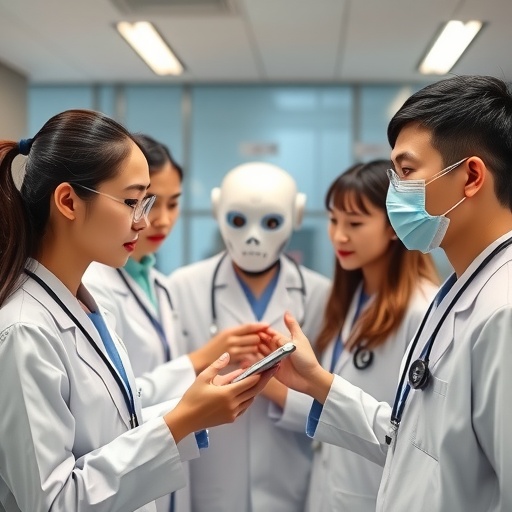
In the rapidly evolving landscape of healthcare, one of the most intriguing frontiers is the integration of artificial intelligence (AI) into medicine. Recent research from Shandong Province, China, published in BMC Medical Education, delves deeply into the attitudes and perceptions of medical students regarding AI’s role in the medical field. This study, spearheaded by Liu, M., Cheng, Y., Li, S., and their colleagues, offers a comprehensive exploration of how the next generation of healthcare professionals views AI, its benefits, and its challenges.
Medical students today are on the cusp of witnessing an unprecedented technological transformation within their field. AI has the potential to enhance diagnostic accuracy, improve patient care, and streamline various medical processes. However, this potential is matched by fear and skepticism among many aspiring doctors. Liu et al. conducted surveys and interviews to gauge students’ beliefs and expectations surrounding AI technologies in medicine, uncovering a broad spectrum of comfort levels and apprehensions.
At the heart of these discussions is the concern about AI substituting human judgment. While students recognize AI’s capability to process vast amounts of data quickly, they express doubts over its ability to understand the nuances of human emotions and the complex nature of patient interactions. The study reveals that although students are generally optimistic about AI’s role in enhancing diagnostic procedures, they remain cautious about relying entirely on these technologies for patient care.
An essential focus of the research is the importance of medical education in preparing students for a future where AI is integrated into clinical practice. The findings suggest that universities need to adapt their curriculums, providing not only the necessary technical skills for operating AI systems but also the critical thinking skills crucial for evaluating AI-generated data. Students argue that understanding the ethical implications of AI and being equipped to handle AI-fueled dilemmas will be essential for their future roles as healthcare providers.
AI’s clinical application raises questions about data privacy and security that students highlighted with varying degrees of concern. With AI systems analyzing patient data, understanding the legal and ethical ramifications becomes paramount. Students are aware that these technologies must adhere to strict regulations to ensure patient confidentiality while simultaneously harnessing the power of data analytics to promote better health outcomes.
Moreover, students expressed a desire for collaboration between AI and human practitioners rather than viewing AI as a replacement. They envision a future where AI augments clinical decision-making by providing insights drawn from large datasets, thus empowering doctors rather than undermining their expertise. This perspective underscores a broader acceptance of AI as a tool rather than a competitor in healthcare settings.
Another intriguing aspect of the research is students’ perceptions of the training they will receive regarding AI in medical schools. The survey illustrated concerns that medical education institutions might not be keeping pace with technological advancements. Students called for comprehensive training on using AI efficiently and ethically, with many suggesting that coursework should include hands-on experiences with AI tools to bridge the gap between theory and practice.
In addressing the question of trust, the study revealed a nuanced view: students tend to trust AI technologies, provided they understand the underlying algorithms and data sources. This insight highlights the importance of transparency in AI systems. When students perceive the technology as a ‘black box,’ their trust dwindles; thus, educators and developers are called to prioritize explainability in AI applications within healthcare.
Interestingly, the research showcases a generational divide in perspectives on AI among medical students. While younger students display a willingness to embrace AI, some older cohorts exhibit more skepticism. This divide often correlates with familiarity with technology, indicating that as medical education incorporates more technological components, future graduates may be better equipped to integrate AI into their practices.
Furthermore, discussing the implications of AI extends beyond technical capabilities; it brings forth the necessity for continuous dialogue in medical training. Liu and colleagues propose that educational frameworks should foster a cultural change among students that encourages a proactive engagement with AI advancements. This culture will be instrumental in ensuring that future practitioners can leverage AI-driven insights to deliver superior patient care.
As the study unfolds, it reveals the desire for interdisciplinary collaboration among medical and technology experts. The respondents believe that close partnerships can facilitate the development of more sophisticated AI tools, ensuring they align with clinical needs and ethical standards. This call for collaboration resonates with the growing acknowledgment that healthcare challenges cannot be solved in isolation, and a multi-faceted approach is essential.
Ultimately, Liu et al.’s research sheds light on the complex landscape of AI in medical education, highlighting significant opportunities and formidable challenges. As the medical field stands at this crossroads, the findings advocate for proactive strategies in educational reform to ensure that the alignment between medical professionals and AI technologies leads to successful patient outcomes.
The evolution of AI will undoubtedly reshape healthcare, and the input from the upcoming generation of healthcare providers highlights that there is much to gain from this technological revolution. As future doctors embrace AI as a partner in clinical practice, it is imperative that their education reflects these changing dynamics, preparing them to navigate the complexities of a tech-enhanced medical landscape.
Medical students play a critical role in driving the discourse around the integration of AI in healthcare, as their attitudes will shape how these technologies are adopted. Ongoing research in this field will be instrumental in tracking shifts in perceptions over time, emphasizing the need for an adaptive educational approach that meets the ever-evolving demands of modern medicine.
In conclusion, Liu, M., Cheng, Y., Li, S. and their team’s research serves as a pivotal cornerstone in understanding medical students’ perceptions of AI, charting a path forward as healthcare continues to innovate. This study, while localized in China, resonates on a global scale, highlighting a universal quest to strike a balance between the advantages of AI and the essential human elements that make medicine an art as well as a science.
Cite Scienmag News
Courtney Benton. (December 15, 2025). Medical Students in Shandong Embrace AI in Healthcare. Scienmag. https://scienmag.com/medical-students-in-shandong-embrace-ai-in-healthcare/
Courtney Benton. "Medical Students in Shandong Embrace AI in Healthcare." Scienmag, 15 December 2025, https://scienmag.com/medical-students-in-shandong-embrace-ai-in-healthcare/. Accessed 4 September 2026.
Courtney Benton. "Medical Students in Shandong Embrace AI in Healthcare." Scienmag. December 15, 2025. https://scienmag.com/medical-students-in-shandong-embrace-ai-in-healthcare/


