


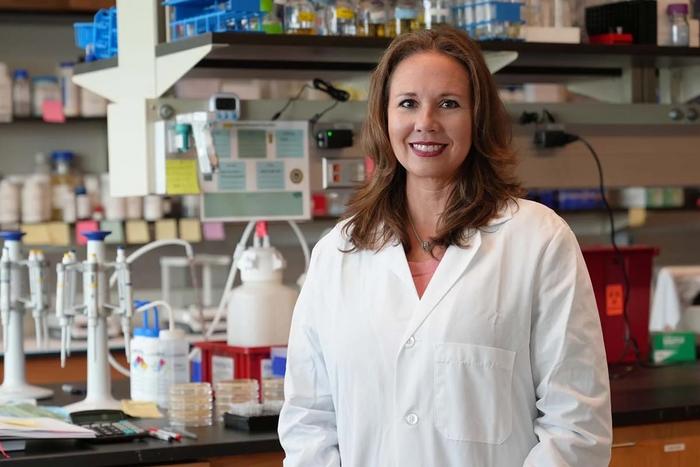
University of Central Florida College of Medicine researcher Renee Fleeman is on a mission to kill drug-resistant bacteria, and her latest study has identified a therapy that can penetrate the slime that such infections use to protect themselves from antibiotics.

Credit: University of Central Florida
University of Central Florida College of Medicine researcher Renee Fleeman is on a mission to kill drug-resistant bacteria, and her latest study has identified a therapy that can penetrate the slime that such infections use to protect themselves from antibiotics.
In a study published recently in Cell Reports Physical Science, Fleeman showed that an antimicrobial peptide from cows has potential for treating incurable infections from the bacterium Klebsiella pneumoniae. The bacteria, commonly found in the intestines, is usually harmless. It becomes a health hazard when it enters other parts of the body and can cause pneumonia, urinary tract and wound infections. Those at highest risk include seniors and patients with other health problems such as diabetes, cancer, kidney failure and liver disease. However, younger adults and people without additional health problems can acquire urinary tract and wound infections from the bacteria that cannot be treated by antibiotics available today.
The CDC reports that antibiotic resistant bacteria are a growing global health threat. A 2019 study found that nearly 5 million people died worldwide that year from drug-resistant infections. A large portion of those deaths are attributable to K. pneumoniae because it has a 50% death rate without antibiotic therapy.
These bacteria are more resistant to drugs when they live in a biofilm — microorganisms that stick together and are embedded in a protective slime. Recent studies have shown that 60-80% of infections are associated with bacteria biofilms, which increase their drug resistance.
“It’s Iike a coat that bacteria put around itself,” Fleeman says.
Her research is examining ways to remove the protective coat and expose the bacteria so it can be killed by the body’s immune system or antibiotics that currently cannot pass through the biofilm. Through that research, Fleeman discovered how the peptides made by cows can quickly kill K. pneumoniae.
She determined that the peptides interact with sugar connections that keep the slime intact. She likened the process to cutting into a chain-linked fence. Once multiple chains are cut, the integrity of the slime structure is damaged, and the peptide can enter and destroy the bacteria that are no longer protected.
“Our research has shown polyproline peptide can penetrate and begin to break the slime barrier down in as little as an hour after treatment,” says Fleeman.
The peptide has another advantage — once it breaks through the protective slime barrier, tests showed it killed the bacteria better than antibiotics used as a last resort to treat incurable infections. Peptides kill the bacteria by punching holes in their cell membrane, causing death quickly compared to other antibiotics that inhibit growth from inside the cell.
The peptide could also be used as a topical treatment for a wide range of uses, especially for the military, to treat open wounds in the field. “Bacteria divide every 30 minutes, so you have to act fast,” Fleeman says.
The next phase of her research will seek to understand the biology behind the peptide’s efficacy and if combinations of other drugs would aid in its application.
Her research is funded through a three-year National Institutes of Health funding Pathway to Independence R00 grant and is in its second year. Her study initially started as a K99 award at University of Texas at Austin, where she worked before joining UCF in September of 2022.
Fleeman says research into resistant infections must continue because they pose such a threat to health.
“It is estimated that by 2050, antibiotic resistant bacterial infections will be the number one cause of human deaths,” she says. “Our work is focused on preparing for this post-antibiotic era battle, where common antibiotics that we take for granted will no longer be effective, jeopardizing cancer therapy, organ transplants, and any modern medical advancement that relies on effective antibiotic therapies.”
Journal
Cell Reports Physical Science
Method of Research
Experimental study
Subject of Research
Animals
Article Title
Polyproline peptide targets Klebsiella pneumoniae polysaccharides to collapse biofilms
Article Publication Date
13-Mar-2024
Cite Scienmag News
Nathaniel Bowman. (May 1, 2024). Medical school scientist creates therapy to kill hypervirulent bacteria. Scienmag. https://scienmag.com/medical-school-scientist-creates-therapy-to-kill-hypervirulent-bacteria/
Nathaniel Bowman. "Medical school scientist creates therapy to kill hypervirulent bacteria." Scienmag, 1 May 2024, https://scienmag.com/medical-school-scientist-creates-therapy-to-kill-hypervirulent-bacteria/. Accessed 5 September 2026.
Nathaniel Bowman. "Medical school scientist creates therapy to kill hypervirulent bacteria." Scienmag. May 1, 2024. https://scienmag.com/medical-school-scientist-creates-therapy-to-kill-hypervirulent-bacteria/

