

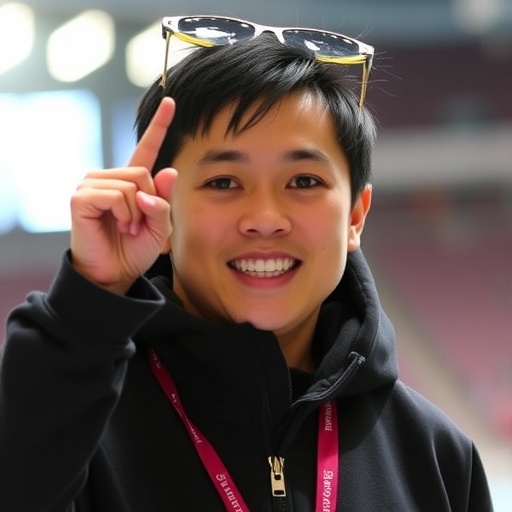
Asian American Olympians Chloe Kim and Eileen Gu have subjected to contrasting portrayals in the U.S. media during their respective Winter Games debuts, revealing deep-seated ideological and racial undercurrents. A recent study by researchers at the University of Michigan meticulously analyzes these diverging narratives, shedding light on broader societal patterns regarding race, identity, and belonging within American sports culture.
Chloe Kim, a snowboarder born and raised in California to Korean immigrant parents, emerged as a symbol of the “All-American teenager” when she competed under the U.S. flag in the 2018 Winter Olympics. Her triumphs on the international stage were celebrated with enthusiasm, her media image carefully crafted to resonate with traditional ideals of the American dream. This framing underscored her status as an insider, emphasizing her loyalty and embodiment of American values.
Conversely, Eileen Gu, a freestyle skier with a Chinese immigrant mother and a white American father, chose to represent China during the 2022 Beijing Winter Olympics, ultimately winning two gold medals and a silver. However, this decision made her a lightning rod for criticism in U.S. media, where she was often branded as an “ungrateful traitor.” The media discourse cast Gu as an outsider, portraying her choice as a betrayal rather than a complex navigation of identity, thus reinforcing a nationalistic paradigm that demands clear allegiance.
The University of Michigan research team, comprising Doo Jae Park and co-authors NaRi Shin and Wenyuan Yu, undertook a critical discourse analysis of over 200 newspaper articles in English, spanning both Olympiads. By meticulously examining 116 reports on Kim and 106 on Gu, the study unveiled how media narratives operate not merely as passive reflections but as active creators of social meaning, defining who is deemed authentically American or foreign.
Their analysis reveals that Kim’s portrayal aligns with a deeply ingrained “insider vs. outsider” binary prevalent in U.S. societal discourse. Kim’s choice to compete for the United States placed her firmly within the insider category, enabling the media to frame her story as a testament to the merits of immigrant success and assimilation. Her identity was intertwined with Americana, and her achievements were celebrated as a triumph of national character.
In stark contrast, Gu’s representation was filtered through suspicion and othering. Her decision to compete for China was interpreted as an abdication of American loyalty, and the media often utilized inflammatory language, such as urging her to “pick a side,” thereby reinforcing a rigid dichotomy that excludes complex bicultural identities. This polarized framing underscores a nationalist imperative that demands unequivocal loyalty, especially from minorities perceived as perpetual foreigners.
An additional layer to these portrayals is the pervasive influence of the “model minority” myth. Both athletes were frequently lauded not only for their athletic achievements but also for their academic credentials—Kim’s association with Princeton and Gu’s admission to Stanford—underscoring a societal script that conflates Asian American success with intellectual and cultural conformity. The media emphasized their parents’ immigrant backgrounds and the robust parental support they received, reinforcing stereotypes that both valorize and constrain Asian American identities.
Despite Kim’s status as a celebrated insider, the study points out that her sense of belonging remains tenuous. The COVID-19 pandemic, marked by a surge in anti-Asian sentiment, saw Kim endure racism and bullying, highlighting how Asian Americans’ acceptance in society is conditional, fragile, and subject to broader social tensions. This underscores the persistence of Asian racialization in America, where success does not exempt individuals from discrimination and exclusion.
Fundamentally, the research asserts that sports media does not merely mirror societal attitudes but actively shapes them by delineating the parameters of inclusion and exclusion. By focusing predominantly on a Black-white racial binary, sport studies and media narratives often marginalize Asian American experiences, thereby perpetuating what the authors describe as the “perpetual foreigner” stereotype. This ongoing racial paradigm restricts the full recognition of Asian Americans as integrated members of society.
The study’s critical discourse analysis exposes how dominant media practices tokenize Asian American athletes within rigid frameworks that uphold nationalistic and racial hierarchies. The conditional belonging these narratives enforce signals a societal reluctance to embrace multicultural identities fully and signals the necessity for transformative approaches in media representation and sports studies.
The authors advocate for a comprehensive revision of the racial paradigms employed within sport studies to foster inclusivity for Asians, Asian Americans, and other minoritized populations. By diversifying and redesigning these frameworks, the social sciences can better capture the complexities of identity and belonging in contemporary America, moving beyond reductive binaries and enabling more nuanced understandings.
Such an expanded approach is crucial not only for academic inquiry but also for practical implications in media, policymaking, and social integration. Recognizing the multifaceted nature of identity among Asian American athletes—and minorities at large—can contribute meaningfully to dismantling racism, fostering solidarity, and promoting equity in sports and beyond.
The University of Michigan study, published in the journal Communication & Sport, represents a vital intervention in conversations about race, nationalism, and representation. It challenges existing narratives and offers a compelling argument for the urgent need to rethink the intersections of sports, media, and society in an increasingly diverse America.
Through their rigorous analysis, Park and his colleagues illuminate the complexities surrounding Asian American athletes’ identities in the public eye, underscoring the persistent barriers they navigate. Their work calls attention to the ongoing struggle for recognition, authenticity, and belonging—a struggle not confined to the sports arena but resonant across the social fabric of the United States.
Subject of Research:
Article Title:
News Publication Date:
Web References: https://doi.org/10.1177/21674795251411206
References: Ungrateful Immigrant vs. American Dream: Critical Discourse Analysis of U.S. Popular Press on the Nationality Choices of Eileen Gu and Chloe Kim
Image Credits:
Keywords: Social sciences, Sociology, Society, Social change, Social class, Social conditions, Social problems


