

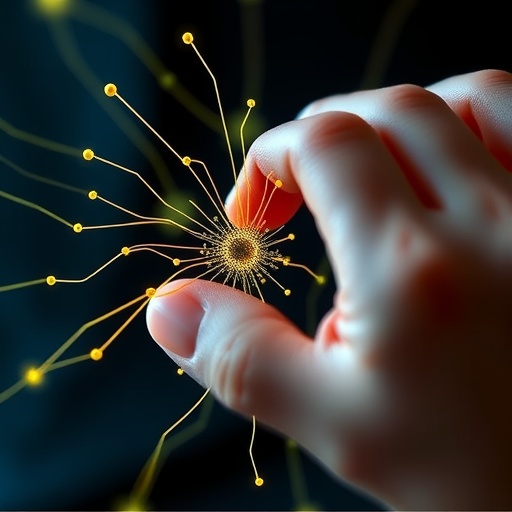
In the rapidly evolving field of wearable electronics and bioinspired sensors, a groundbreaking advancement promises to revolutionize the way machines perceive and interact with the physical world. Researchers Jeon, Lee, Won, and their colleagues have pioneered an innovative class of mechanoreceptor-inspired multisensory fibers that bring artificial somatosensation closer to reality than ever before. Published in the 2026 issue of npj Flexible Electronics, their work addresses the fundamental challenge of replicating human-like touch sensitivity and proprioception in artificial systems, enabling potential applications ranging from advanced prosthetics to next-generation robotics.
Artificial somatosensation—the capability of a device to sense and interpret tactile information—has long been an elusive goal in the field of flexible electronics and neuroprosthetics. While traditional sensors can measure simple pressure or strain, they often fail to capture the rich, multidimensional data processed by biological mechanoreceptors. The human skin contains a variety of mechanoreceptors, each tuned to distinct mechanical stimuli like pressure, vibration, and stretch. The key contribution of Jeon and colleagues is their design of multisensory fibers that mimic this natural complexity, thereby offering a sensor system capable of detecting multiple mechanical stimuli simultaneously and conveying this information with high fidelity.
At the heart of this technology lies the concept of bioinspiration: studying nature’s designs to engineer novel devices. The team’s multisensory fibers emulate the layered structure of skin mechanoreceptors by integrating diverse sensing elements within a single flexible fiber. These elements are engineered to transduce different mechanical cues—such as shear force, normal pressure, and stretch—into distinct electrical signals. This multiplexed sensing approach allows for a nuanced interpretation of tactile stimuli, a critical feature for applications requiring fine motor control and dexterous manipulation.
The fabrication process for these fibers combines cutting-edge flexible electronics manufacturing techniques with advanced materials science. The researchers employed ultrathin piezoresistive and piezoelectric materials embedded within elastomeric matrices to achieve both mechanical resilience and sensitivity. The elastomeric base imparts stretchability and conformability crucial for wearable devices, while the embedded sensors provide rapid and precise response to mechanical deformation. Importantly, the fibers maintain signal stability and repeatability over extended cycles, overcoming a common limitation in flexible sensor design.
One of the standout features of this work is the integration of multisensory signals within the same fiber architecture. Unlike conventional sensor arrays where individual sensors are spatially separated, the team’s multisensory fiber offers a compact, scalable platform where multiple sensory modalities coexist in a coherent and miniaturized form. This structural innovation reduces complexity and enhances the practicality of embedding such sensors into wearable garments or prosthetic skins, where space and weight are critical constraints.
Beyond mere detection, these multisensory fibers exhibit intelligent signal processing capabilities inspired by biological neural encoding. By emulating the sensory processing strategies of mechanoreceptors, the system can discriminate between different types of stimuli and dynamically adapt its responses. This biomimetic processing is enabled by tailored sensor designs coupled with advanced algorithms that extract meaningful patterns from the raw electrical signals, paving the way for real-time application in adaptive prosthetics and robotic touch interfaces.
Experimental validation of the fibers included extensive mechanical testing under various conditions, demonstrating not only sensitivity and selectivity but also robustness and durability. The fibers responded consistently across a wide range of pressures and strains, faithfully reproducing the multidimensional tactile landscape experienced by human skin. In addition, their integration with soft robotic systems illustrated practical utility, where the sensors provided feedback enabling more nuanced control of robotic manipulation tasks.
The implications of this research for prosthetic design are profound. Current prosthetic limbs often lack a sense of touch, forcing users to rely heavily on visual or auditory cues for interaction with their environment. Incorporating mechanoreceptor-inspired multisensory fibers into prosthetic skins could restore a degree of somatosensation, enabling users to perceive object texture, shape, and force intuitively. This advancement has the potential to dramatically enhance prosthetic functionality, user comfort, and overall quality of life.
Robotics, too, stands to benefit tremendously from these multisensory fibers. As robots become increasingly integrated into human environments, the ability to handle delicate objects and interact safely with people depends on sophisticated tactile sensing. The fibers’ bioinspired design equips robots with the nuanced, multidirectional touch sensing that mimics human skin, facilitating safer and more dexterous interactions in settings ranging from healthcare to manufacturing.
Looking forward, the researchers envision further refinement of their sensory fibers through integration with advanced computing frameworks, including neuromorphic processors and artificial intelligence. By combining bioinspired sensing hardware with intelligent signal interpretation, future systems could achieve highly autonomous and context-aware tactile perception, opening new frontiers in human-machine interfaces. Moreover, the modular nature of the fiber design could allow for customized configurations tailored to specific application requirements, from minimally invasive medical devices to immersive virtual reality suits.
The interdisciplinary nature of this innovation—spanning materials science, electronic engineering, computational neuroscience, and biomechanics—highlights the collaborative effort required to translate biological principles into engineered technologies. The success of Jeon and colleagues’ work underscores a broader trend in technology development that leverages the intricate designs perfected through evolution to solve complex engineering problems, transforming the landscape of wearable health monitoring and interactive devices.
As the world increasingly embraces flexible electronics embedded in everyday life, the demand for sensors that can “feel” like human skin will only intensify. The mechanoreceptor-inspired multisensory fibers represent a major leap toward this vision, combining flexibility, multisensory capability, and intelligent processing in a form factor suitable for practical deployment. This breakthrough not only advances artificial somatosensation but also sets a new benchmark for what sensory hardware can achieve.
In essence, the innovation presented by Jeon, Lee, Won, and their team heralds a new era where machines do not merely receive data passively but sense and interpret the tactile world in ways reminiscent of biological organisms. This convergence of bioinspired design and flexible electronics will increasingly blur the boundaries between humans and machines, enhancing the capabilities of prosthetics, robotics, and wearable technology alike.
As researchers continue to explore and expand on these multisensory fibers, future developments may include integration with direct neural interfaces, allowing seamless somatosensory feedback between devices and the human nervous system. Such advances could redefine human experience, restore sensory functions lost to injury or illness, and create new dimensions of interaction in digital and physical realms.
Thus, the mechanoreceptor-inspired multisensory fibers represent not only a technological achievement but a paradigm shift toward genuinely responsive and adaptive artificial skins. Their demonstration showcases the promise of marrying fine-grained biological insight with engineering ingenuity, with the potential to reshape multiple facets of medicine, robotics, and beyond.
Jeon, Lee, Won, and their colleagues have laid a robust foundation for future exploration in artificial somatosensation. Their work stands as a testament to the power of biomimicry, heralding a future where the sense of touch is not exclusive to living creatures but shared with artificial systems in increasingly intimate and sophisticated ways.
Subject of Research: Development of mechanoreceptor-inspired multisensory fibers for artificial somatosensation
Article Title: Mechanoreceptor-inspired multisensory fibers for artificial somatosensation
Article References:
Jeon, S., Lee, J., Won, J. et al. Mechanoreceptor-inspired multisensory fibers for artificial somatosensation. npj Flex Electron (2026). https://doi.org/10.1038/s41528-026-00555-3
Image Credits: AI Generated


