


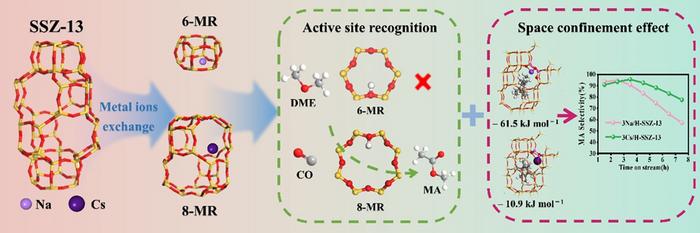
Dimethyl ether (DME) carbonylation to methyl acetate (MA) is one of the crucial steps in an indirect synthesis route of ethanol from syngas. SSZ-13 zeolite, with a typical topology of CHA, characterized by its 8-membered ring (8-MR) channels, has shown potential in catalyzing DME carbonylation. However, current studies lack a comprehensive understanding of the catalytic mechanism. Meanwhile, the influence of spatial confinement in SSZ-13 on the reaction has also not been considered.

Credit: Chinese Journal of Catalysis
Dimethyl ether (DME) carbonylation to methyl acetate (MA) is one of the crucial steps in an indirect synthesis route of ethanol from syngas. SSZ-13 zeolite, with a typical topology of CHA, characterized by its 8-membered ring (8-MR) channels, has shown potential in catalyzing DME carbonylation. However, current studies lack a comprehensive understanding of the catalytic mechanism. Meanwhile, the influence of spatial confinement in SSZ-13 on the reaction has also not been considered.
Recently, a research team led by Prof. Shouying Huang from Tianjin University, China, prepared a range of SSZ-13 samples with different metal loadings by simple ion exchange to fill this gap. Selective shielding out BAS within different channels of SSZ-13 is achieved by loading different sizes of Na+ and Cs+ metals. The characterization of acidity and Density Functional Theory (DFT) calculations confirm that at lower loading, Na+ preferentially settles in the 6-MR of SSZ-13 and replaces the BAS therein, while Cs+ can only interact with BAS in the 8-MR due to its large ionic radius. Combining activity data and the dissociation energies of reactants on BAS within different channels, it was indicated that both the main and side reactions of DME carbonylation occur on the 8-MR BAS of SSZ-13.
To highlight the role of spatial confinement on reaction, this work compared the pore structure of samples loaded with different size metals, TG/DTG and GC-MS analyses of spent samples, and the adsorption stability of key intermediates in side reactions, proving that the SSZ-13 cage space is a key factor for affecting MA selectivity. Through metal loading to narrow the space of 8-MR, the formation of side-reaction intermediates could be efficiently inhibited, resulting in an improvement of the main reaction selectivity. The results were published in Chinese Journal of Catalysis (
###
About the Journal
Chinese Journal of Catalysis is co-sponsored by Dalian Institute of Chemical Physics, Chinese Academy of Sciences and Chinese Chemical Society, and it is currently published by Elsevier group. This monthly journal publishes in English timely contributions of original and rigorously reviewed manuscripts covering all areas of catalysis. The journal publishes Reviews, Accounts, Communications, Articles, Highlights, Perspectives, and Viewpoints of highly scientific values that help understanding and defining of new concepts in both fundamental issues and practical applications of catalysis. Chinese Journal of Catalysis ranks among the top one journals in Applied Chemistry with a current SCI impact factor of 15.7. The Editors-in-Chief are Profs. Can Li and Tao Zhang.
Journal
Chinese Journal of Catalysis
Article Title
Mechanistic insights and the role of spatial confinement in catalytic dimethyl ether carbonylation over SSZ-13 zeolite
Article Publication Date
13-Jul-2024
Cite Scienmag News
Bethany Barker. (August 19, 2024). Mechanistic insights over SSZ-13 zeolite in catalytic dimethyl ether carbonylation. Scienmag. https://scienmag.com/mechanistic-insights-over-ssz-13-zeolite-in-catalytic-dimethyl-ether-carbonylation/
Bethany Barker. "Mechanistic insights over SSZ-13 zeolite in catalytic dimethyl ether carbonylation." Scienmag, 19 August 2024, https://scienmag.com/mechanistic-insights-over-ssz-13-zeolite-in-catalytic-dimethyl-ether-carbonylation/. Accessed 4 September 2026.
Bethany Barker. "Mechanistic insights over SSZ-13 zeolite in catalytic dimethyl ether carbonylation." Scienmag. August 19, 2024. https://scienmag.com/mechanistic-insights-over-ssz-13-zeolite-in-catalytic-dimethyl-ether-carbonylation/

