

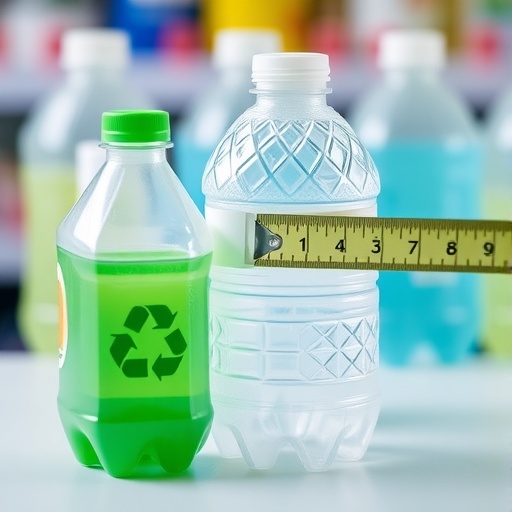
In a groundbreaking advancement for sustainability and environmental stewardship, researchers have developed a novel methodology to accurately determine the percentage of recycled plastic contained within a plastic product. This innovative approach, detailed in a recent publication, promises to transform how industries and consumers verify recycled content claims, ensuring transparency and fostering greater trust in circular economy initiatives. As global plastic pollution challenges intensify, this technique offers a sophisticated tool for promoting responsible manufacturing and consumption patterns.
Plastic waste has become one of the most pressing environmental issues of the 21st century. Governments and corporations alike have pledged ambitious targets to increase recycled plastic usage in products, but verifying these claims at the product level has remained elusive. Traditional methods, relying largely on documentation and supply chain auditing, are vulnerable to errors and fraud, making objective, reliable measurement tools sorely needed. The newly devised method addresses this gap by employing advanced analytical techniques to quantitatively dissect the composite nature of plastics.
Central to the development is an integration of spectroscopic and chemometric analysis that allows precise identification and quantification of recycled polymers amidst virgin materials. By analyzing characteristic molecular signatures and polymer morphologies, the system can calculate the exact fraction of recycled material present. Such fine resolution was previously unattainable due to overlapping signals and the heterogeneous nature of post-consumer plastic inputs. This breakthrough overcomes prior limitations, enabling direct, non-destructive evaluation of plastic products.
The implications for supply chains are profound. Manufacturers often face increasing regulatory and consumer pressure to declare recycled content with accuracy. This technique can be seamlessly integrated into quality assurance workflows, providing real-time verification and supporting compliance with legislation. Moreover, it empowers consumers by validating eco-labels and sustainability certifications, reinforcing purchasing decisions grounded in genuine environmental benefit.
Beyond manufacturing, policymakers stand to benefit as well. Quantitative recycled content data affords more effective monitoring and enforcement of recycling mandates, incentivizing higher circularity rates. The rigorous data generated can inform economic models assessing lifecycle impacts, guiding resource allocation toward the most effective interventions in waste reduction. Thus, the tool has the potential to catalyze systemic change across multiple sectors linked to plastics.
At the core of the technological workings is a novel algorithmic framework that interprets spectral data with unprecedented accuracy. By harnessing machine learning techniques, the system adapts to diverse plastic formulations and additives, accounting for variables that confound traditional analysis. This adaptability ensures consistent performance across product types, from packaging and consumer goods to industrial components. The research team highlights how iterative refinement continues to enhance precision in complex matrices.
This innovation emerges against the backdrop of escalating calls for sustainability. The global plastic recycling rate remains insufficient to stem ocean pollution and landfill accumulation. Consumer awareness campaigns have increased demand for circular products, yet without tools to authenticate recycled content, skepticism undermines progress. This newly introduced methodology addresses a critical bottleneck, bridging scientific rigor with industrial practicality in a way that resonates with modern sustainability imperatives.
The research process entailed rigorous validation on a comprehensive library of plastic blends representing both virgin and multiple recycled mixtures. Experimental results demonstrated that the method achieves accuracy levels surpassing 95%, a marked improvement over extant spectrometric or chromatographic assessments. The team also explored the impact of different recycling techniques on measurement fidelity, confirming robustness even in mechanically or chemically recycled specimens.
Looking ahead, this technique could fuel novel certifications and eco-label programs that rely on quantified recycled content metrics rather than self-reported data. Companies adopting the method can more credibly showcase their commitment to circularity, potentially influencing market differentiation and brand loyalty. Industry experts anticipate that such scientific underpinnings will accelerate adoption of recycled plastics at scale, transforming supply chains toward greater environmental accountability.
The environmental community has welcomed this advancement as a critical enabler for plastic circularity goals. By reducing uncertainty around recycled content, the method encourages investment in recycling infrastructure and technology, driving economic viability for recovered materials. It also supports broader efforts in resource efficiency, helping governments and industries meet carbon reduction targets by minimizing virgin polymer production, which is energy-intensive and carbon-emitting.
A striking aspect of the methodology is its non-destructive nature, which preserves product integrity during analysis. This allows sampling at multiple points along supply chains without damaging goods or interrupting production lines. Portability of analytical instruments further permits on-site verification, enhancing transparency and accountability. Such practical considerations bode well for widespread adoption and scalability in diverse operational contexts.
This breakthrough dovetails with advancements in digital technologies for supply chain transparency, including blockchain and IoT monitoring. Coupled with quantitative recycled content determination, these tools form a holistic ecosystem for tracking sustainability metrics from raw material sourcing to end-of-life management. This synergy signals a future where data-driven rigor underpins the entire lifecycle of plastic products, facilitating circular economy transitions.
Researchers emphasize the societal impact of this method beyond environmental benefits. By providing quantifiable evidence of recycled content, it combats greenwashing and empowers stakeholders with credible information. Ethical corporate behavior, consumer trust, and regulatory oversight are all bolstered, advancing a culture of genuine sustainability rather than empty claims. The approach represents a paradigm shift in how plastic product composition is understood and communicated.
Challenges remain in scaling the technology to all types of plastics and complex composites, particularly those with multi-layered structures or extensive additive packages. Continued R&D will focus on refining spectral libraries and machine learning models to enhance detection limits and adapt to emerging plastic types. Collaboration with industry players will be vital to tailor solutions to practical constraints and establish standardized protocols for measurement and reporting.
In sum, the ability to determine recycled plastic content with precision stands as a milestone in efforts to close the loop on plastic usage. This innovative analytical technique equips stakeholders with a powerful tool to verify sustainability claims, reduce fraud, and ultimately accelerate global progress toward circular plastic economies. As the method gains traction, it is poised to become an indispensable component of environmental governance and responsible manufacturing in the plastic age.
Subject of Research: Determining the percentage of recycled plastic content in plastic products.
Article Title: Determining the percentage of recycled plastic content in a plastic product.
Article References:
Zhao, Y., Adhivarahan, C., Jyothula, C.L. et al. Determining the percentage of recycled plastic content in a plastic product. Commun Eng 5, 51 (2026). https://doi.org/10.1038/s44172-026-00639-y
Image Credits: AI Generated


