


Caring for a child with autism spectrum disorder (ASD) is one of the most demanding long-term caregiving roles a family can face, and a new cross-sectional study from Lianyungang, a coastal city in eastern China, has now mapped in unusually fine detail which factors push parenting stress upward and which pull it back down. The research, published in the Journal of Autism and Developmental Disorders, surveyed caregivers of children aged two to fourteen years and measured their stress with the Parenting Stress Index–Short Form (PSI-SF), a widely validated 36-item instrument that captures parental distress, difficult parent–child interactions, and a difficult child domain. The team, led by researchers at Lianyungang Maternal and Child Health Hospital Affiliated to Kangda College of Nanjing Medical University, then used multiple linear regression to isolate the independent contribution of each candidate factor while statistically controlling for the others.
The headline number is stark: the average parenting stress score in the sample was 44.40, with a standard deviation of 12.22. Because the PSI-SF yields scores that can be benchmarked against clinical cutoffs, a mean in the mid-forties signals that a substantial share of these caregivers are carrying stress loads that would raise concern in a clinical setting. This is not merely an abstract statistic. Decades of research, including meta-analytic work comparing parents of children with and without ASD, show that elevated parenting stress is linked to poorer caregiver mental and physical health, harsher or less effective parenting practices, and worse developmental trajectories for the child. Chronic stress in caregivers has even been associated in recent neuroimaging studies with measurable changes in brain structure and function, underscoring that parenting stress is a genuine public health variable rather than a soft psychosocial endpoint.
Among the child-related predictors, age mattered. Caregivers of children older than six years reported significantly higher stress than those with younger children, with a regression coefficient of 2.376 points (95% confidence interval 0.424 to 4.329). This finding may seem counterintuitive at first glance, since early diagnosis and the toddler years are often portrayed as the most turbulent period. But the authors’ data align with a growing body of longitudinal work suggesting that stress does not necessarily attenuate as autistic children grow. School-age children face mounting demands around education, independence, and social integration, and in the Chinese context the pressure of academic expectations and the scarcity of inclusive educational placements can intensify rather than ease the caregiving burden as time passes.
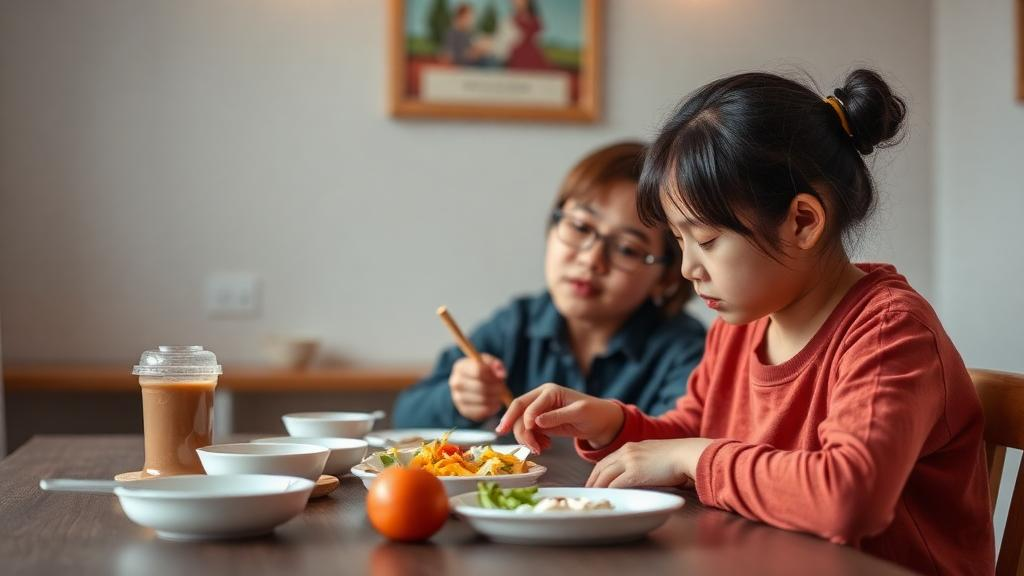
Two specific child behavior patterns emerged as particularly potent stress amplifiers. Children who exhibited stereotyped behaviors — the repetitive, restricted patterns such as hand-flapping, rocking, lining up objects, or rigid insistence on sameness, measured here with the Repetitive Behavior Scale–Revised — added an average of 4.207 points to their caregivers’ stress scores (95% CI 1.504 to 6.909). Stereotypies are among the most visible and socially conspicuous features of autism, and they frequently attract unwanted attention in public spaces, compounding the emotional labor of managing the behavior itself. Meanwhile, mealtime behavior problems, assessed with the Brief Autism Mealtime Behavior Inventory, contributed 0.236 points per unit increase on that scale (95% CI 0.139 to 0.333). Feeding difficulties are remarkably common in autistic children, encompassing extreme food selectivity, ritualized eating patterns, and mealtime tantrums, and because meals occur three times a day, every day, they transform a routine family activity into a recurring battleground that erodes caregiver resilience incrementally but relentlessly.
The caregiver’s own circumstances proved equally decisive. Unemployed caregivers scored 3.182 points higher on average than those who were employed (95% CI 0.586 to 5.779). The direction of this association is complex: unemployment may reflect the practical reality that round-the-clock caregiving, therapy appointments, and school advocacy make holding a job untenable, while the resulting loss of income and social identity feeds back into stress. In China, where families of children with ASD often shoulder substantial out-of-pocket costs for rehabilitation services, the economic dimension of this loop is especially consequential. Previous economic analyses have estimated that the lifetime cost of supporting a child with autism can reach into the millions of dollars in high-income settings, and in regions with thinner public safety nets the financial strain falls almost entirely on households.
Perhaps the most striking social finding concerns public stigma. Caregivers who perceived high levels of public stigma, measured with the Perceived Public Stigma Scale, showed markedly elevated stress, with each unit increase on the stigma scale adding 0.534 points (95% CI 0.389 to 0.678). Stigma operates as a chronic, ambient stressor: it shapes how strangers react to a child’s meltdown in a supermarket, whether relatives offer help or judgment, and whether parents feel safe disclosing their child’s diagnosis. Research on affiliate stigma — the stigma experienced by association — has shown that in many East Asian communities, misconceptions about autism still cast blame on parenting or ancestry, isolating families precisely when they most need community support. The Lianyungang data quantify how strongly this social climate translates into individual psychological burden.
On the protective side, three factors were associated with significantly lower stress. Female caregivers scored 3.580 points lower than male caregivers in the sample (95% CI −6.195 to −0.964), a result the authors report with appropriate caution, since gender differences in stress reporting and coping styles complicate interpretation. More actionable were the two psychosocial buffers. Caregivers reporting good family function, assessed with the Family APGAR index — a five-item screen covering adaptation, partnership, growth, affection, and resolve — showed reduced stress, with each unit of better functioning subtracting 0.383 points (95% CI −0.760 to −0.006). And social support emerged as the strongest protective variable in the model: each unit increase in perceived support was associated with a 1.228-point reduction in stress (95% CI −1.734 to −0.723). These coefficients are consistent with a large international literature showing that cohesive families and robust support networks dampen the physiological and psychological impact of chronic caregiving demands.
The methodological design deserves attention for what it does and does not establish. As a cross-sectional study, it captures a single moment in time, so the causal arrows remain ambiguous: do mealtime problems cause stress, or do stressed caregivers perceive mealtime behavior as more problematic? Longitudinal and intervention studies, including a recent randomized controlled trial of hospital–family collaborative intervention in China, suggest the relationship is bidirectional and that improving child symptoms and family functioning can indeed reduce stress. The authors also took standard precautions against statistical artifacts, using variance inflation factors to check for multicollinearity among predictors and reporting confidence intervals throughout, which strengthens confidence in the precision of the estimates even if causality cannot be inferred.
The practical implications, however, are clear and potentially far-reaching. The study was funded by the Lianyungang Science and Technology Bureau and the city’s maternal and child health research program, signaling local government interest in translating findings into services. The authors conclude that interventions to improve family function and social support, and to reduce public stigma, may help alleviate parenting stress in caregivers of children with ASD. Concretely, that points toward parent-mediated intervention programs that strengthen family cohesion, peer support networks and community education campaigns that normalize autism, respite care and employment protections that keep caregivers connected to the workforce, and feeding-focused behavioral therapy that defuses one of the most frequent daily flashpoints. As autism prevalence continues to rise globally — recent surveillance from the United States estimated that roughly one in thirty-one eight-year-olds is identified with ASD — the caregivers behind those statistics are asking a simple question: what would actually lighten the load? This study offers a data-driven answer, and it is less about changing the child than about changing the ecosystem around the family.
Subject of Research: Factors associated with parenting stress among caregivers of children with autism spectrum disorder in eastern China
Article Title: The Associated Factors of Parenting Stress Among Caregivers of Children With Autism Spectrum Disorders in Lianyungang, Eastern China: A Cross-Sectional Study
Article References: Chen, X., Tong, J., Ma, S., Zhu, L., Wang, X., Tao, Y., Zhao, H., Liu, C., Wang, Y., Wang, T., & Yan, D. (2026). The Associated Factors of Parenting Stress Among Caregivers of Children With Autism Spectrum Disorders in Lianyungang, Eastern China: A Cross-Sectional Study. Journal of Autism and Developmental Disorders. https://doi.org/10.1007/s10803-026-07559-y
Image Credits: AI Generated
DOI: 10.1007/s10803-026-07559-y
Keywords: parenting stress, autism spectrum disorder, caregivers, Lianyungang, public stigma, social support, family function, mealtime behavior, stereotyped behaviors, cross-sectional study, PSI-SF, China
Cite Scienmag News
Ophelia Keating. (October 5, 2026). Mealtime Battles, Stigma and Job Loss Drive Parenting Stress in Chinese Autism Caregivers. Scienmag. https://scienmag.com/mealtime-battles-stigma-and-job-loss-drive-parenting-stress-in-chinese-autism-caregivers/
Ophelia Keating. "Mealtime Battles, Stigma and Job Loss Drive Parenting Stress in Chinese Autism Caregivers." Scienmag, 5 October 2026, https://scienmag.com/mealtime-battles-stigma-and-job-loss-drive-parenting-stress-in-chinese-autism-caregivers/. Accessed 5 October 2026.
Ophelia Keating. "Mealtime Battles, Stigma and Job Loss Drive Parenting Stress in Chinese Autism Caregivers." Scienmag. October 5, 2026. https://scienmag.com/mealtime-battles-stigma-and-job-loss-drive-parenting-stress-in-chinese-autism-caregivers/


