

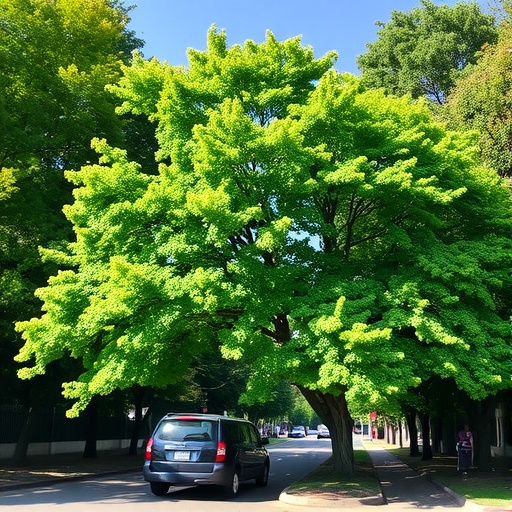
In an era marked by rapid urbanization and escalating environmental challenges, cities worldwide are under unprecedented pressure to innovate sustainable solutions that enhance urban living while mitigating ecological impacts. A groundbreaking study by Dong, Ye, Su, and colleagues, soon to appear in npj Urban Sustainability (2026), presents an advanced framework for optimizing urban tree species composition to maximize the benefits of nature-based solutions. This research strikes at the core of urban ecology, proposing a scientifically informed approach that could revolutionize how cities integrate green infrastructure into their planning and resilience strategies.
Urban forests are more than aesthetic enhancements; they are vital components of urban ecosystems that offer multifaceted environmental, social, and economic benefits. However, traditional urban greening efforts have often overlooked the complex interactions between tree species, environmental variables, and human needs. The innovative methodology presented in this study transcends these limitations by employing a comprehensive optimization model that accounts for species-specific traits, local climatic conditions, and ecosystem service demands. This approach aims to create resilient urban landscapes that are not only visually appealing but also functionally robust.
Central to this framework is the concept of nature-based solutions (NbS), which utilize natural processes and ecosystem services to address societal challenges such as air pollution, urban heat islands, and stormwater management. Urban trees are critical actors in NbS due to their abilities to sequester carbon, filter pollutants, regulate microclimates, and enhance biodiversity. Yet, not all tree species contribute equally to these functions under varying urban contexts. Dong and colleagues’ work quantifies these functional differences, creating a nuanced species composition index tailored to maximize environmental returns on urban greening investments.
The study employs high-resolution spatial data and species-specific ecophysiological parameters to model potential benefits across diverse urban settings. By integrating remote sensing technologies, urban microclimate modeling, and city-specific environmental stressors, the researchers establish a scalable and adaptable framework. Their model identifies optimal combinations of native and non-native tree species, balancing trade-offs between growth rates, canopy cover, resilience to pests and diseases, and capacity to provide ecosystem services over extended time horizons.
Beyond ecological performance, the study emphasizes socio-environmental equity by incorporating demographic and health data to prioritize tree planting in underserved neighborhoods disproportionately affected by environmental hazards. This socially conscious lens elevates urban forestry from a purely ecological consideration to a tool for environmental justice. By tailoring species composition to ameliorate localized air quality issues, mitigate heat stress, and support mental well-being, the model promises targeted ecosystem service delivery where it is most needed.
The researchers also address the challenges of climate change adaptability. Urban trees face increasing thermal and hydric stresses that jeopardize survival and ecosystem service continuity. To pre-empt these threats, the optimization model integrates climate projections and phenotypic plasticity data, recommending species mixes that enhance resilience to drought, heat waves, and extreme precipitation events. This forward-looking strategy equips urban forests to sustain functional performance amid uncertain future conditions, underscoring the importance of dynamic, data-driven urban ecology.
One of the most compelling aspects of this study is its use of a multi-criteria decision analysis platform that synthesizes ecological, social, and economic objectives into a holistic decision-making tool. This platform allows urban planners to simulate scenarios reflecting diverse policy priorities, from maximizing carbon capture to enhancing community well-being or reducing infrastructure strain during storms. Such flexibility enables bespoke urban forestry strategies aligned with specific municipal goals and constraints.
Moreover, the research highlights the critical role of biodiversity in maintaining ecosystem stability and multifunctionality in urban environments. Diverse species assemblages buffer against monoculture vulnerabilities, such as pest outbreaks and climate stress, while supporting richer urban faunal communities. By quantifying species complementarity and redundancy, the optimization approach ensures that urban forests perform optimally not just at the individual species level but across the entire assemblage, fostering healthy, resilient ecosystems.
The study also makes important contributions to urban governance and policy. By translating ecological theory and complex datasets into actionable guidelines, the authors provide city officials with practical tools to enhance transparency and stakeholder engagement in urban greening efforts. Decision-support systems derived from this framework could empower municipalities to prioritize investments, monitor outcomes, and adapt management strategies in iterative cycles, fostering adaptive urban ecosystem stewardship.
Furthermore, the economic dimension of urban tree species selection is rigorously evaluated. The model incorporates lifecycle cost assessments, including planting, maintenance, and potential damage mitigation, thus facilitating cost-effective urban greening plans that deliver maximal ecosystem services per dollar invested. This property is particularly crucial for cash-strapped municipalities seeking evidence-based, fiscally responsible sustainability pathways.
Crucially, the study’s scalability offers promise for application beyond municipal boundaries, extending into regional and national urban planning contexts. Its data-driven principles could inform the greening of suburban and peri-urban zones, augmenting metropolitan ecological networks that enhance overall urban resilience. Such landscape-scale integration aligns with emerging paradigms in sustainable urbanism, championing connectivity and multifunctionality in green infrastructure.
The researchers also challenge traditional homogeneity in urban forestry. Instead of prioritizing a few popular tree species, they advocate sophisticated, site-specific species mixes as a means to optimize a composite portfolio of ecosystem services. This paradigm shift could reduce vulnerability derived from overreliance on a narrow selection of species, often susceptible to invasive pests or diseases, and ultimately support healthier, more self-sustaining urban forests.
Another vital consideration presented is the incorporation of community knowledge and preferences into species selection. The model is designed with input mechanisms acknowledging that public acceptance profoundly shapes urban greening success. By aligning ecological optimization with cultural and aesthetic values, planners can foster lasting civic engagement and stewardship, essential for sustainable urban tree management.
In conclusion, Dong et al.’s pioneering work offers a transformative approach to urban greening, integrating cutting-edge science with practical, socially attuned implementation strategies. Their framework equips cities with the analytical power necessary to tailor urban forests for multifaceted benefits, ensuring these vital green spaces achieve their full potential as agents of climate mitigation, public health enhancement, and urban resilience. As climate change continues to escalate challenges in the built environment, deploying optimized, multifunctional urban tree compositions may become an indispensable pillar of sustainable urban futures.
The publication of this research heralds a new chapter in urban ecology, where precision and adaptability replace traditional one-size-fits-all greening approaches. Building on technological advancements in data acquisition and modeling, the proposed optimization tool represents an essential leap forward in evidence-based nature-based solutions. For policy-makers, urban planners, ecologists, and citizens alike, the implications of this work resonate deeply—empowering collective efforts to forge greener, healthier, and more equitable cities around the globe.
Article References:
Dong, X., Ye, Y., Su, D. et al. Optimizing urban tree species composition to maximize nature-based solutions. npj Urban Sustain (2026). https://doi.org/10.1038/s42949-026-00361-w
Image Credits: AI Generated


