


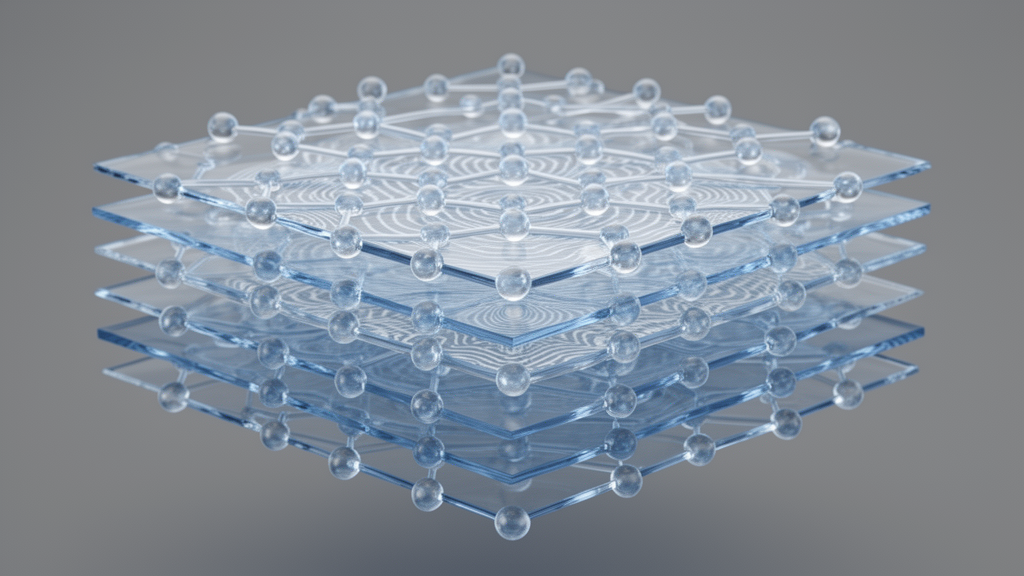
An international research team led by Tohoku University’s Advanced Institute for Materials Research (WPI-AIMR) has established a mathematical framework that extends orbifold notation to describe symmetry in complex layered structures. Published in the journal Interface Focus on August 14, 2026, the study addresses doubly periodic configurations that repeat along two spatial directions while extending into three dimensions. This development resolves an existing gap in structural classification, providing a formal mathematical language for systems situated between purely two-dimensional planes and fully periodic three-dimensional lattices.
Originally developed by mathematician John Conway and his collaborators, orbifold notation compresses complex geometric descriptions into standardized symbols governed by consistent rules. These symbols can be assembled like letters into words, efficiently representing spatial transformations such as rotations, reflections, and glide reflections. Prior to this work, orbifold notation had been established for two-dimensional repeating patterns and three-dimensional structures with periodicity in all three directions, leaving layered arrangements without a comparable compact descriptive system.
To test and illustrate the extended framework, the researchers applied the notation to knitted fabrics. Knitted textiles present a rigorous mathematical challenge because their flexible strands curve, loop, and pass around one another to form intricate three-dimensional networks without an underlying atomic lattice. Because these fabrics lack the rigid crystalline scaffolding typical of traditional solid-state materials, they served as a robust test case for verifying whether the new notation could accurately capture symmetry in non-crystalline, entangled systems.
The study highlights how geometric arrangements directly dictate physical behavior, noting that the configuration of interlocking textile loops determines how a finished garment stretches and fits. The authors explain that analogous geometrical and topological mechanisms operate in engineered materials, where structural symmetry influences how a medium conducts heat, transports electricity, and interacts with light. Formalizing symmetry in layered and entangled structures provides an analytical foundation for examining how these physical properties emerge from structural geometry.
A primary objective of the framework is to support the design and screening of functional materials for targeted applications. By offering an alternative to cumbersome coordinate-based descriptions, the compact symbolic language enables scientists to identify promising structural configurations and evaluate expected physical behaviors more systematically. The approach aims to bridge the relationship between how a material is constructed and its macroscopic functional capabilities.
Future work by the research team will focus on defining knot invariants within the orbifold framework to capture the topological characteristics of entangled strands. Developing coordinate-free representations of symmetry is intended to streamline computational algorithms and enhance materials simulations. The investigation was conducted in collaboration with Texas A&M University, the International Institute for Sustainability with Knotted Chiral Meta Matter (WPI-SKCM²) at Hiroshima University, and the University of California, Berkeley.
Discussing the perspective of the lead investigators, Sonia Mahmoudi, assistant professor at WPI-AIMR in Japan, emphasized the practical and theoretical value of expanding the mathematical vocabulary. According to Mahmoudi, extending orbifold notation to layered structures establishes a more flexible mathematical language for describing complex materials. She noted that the framework could help scientists better understand how structural symmetry and entanglement influence material properties, which could ultimately support the deliberate design of substances tailored for specific applications. To achieve this characterization, the research team introduced new mathematical symbols that formally extend John Conway’s original orbifold notation to layer groups, enabling researchers to classify doubly periodic configurations without relying on coordinate grids.
The peer-reviewed paper, titled “An orbifold framework for classifying layer groups with an application to knitted fabrics,” appeared with the digital object identifier 10.1098/rsfs.2025.0093. In their analysis, the authors emphasized that formalizing symmetry rules provides a compact mechanism for exploring how symmetrical patterns might be utilized to enhance key physical capabilities, including heat conduction, electricity transport, and optical interactions. Because the symbolic system treats complex symmetries as combinations of rule-bound characters, it offers an early foundation for integrating knot invariants into materials science. By capturing the precise geometric characteristics of how entangled strands loop around one another, this mathematical framework aims to simplify algorithms used in materials simulations and improve the efficiency of performance predictions.
This collaborative investigation reflects the interdisciplinary operational model of the Advanced Institute for Materials Research at Tohoku University. AIMR functions as a research center dedicated to addressing scientific frontiers and contributing to society by advancing materials science. To achieve these objectives, the institute gathers researchers across physics, chemistry, materials science, engineering, and mathematics.
The research was conducted under the auspices of the World Premier International Research Center Initiative, a national program launched in 2007 by Japan’s Ministry of Education, Culture, Sports, Science and Technology. Administered by the Japan Society for the Promotion of Science, the WPI program was established to foster globally visible research centers boasting the highest standards and outstanding research environments. Numbering more than a dozen institutions across Japan, these centers possess a high degree of autonomy, allowing them to engage in innovative modes of management and research.
Subject of Research: Mathematical framework extending orbifold notation to layered material symmetries
Article Title: A new math framework captures symmetry in layered materials
Article References: A new math framework captures symmetry in layered materials. Original publication (Bibliographic details unavailable.)
Image Credits: AI Generated
DOI: Not provided
Keywords: materials science, orbifold notation, symmetry, layered materials, knitted fabrics, applied mathematics, topology, layer groups, math, framework, captures, layered
Cite Scienmag News
Reid Dalton. (November 10, 2026). Mathematical Framework Extends Orbifold Notation to Classify Layered Material Symmetries. Scienmag. https://scienmag.com/mathematical-framework-extends-orbifold-notation-to-classify-layered-material-symmetries/
Reid Dalton. "Mathematical Framework Extends Orbifold Notation to Classify Layered Material Symmetries." Scienmag, 10 November 2026, https://scienmag.com/mathematical-framework-extends-orbifold-notation-to-classify-layered-material-symmetries/. Accessed 10 November 2026.
Reid Dalton. "Mathematical Framework Extends Orbifold Notation to Classify Layered Material Symmetries." Scienmag. November 10, 2026. https://scienmag.com/mathematical-framework-extends-orbifold-notation-to-classify-layered-material-symmetries/




