

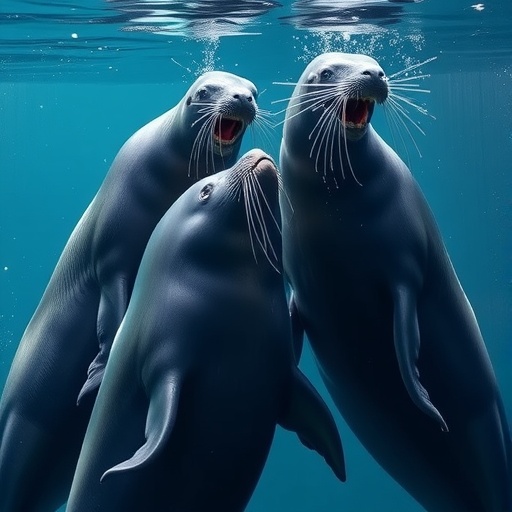
In a groundbreaking study set to reshape our understanding of marine mammal communication, researchers have unveiled remarkable insights into the remarkable vocal capabilities of certain species. The study, spearheaded by a team of experts including Tamara Raimondi, Fulvio D’Orazio, and Domenico Di Martino, reveals how upper vocal tract movements contribute to formant modulation in marine mammals. This discovery not only sheds light on the complexity of marine mammal sounds but also suggests a nuanced level of cognitive processing previously considered exclusive to human speech.
Marine mammals, such as dolphins and certain whale species, possess sophisticated vocalizations that have intrigued scientists for decades. The study meticulously investigates how these animals use their upper vocal tracts — comprising the throat, mouth, and nasal cavities — to modify their calls and produce distinctive sound patterns. It probes deep into the anatomy and mechanics behind these vocalizations, exploring how these creatures articulate sounds using their unique morphology.
By examining the intricate relationship between vocal tract movements and sound production, the researchers have painted a vivid picture of how marine mammals might communicate in their underwater worlds. The study utilizes advanced acoustic analysis techniques coupled with high-resolution anatomical imaging to uncover how adjustments in the shape and movement of the vocal tract can lead to different formants — the resonant frequencies of the vocal tract that shape the quality of sound.
Notably, the researchers observed that certain species exhibited an impressive ability to learn and adapt their vocalizations based on social interactions. This capacity for vocal learning is a critical component of communication and social bonding in marine environments. The findings suggest that just like human infants learn to speak by mimicking adults, marine mammals develop their distinctive calls through exposure to their peers, highlighting a shared cognitive trait that bridges the gap between species.
Understanding the role of vocal tract movements in sound production has implications that extend beyond mere curiosity. The ability of marine mammals to modulate their vocal sounds in response to varying social contexts can provide insight into their social structures and relationships. For instance, in tightly-knit pods, communicative nuances facilitated by subtle changes in sound can foster cooperation and bonding among individuals, enhancing group survival.
This research also raises questions about the evolutionary trajectories of vocal communication in marine environments. As marine mammals adapt to their specific ecological niches, the continuous refinement of their vocal capabilities may signify an evolutionary advantage, allowing them to convey increasingly complex messages, whether alerting others to dangers, coordinating hunting strategies, or expressing other social cues.
Beyond its implications for marine biology and the study of animal behavior, this research resonates with broader inquiries into the nature of communication across species. Understanding the mechanisms behind sound production in marine mammals enriches our knowledge of communication as a fundamental aspect of life. The cognitive parallels drawn between these animals and humans provide a tantalizing glimpse into the evolutionary origins of language.
Additionally, the research offers critical insights that could inform conservation efforts. As climate change and human activities continue to threaten marine habitats, understanding how these vocalizations function can assist in developing strategies to mitigate disturbances that may affect communication patterns among marine mammals, ultimately aiding in their preservation.
Moreover, the findings underscore the importance of interdisciplinary collaboration, blending expertise from fields such as bioacoustics, animal behavior, and cognitive science. Such collaboration enhances our understanding of the multifaceted nature of communication and its implications for social structures within animal communities.
The urgency of this research resonates in light of escalating environmental pressures that challenge marine ecosystems across the globe. By documenting the subtleties of vocal communication in marine mammals, the study emphasizes the need for a holistic approach to conservation — one that takes into account not only habitat preservation but also the social and communicative nuances of these sentient beings.
As we delve deeper into the complexities of marine mammal communication, the potential for new discoveries looms large. With technology advancing rapidly, future research could further illuminate the acoustic landscapes of our oceans, potentially unveiling new vocalizations or patterns that remain currently undiscovered. These explorations may redefine our understanding of not just marine mammals, but of communication as a fundamental aspect of intelligence across all species.
In conclusion, the transformative findings from this study mark a significant leap in our comprehension of marine mammal communication. The ability to learn and modulate formants through upper vocal tract movements signifies a profound cognitive complexity that reflects the rich social lives of these creatures. As researchers continue to unravel the mysteries of their vocalizations, we are reminded of the intricate web of life that exists beneath the waves, where communication serves as the lifeblood of social interaction, survival, and perhaps even a deeper connection to the natural world.
Subject of Research: Vocal communication in marine mammals
Article Title: Learnt formant modulation via upper vocal tract movements in a marine mammal.
Article References: Raimondi, T., D’Orazio, F., Di Martino, D. et al. Learnt formant modulation via upper vocal tract movements in a marine mammal. Discov Anim 3, 2 (2026). https://doi.org/10.1007/s44338-025-00145-z
Image Credits: AI Generated
DOI: https://doi.org/10.1007/s44338-025-00145-z
Keywords: Marine Mammals, Vocal Communication, Formant Modulation, Aquatic Ecology, Animal Behavior, Cognitive Science, Conservation Biology.


