


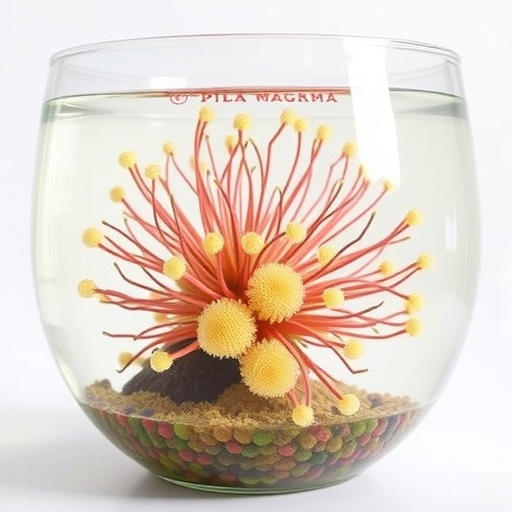
In recent years, the importance of maintaining clean and healthy aquatic environments has increasingly come to the forefront of scientific research and environmental policy. Amidst growing concerns over pollution, habitat destruction, and the challenges of climate change, innovative solutions are critical. A groundbreaking study by researchers including Phillips, Draper, and Geary, explores the use of Marimo, a type of green algae, as both a monitoring tool and a filtering agent for aquatic ecosystems. This innovative approach offers promising implications for environmental conservation and pollution mitigation.
Marimo, scientifically known as Aegagropila linnaei, is not only a fascinating organism but also an ecological powerhouse. Found in freshwater lakes across the globe, this unique form of algae grows in dense green balls that can be as large as a soccer ball. It plays a pivotal role in maintaining aquatic ecosystems by absorbing nutrients and stabilizing sediments, thus preventing erosion. The study presents a detailed analysis of Marimo’s capabilities to filter pollutants and monitor water quality effectively, thereby enhancing ecological resilience.
One of the most remarkable features of Marimo is its ability to thrive in a variety of environmental conditions. This adaptation makes it a suitable candidate for deployment in diverse aquatic ecosystems, ranging from pristine lakes to heavily polluted waterways. The researchers employed a series of controlled experiments to evaluate the algae’s efficiency in removing harmful substances from the water, including nitrates, phosphates, and heavy metals. Their findings indicate that Marimo demonstrates significant potential for bioremediation, an essential process for restoring polluted habitats.
The methodology employed in the study involved subjecting Marimo to various concentrations of pollutants typically found in contaminated freshwater environments. Over a designated period, the researchers meticulously monitored changes in water quality parameters, including pH, turbidity, and levels of specific contaminants. Marimo’s remarkable filtration efficiency was observed, showcasing its ability to adaptively respond to increased pollutant levels while simultaneously promoting the restoration of aquatic health.
In addition to its filtering capabilities, Marimo serves as an excellent bioindicator for monitoring the health of aquatic environments. A bioindicator is a species or group of species that provide crucial information about the status of an ecosystem. The study outlines how Marimo’s responses to changes in water quality—such as alterations in color, texture, and biomass—can be employed as reliable indicators of environmental shifts. By integrating Marimo into ecosystem monitoring practices, scientists can gain valuable insights into the health and stability of aquatic systems.
The research presents several implications for the application of Marimo in real-world settings. For instance, in regions suffering from excessive nutrient loading due to agricultural runoff or wastewater discharge, the introduction of Marimo can help mitigate harmful effects. By actively filtering out excess nutrients, Marimo not only contributes to improved water quality but also reduces the likelihood of harmful algal blooms—a pressing issue in many freshwater systems globally.
Moreover, the study emphasizes the cost-effectiveness and sustainability of utilizing Marimo for environmental monitoring and remediation. Unlike traditional mechanical filtration systems, which can be energy-intensive and expensive to maintain, Marimo functions as a natural filter, requiring minimal human intervention. This characteristic aligns with the ethos of sustainability, fostering a symbiotic relationship between technology and nature.
In light of these findings, it is essential to consider the broader implications of using biological agents like Marimo in environmental policy and conservation initiatives. Policymakers may harness the insights provided by this research to promote the integration of bioremediation techniques in restoration plans for polluted water bodies. Furthermore, public awareness campaigns can highlight the importance of preserving natural organisms like Marimo, which play significant roles in our ecosystems.
The study also calls for further exploration of the ecological role of Marimo and its interaction with other aquatic life forms. Understanding how Marimo contributes to overall biodiversity will be crucial in comprehensive ecosystem management strategies. Future research could focus on the synergistic effects of deploying Marimo in conjunction with other bioindicators and filter feeders within the ecosystem.
In conclusion, the investigation into Marimo’s capabilities as both a biological filter and an environmental monitor underscores its significance in contemporary ecological research. The promising results indicate that this native algae could become an integral component of efforts aimed at conserving aquatic environments. As the world grapples with increasing pollution levels and climate change, the innovative use of natural organisms like Marimo could light the path toward restoring and protecting our precious water resources.
This study serves as a reminder of the intricate connections within ecosystems, urging a holistic approach to environmental science and management. By fostering partnerships between nature and science, we can develop sustainable solutions to the pressing challenges facing our aquatic environments today. Researchers and conservationists alike must prioritize the exploration of such nature-based solutions to ensure a healthier planet for future generations.
Phillips, N., Draper, T.C., Geary, A.P. et al. Marimo for monitoring and filtering of aquatic environments.
Environ Sci Pollut Res (2025). https://doi.org/10.1007/s11356-025-37259-6
Cite Scienmag News
Violet Maxwell. (December 19, 2025). Marimo: Nature’s Filter for Aquatic Ecosystems. Scienmag. https://scienmag.com/marimo-natures-filter-for-aquatic-ecosystems/
Violet Maxwell. "Marimo: Nature’s Filter for Aquatic Ecosystems." Scienmag, 19 December 2025, https://scienmag.com/marimo-natures-filter-for-aquatic-ecosystems/. Accessed 4 September 2026.
Violet Maxwell. "Marimo: Nature’s Filter for Aquatic Ecosystems." Scienmag. December 19, 2025. https://scienmag.com/marimo-natures-filter-for-aquatic-ecosystems/


