


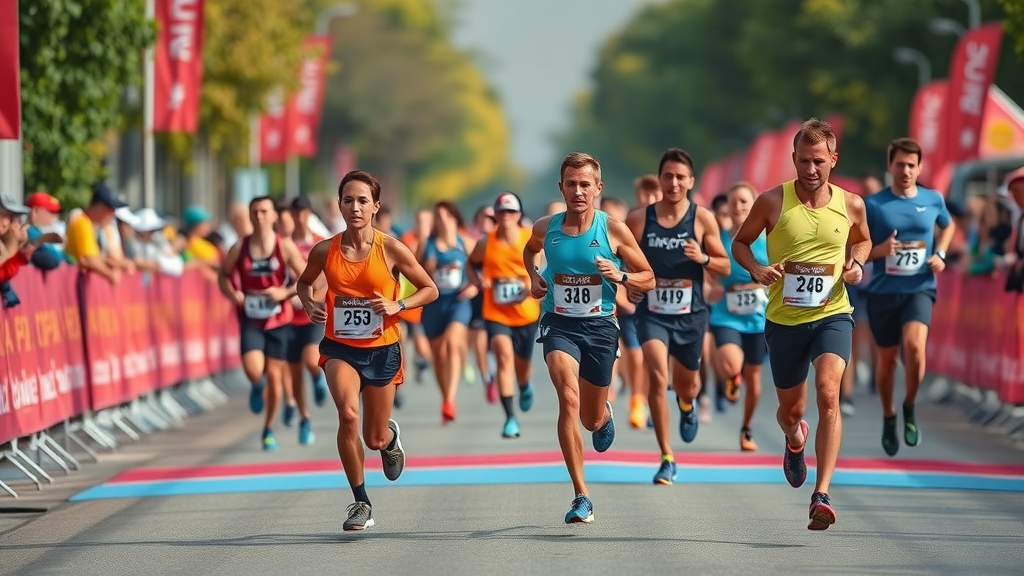
People living with type 1 diabetes can complete a full marathon safely and finish in times comparable to runners without the condition, according to new research being presented at the Annual Meeting of the European Association for the Study of Diabetes (EASD) in Milan, Italy, running from September 28 to October 2. The study, conducted by Michał Kulecki, Dr Andrzej Gawrecki and colleagues at Poznan University of Medical Sciences and Raszeja City Hospital in Poznań, Poland, used continuous glucose monitoring (CGM) technology to track blood sugar in real-world race conditions, offering one of the most detailed pictures yet of how glucose behaves over 42 kilometres of continuous endurance effort.
Completing a marathon with type 1 diabetes is a metabolic balancing act of unusual complexity. Every kilometre of running consumes muscle glycogen and blood glucose, while carbohydrate intake, insulin sensitivity, adrenaline, dehydration and core temperature all push glucose levels in different directions at different times. Too much circulating insulin, or too little carbohydrate on board, risks hypoglycaemia, a dangerous drop in blood sugar that can cause confusion, collapse or worse. Too little insulin risks hyperglycaemia and ketoacidosis. Despite the well-documented health benefits of regular exercise, fear of these low-glucose episodes remains the single biggest barrier to physical activity for people with type 1 diabetes, affecting up to 45 per cent of those living with the condition.
To examine how amateur runners actually manage this challenge, the researchers designed an observational study built around the 2025 Poznań Marathon, a standard 42-kilometre road race. They recruited 20 amateur runners: 10 with type 1 diabetes of at least one year’s duration and 10 controls without diabetes. The two groups were well matched, showing no significant difference in age (a mean of 35.4 years in the diabetes group versus 39.7 years in the controls), and each group contained eight men and two women. Among the runners with type 1 diabetes, the median duration of the condition was 16.5 years and median glycated haemoglobin, a measure of long-term glucose control, stood at 6.4 per cent, indicating generally well-managed diabetes.
Before the race, each runner with type 1 diabetes followed an individualised insulin strategy agreed in advance. The target pre-race glucose range was set at 140 to 200 mg/dL, deliberately above the normal fasting range to create a safety buffer for the exercise-induced drops to come. Runners using multiple daily injections reduced their basal insulin dose by 25 per cent, while those using non-hybrid insulin pumps cut basal delivery by 50 per cent. Participants on hybrid closed-loop systems, which automatically adjust insulin delivery, instead set a target glucose of 150 mg/dL. Five runners used multiple daily injections, three used continuous subcutaneous insulin infusion pumps, and two used automated insulin delivery systems, reflecting the full spectrum of modern insulin therapy.
Glucose was assessed at five checkpoints along the course: the start line, 10 km, 19 km, 30 km and the finish. At each point, capillary glucose was measured with a standard fingerstick glucometer and compared against readings from two different CGM systems, one intermittently scanned and one transmitting in real time. Carbohydrates or insulin were administered as required throughout the race. The researchers also evaluated the accuracy of the CGM devices using mean absolute relative difference, or MARD, a standard metric that expresses the average absolute percentage difference between sensor readings and reference glucose values. The lower the MARD, the more faithfully the sensor tracks true blood glucose.
The headline performance result was striking in its ordinariness. Marathon completion times did not differ significantly between the groups, with a median finishing time of 228 minutes for the runners with type 1 diabetes and 248 minutes for the controls. In other words, with careful preparation, the runners with diabetes were not merely surviving the distance; they were racing it on equal terms. During the race, they consumed a median of 53.5 grams of carbohydrate per hour, equivalent to 2.61 grams per kilogram of body weight across the entire marathon, a fueling rate consistent with general endurance-sport guidance.
The glucose traces themselves told a reassuring story. Median capillary glucose measured by glucometer stood at 183.5 mg/dL at the start, within the planned pre-race target, then fell to 119.5 mg/dL at 10 km, rose to 142.5 mg/dL at 19 km, dipped to 121.5 mg/dL at 30 km and finished at 108.5 mg/dL. These values remained within or close to a safe range throughout, showing that the pre-race insulin reductions and steady carbohydrate intake kept the runners’ blood sugar from collapsing under the metabolic demands of the distance. Only two hypoglycaemic measurements occurred, and both were in the same participant, who nevertheless completed the race. Notably, that runner had started with a glucose level below 140 mg/dL, beneath the study’s recommended pre-race floor, and consumed 49.5 grams of carbohydrate per hour, slightly less than the group median.
But the study also delivered a caution about the very technology that made it possible. CGM accuracy deteriorated substantially during the marathon. The intermittently scanned system differed from glucometer measurements by an average of approximately 43 per cent, and the real-time system by approximately 37 per cent. Both sensors overestimated capillary glucose, by +32.2 mg/dL and +50.4 mg/dL respectively. This matters because a runner who trusts an inflated sensor reading may believe their glucose is safe when it is in fact falling toward hypoglycaemia. Sensor error during prolonged exercise is thought to arise from a combination of factors, including reduced subcutaneous blood flow as the body shunts blood to working muscle, sweat interfering with sensor adhesion, compression of the sensor site, and the lag between interstitial fluid glucose, which CGM devices measure, and blood glucose, which changes fastest during rapid metabolic swings.
The authors drew a practical conclusion from this discrepancy. In a statement, they said: In this small observational study, all runners with type 1 diabetes completed the marathon, with performance comparable to controls. The runner who experienced low blood sugar had started the race with a glucose level below 140 mg/dL. During the marathon, CGM readings differed from glucometer measurements. For longer endurance events, runners should therefore consider checking their glucose with a glucometer, especially when the sensor reading does not match how they feel. That advice effectively reframes CGM as a trend-monitoring tool rather than a standalone decision-making instrument during ultra-endurance efforts, with fingerstick confirmation reserved for moments when symptoms and sensor numbers diverge.
The research team emphasised that the findings should not be read as a green light for unsupervised endurance racing. They noted that fear of hypoglycaemia is the main barrier to physical activity and affects up to 45 per cent of people with type 1 diabetes despite the major health benefits of regular exercise, and that managing glucose is challenging when levels change rapidly and responses vary between individuals. Their message was nonetheless an optimistic one: with appropriate education and careful blood sugar management, people with type 1 diabetes can successfully take part in even very demanding endurance exercise. They advised anyone with type 1 diabetes preparing for a marathon to discuss an individual glucose, carbohydrate and hydration plan with their doctors before the event, stressing that the most important element is an appropriate insulin management strategy, including reductions in basal and prandial insulin, and that baseline glucose control, exercise experience, diabetes duration and complications all shape individual risk. Some people, they added, should consult a cardiologist before starting endurance training. The team, which supports many athletes with type 1 diabetes, including competitors at the Olympic Games, Ironman triathlon finishers and a runner who completed ten marathons in ten consecutive days, presents the study as further evidence that the condition need not disqualify anyone from the marathon start line, provided the science of glucose management is respected as rigorously as the training plan itself.
Subject of Research: Glucose management, carbohydrate intake and CGM accuracy in amateur marathon runners with type 1 diabetes during a real-world 42 km race
Article Title: Running marathons with type 1 diabetes can be safe, shows small study using continuous glucose monitoring devices
Article References: Running marathons with type 1 diabetes can be safe, shows small study using continuous glucose monitoring devices. (n.d.). Original publication
Image Credits: AI Generated
DOI: Not provided
Keywords: type 1 diabetes, marathon, continuous glucose monitoring, hypoglycaemia, endurance exercise, insulin adjustment, carbohydrate intake, CGM accuracy, MARD, EASD, sports medicine, glucose management
Cite Scienmag News
Ophelia Keating. (September 20, 2026). Marathon Runners With Type 1 Diabetes Finish Safely, Small CGM Study Finds. Scienmag. https://scienmag.com/marathon-runners-with-type-1-diabetes-finish-safely-small-cgm-study-finds/
Ophelia Keating. "Marathon Runners With Type 1 Diabetes Finish Safely, Small CGM Study Finds." Scienmag, 20 September 2026, https://scienmag.com/marathon-runners-with-type-1-diabetes-finish-safely-small-cgm-study-finds/. Accessed 4 October 2026.
Ophelia Keating. "Marathon Runners With Type 1 Diabetes Finish Safely, Small CGM Study Finds." Scienmag. September 20, 2026. https://scienmag.com/marathon-runners-with-type-1-diabetes-finish-safely-small-cgm-study-finds/


