


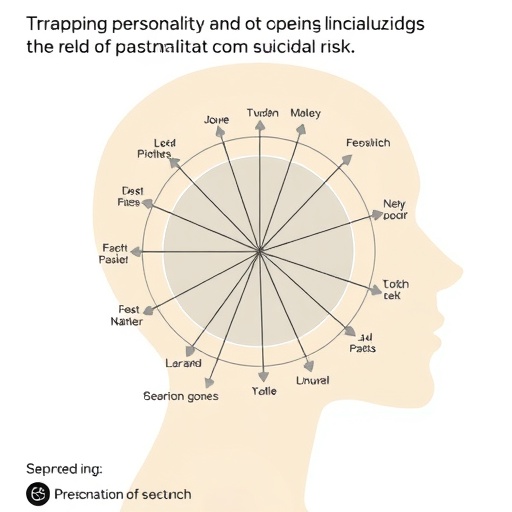
In the high-pressure environment of university life, students are frequently confronted with significant emotional and psychological challenges. A groundbreaking study published in BMC Psychiatry (2025) sheds new light on the intricate interplay between personality traits, emotion regulation strategies, coping mechanisms, and psychopathology—and how these factors collectively influence suicide risk among university students. Utilizing a sophisticated network analysis approach, the research offers a novel perspective that could revolutionize mental health interventions targeted at this vulnerable population.
University students often navigate a transitional phase marked by adapting to novel social contexts, academic demands, and future uncertainties. This adjustment period can be particularly fraught for individuals exhibiting maladaptive personality characteristics and ineffective emotional coping styles. The study’s authors emphasize that these internal psychological dynamics are critical in understanding the heightened risk of suicide that prevails within this demographic.
The research sample comprised 1,653 university students, predominantly female (71.8%), with an average age of approximately 21.6 years. Participants were assessed through comprehensive self-report surveys administered online. The investigators then applied partial correlation network analysis to map and quantify the complex interrelationships among personality traits, emotion regulation modalities, coping styles, and various psychopathological symptoms associated with suicidal ideation and behaviors.
One of the most compelling findings is the identification of significant and positive associations between suicide risk and nearly all measured psychopathological symptoms—except psychotic-like experiences—alongside avoidance coping behaviors, impulsivity, and venturesomeness. This suggests that students exhibiting these clinical and behavioral traits are at an increased likelihood of experiencing suicidal thoughts or actions. The network framework delineated these intricate connections, revealing how multifaceted psychological variables dynamically interact rather than operate in isolation.
Conversely, suicide risk demonstrated significant negative correlations with adaptive psychological constructs such as problem-focused coping, cognitive reappraisal, and empathy. These protective factors appear to buffer against suicide-related pathology by fostering more effective emotional regulation and interpersonal engagement. Cognitive reappraisal, in particular, allows students to reinterpret adverse experiences constructively, while empathy can engender social connectedness that mitigates isolation—both critical buffers in suicide prevention.
A particularly salient discovery in this study is the robust connection between suicide risk and dissociative symptoms—a psychological disruption characterized by detachment from reality or the self. Not only was this link strongest among all direct associations with suicide risk, but the intensity of this relationship also exceeded that of any other network connections. This underscores dissociation as a critical psychopathological marker meriting focused clinical attention within university mental health services.
Beyond individual symptomatology, the network analysis evaluated the concept of “bridge expected influence,” a metric quantifying the centrality and bridging potential of specific variables within the overall network. Notably, avoidance coping emerged as the prime contributor with the greatest bridge expected influence, indicating its pivotal role in maintaining and propagating the cascade of suicidal risk factors. Avoidance coping reflects a tendency to evade confronting stressful issues, which may exacerbate emotional distress and hinder adaptive problem-solving.
These revelations carry profound implications for therapeutic interventions aimed at reducing suicide risk in university populations. Targeted strategies addressing dissociation symptoms could significantly diminish the immediate risk of suicidal thoughts and behaviors. Equally important, the study advocates for clinical approaches that reduce reliance on avoidance coping while simultaneously cultivating adaptive, problem-focused coping strategies to bolster resilience and emotional regulation capacity.
The integration of these findings into university counseling programs can lead to more nuanced risk assessments and personalized treatment plans. Mental health practitioners are encouraged to incorporate screening protocols for dissociative experiences and maladaptive coping behaviors, alongside promoting cognitive techniques such as reappraisal and fostering social-emotional skills like empathy to engender holistic wellbeing.
This pioneering research exemplifies the power of network analysis as a cutting-edge tool for illuminating the complex architecture of psychological risk factors. By moving past traditional linear models, it captures the multifaceted and intertwined nature of suicide risk determinants, presenting opportunities for innovative prevention paradigms that could ultimately save young lives.
In the face of rising mental health challenges among university students globally, these insights offer a timely framework for policymakers, educators, clinicians, and researchers. A multidisciplinary effort grounded in empirical evidence and advanced analytical methods holds promise to combat the tragic toll of suicide in academic communities.
As the study underscores, effective suicide prevention must transcend symptomatic treatment, targeting underlying dysfunctional coping pathways and personality dysfunctions. By strategically disrupting these perilous networks of risk, there is potential not only to alleviate suicide incidence but also to enhance overall psychological resilience in future generations.
The enduring hope is that this sophisticated, data-driven approach will inform the next generation of mental health interventions—transforming how universities address emotional crises and ultimately fostering safer, healthier learning environments around the world.
Cite Scienmag News
Glenn Wilkins. (October 6, 2025). Mapping Personality and Coping Links to Suicide Risk. Scienmag. https://scienmag.com/mapping-personality-and-coping-links-to-suicide-risk/
Glenn Wilkins. "Mapping Personality and Coping Links to Suicide Risk." Scienmag, 6 October 2025, https://scienmag.com/mapping-personality-and-coping-links-to-suicide-risk/. Accessed 4 September 2026.
Glenn Wilkins. "Mapping Personality and Coping Links to Suicide Risk." Scienmag. October 6, 2025. https://scienmag.com/mapping-personality-and-coping-links-to-suicide-risk/


