


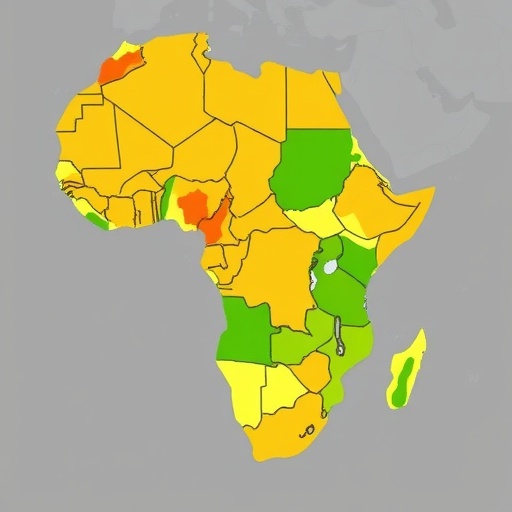
In a landmark scoping review published in the International Journal for Equity in Health, researchers have undertaken the ambitious task of conceptualizing “hardship areas” across Sub-Saharan Africa. This multifaceted review, led by Auma, Karing’u, Harriss, and colleagues, addresses a critical gap in both policy formulation and academic discourse by systematically analyzing the complex social, economic, and environmental dimensions that define regions experiencing acute and chronic adversities. Their study proposes a framework that not only captures the lived realities of deprivation but also underpins strategies aimed at mitigating inequities on the continent.
Sub-Saharan Africa, home to a diverse range of ecological zones and sociopolitical contexts, continues to grapple with persistent poverty and developmental challenges. However, the nature of hardship within this wide geographic expanse is far from uniform. This review distinguishes itself by moving beyond monolithic narratives and instead embracing the heterogeneity of hardship experiences. Through a meticulous synthesis of existing literature and empirical studies, the authors elucidate how factors such as resource scarcity, political instability, climate vulnerability, and social marginalization intertwine to produce localized forms of hardship that demand tailored interventions.
One of the pivotal contributions of this scoping review lies in its methodological rigor. By deploying advanced literature mapping techniques and thematic coding, the study aggregates a vast corpus of peer-reviewed articles, government reports, and gray literature, spanning various disciplines including public health, economics, and environmental science. This cross-disciplinary approach enables the researchers to transcend sector-specific limitations and offer a comprehensive, nuanced understanding of the variables that perpetuate hardship across Sub-Saharan Africa’s diverse landscapes.
The researchers underscore the critical importance of context-sensitive measurement tools in identifying hardship areas. Traditional metrics that rely heavily on income levels or GDP often fail to capture the multidimensional nature of deprivation. Instead, the review advocates for composite indices that integrate indicators related to food security, access to healthcare, education quality, infrastructural deficits, and exposure to environmental shocks. This holistic assessment framework promises to enhance the precision of poverty mapping and thus better inform policy priorities and resource allocation.
A significant portion of the review deals with the interplay between environmental stressors and socio-economic vulnerabilities. Climate change, recurrent droughts, and desertification, particularly in the Sahel region, exacerbate food insecurity and water scarcity, pushing communities deeper into cycles of hardship. The authors stress the need for adaptive governance structures capable of anticipating and mitigating the impacts of ecological disruptions. They argue that resilience-building initiatives should be prioritized in hardship areas to buffer communities against climate volatility.
Political and institutional factors also emerge as determinants of hardship in the review’s findings. Regions afflicted by protracted conflict, weak governance, or systemic corruption tend to experience compounded effects of deprivation, as state capacity to deliver basic services is severely compromised. The review highlights cases where displaced populations and refugee-hosting communities face unique hardships, exacerbated by limited access to social protection mechanisms and escalating competition for scarce resources.
In addressing social dimensions, the study draws attention to issues of marginalization and social exclusion. Ethnic minority groups, women, and youth are disproportionately represented in hardship areas, often facing barriers that limit their access to education, economic opportunities, and healthcare. The review calls for inclusive policy designs that recognize intersectionality and seek to dismantle structural inequities entrenched within societies.
Importantly, the scoping review critiques the dominant development paradigms that often prioritize urban centers or national averages while neglecting peripheral rural zones where hardship is concentrated. By pinpointing spatial disparities within countries, the authors encourage policymakers and development practitioners to recalibrate their focus towards localized, bottom-up approaches that engage community knowledge and participation in defining and addressing deprivation.
From a technical standpoint, the review also reveals gaps in data availability and quality, which hinder comprehensive monitoring of hardship areas. Many regions lack up-to-date demographic and socio-economic datasets, complicating efforts to track progress or assess the effectiveness of interventions. The authors advocate for increased investment in data collection infrastructure, including remote sensing technologies, household surveys, and participatory data models, to build reliable, real-time information systems.
The review’s synthesis culminates in a proposed conceptual framework that integrates the identified dimensions—economic, environmental, social, and political—into a cohesive model for classifying hardship areas in Sub-Saharan Africa. This model stresses dynamic interactions and feedback loops, recognizing that hardships are not static but evolve in response to internal and external shocks. Consequently, the framework serves as a valuable tool for anticipatory policy planning and adaptive management.
Equity considerations underpin the entire review, with a persistent focus on how systemic inequalities exacerbate hardships. The authors emphasize that interventions must go beyond alleviation to address root causes embedded in historical patterns of exclusion and uneven development. They champion equity-driven strategies that prioritize vulnerable populations while fostering sustainable livelihoods and community empowerment.
In communicating their findings, the researchers articulate a call for multi-level collaborations involving governments, international organizations, civil society, and local communities. They envision integrated policy mechanisms that link humanitarian aid with long-term development goals, breaking down the silos that too often limit the scope and effectiveness of programs in hardship areas.
The publication of this scoping review comes at a critical juncture, as Sub-Saharan Africa faces converging challenges of demographic pressures, climate change, and geopolitical shifts. Its insights provide a scaffolding for informed decision-making and resource mobilization that are essential to advancing health equity and social justice across the continent.
By illuminating the multi-dimensionality of hardship, this work challenges researchers and practitioners alike to rethink traditional approaches. The nuanced understanding it promotes has the potential to transform how hardship is diagnosed, targeted, and ultimately reduced, making it an indispensable reference for the next generation of development strategies.
While the review is comprehensive, the authors acknowledge the need for ongoing research to refine and validate the conceptual framework through empirical case studies and longitudinal analyses. They advocate for participatory research methodologies that amplify the voices of affected communities, ensuring that definitions of hardship are grounded in lived experiences.
In sum, this scoping review by Auma and colleagues marks a significant advance in the scholarship of hardship and deprivation in Sub-Saharan Africa. Its interdisciplinary lens, robust methodology, and equity-centered orientation offer a powerful blueprint for understanding and confronting the complexities of hardship, paving the way for more effective and inclusive policies that can transform the futures of millions.
Cite Scienmag News
Courtney Benton. (November 21, 2025). Mapping Hardship Zones in Sub-Saharan Africa. Scienmag. https://scienmag.com/mapping-hardship-zones-in-sub-saharan-africa/
Courtney Benton. "Mapping Hardship Zones in Sub-Saharan Africa." Scienmag, 21 November 2025, https://scienmag.com/mapping-hardship-zones-in-sub-saharan-africa/. Accessed 4 September 2026.
Courtney Benton. "Mapping Hardship Zones in Sub-Saharan Africa." Scienmag. November 21, 2025. https://scienmag.com/mapping-hardship-zones-in-sub-saharan-africa/


