

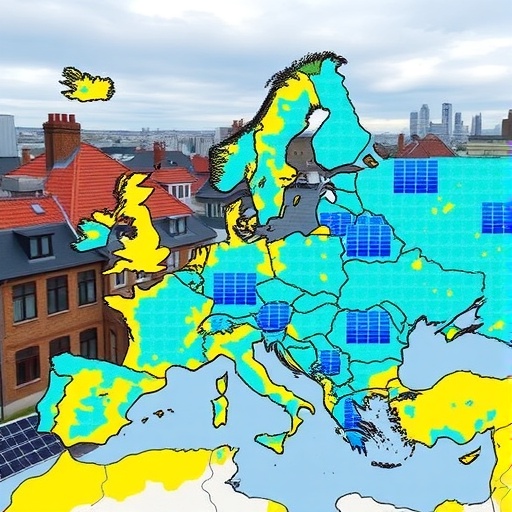
In a groundbreaking advance toward unlocking the latent potential of solar energy across Europe, researchers have unveiled a comprehensive mapping of rooftop photovoltaic (PV) capacity at the individual building level. This meticulous assessment integrates novel data modelling techniques with pragmatic engineering assumptions to chart the solar energy that could be harnessed if rooftops across the continent were optimally equipped with solar PV modules. The study’s approach is a sophisticated synthesis of geospatial analytics and energy yield estimation, addressing the crucial challenge of quantifying usable roof space and expected output under realistic conditions.
Central to this endeavor is the use of the Digital Building Surface Model (DBSM) R2025, which estimates the footprint area of rooftops on a per-building basis. However, the usable area for photovoltaic installations is notably smaller than the mere roof footprint because of multiple practical constraints. These include mandatory spacing between modules, roofs’ variable orientations, obstructions such as chimneys, aerials, HVAC units, and shading effects from adjacent structures. Due to inconsistent and incomplete data — with OpenStreetMap data completeness at a mere 6% across the EU — the authors adopted pivotal simplifications to enable a standardized yet conservative estimate for the entire region.
For residential buildings, the model assumes a uniform 20-degree pitched roof with a south-facing aspect, limiting PV installations to 25% of the total rooftop area. This parameter emerges from established literature and serves as a conservative baseline reflecting typical residential roof structures and module spacing needs. In contrast, non-residential buildings—predominantly commercial facilities characterized by flat rooftops—are modelled with a 40% rooftop area available for PV installations. This distinction acknowledges the greater flexibility inherent in flat roofs for PV array layout while adhering to conservative standards drawn from prior studies.
The PV system modeled for all building types employs free-standing racks oriented due south at an inclination of 20 degrees. This configuration aligns closely with the International Electrotechnical Commission’s IEC 61853 reference standard for PV module energy rating, ensuring international consistency and comparability. The assumed module efficiency is set at a notable 22%, reflecting cutting-edge technology currently available in the market. Importantly, the model accounts for necessary spacing between modules and racks within the stipulated area percentages, ensuring the overall rooftop coverage estimates are grounded in feasible design practices.
Recognizing the diversity in European climates and roof geometries, the researchers conducted a robust sensitivity analysis. This evaluation tested multiple PV orientation and tilt angles across 12 representative European locations spanning a wide climate gradient—from subtropical Mediterranean zones to circumpolar northern latitudes. The analysis varied inclination angles from horizontal (0°) to vertical (90°) in 5° increments and azimuth angles from north (−180°) through south (0°) to west (90°) in 10° increments. This comprehensive simulation framework illuminated the impact of differing solar geometry on PV output and validated the chosen southern 20° tilt as broadly optimal.
Results from the sensitivity analysis substantiated the decision to standardize on a south-facing array at 20° incline as a close approximation to the local optimum in terms of energy yield. While east- or west-facing installations showed an average 15% reduction in output compared to the south-facing ideal, orientations within 45° east or west of south suffered only about a 5% output loss. This finding emphasizes that within typical orientation variances found in urban rooftops, the impact on generation is relatively modest. The 20° tilt angle is also considered conservative, as it often falls just below the real-world optimum angle, thus providing a buffer for other design trade-offs.
For residential buildings, this comprehensive yet simplified model represents a reasoned compromise given the limitations in available rooftop configuration data. The 25% usage factor aligns with established precedents and accounts for shading and technical limitations. For non-residential buildings, commonly featuring flat roofs, the 40% rooftop usage factor is similarly justified and deemed realistically achievable. The flexibility afforded by flat roofs means that installation designs can often be optimized on-site to improve yield beyond the conservative baseline.
A critical component of the methodology is the application of PVGIS, the open-access Photovoltaic Geographical Information System developed by the European Commission’s Joint Research Centre. PVGIS provides spatially resolved solar irradiance data and tools for estimating PV power generation potential tailored to specific locations and configurations. The deployment of PVGIS across the European Union’s building database enabled the computation of annual energy yields, expressed in kilowatt-hours per kilowatt-peak installed, for each geolocated building.
While the one-size-fits-all PV system configuration might seem simplistic, the data-driven validation confirms that it yields cautiously conservative estimates that serve as a reliable pan-European benchmark. The study’s conservative assumptions hedge against overestimation and implicitly allow room for future improvements in module efficiency and rooftop utilization practices, which are expected as photovoltaic technologies evolve. By setting a baseline grounded in current, verifiable technology and realistic deployment constraints, the study furnishes critical insights for policymakers, urban planners, and renewable energy stakeholders.
Notably, the study underscores the profound data gaps in rooftop typology and solar resource mapping within Europe. The absence of a complete and open-access rooftop database hampers precise national or local assessments, accentuating the value of modeling work that blends high-level geospatial data with engineering heuristics. The data incompleteness of OpenStreetMap, covering only about 6% of rooftops, exemplifies this challenge. Future efforts in digital urban mapping and detailed building attribute databases would markedly enhance the resolution and accuracy of solar potential assessments.
Moreover, the research illustrates the delicate interplay between module orientation, tilt angle, and local solar conditions. By simulating diverse orientations, the authors demonstrate that small deviations from the ideal bear limited impact on annual energy yield, especially in locations with diffuse solar radiation or mild seasonal variability. This reinforces the practicality of a uniform, south-facing assumption at moderate tilt for large-scale modeling purposes without requiring exhaustive site-specific data.
The implications of this study reach far into Europe’s decarbonization ambitions. By defining a robust methodology and credible estimate of rooftop solar potential, it provides a scalable analytic framework for cities and countries aiming to accelerate renewable integration. The delineation of realistic rooftop usage ratios and system performance benchmarks enables more accurate forecasting of solar contributions to grid demand and energy independence targets. This granular building-level insight is pivotal for aligning urban energy strategies with sustainability goals.
At the intersection of energy modeling and urban informatics, this approach embodies the future of high-resolution renewable resource assessment. It establishes a foundation for integrating detailed building geometries, rooftop configurations, and solar irradiance in a unified platform, enabling enhanced planning transparency. By offering a replicable methodology, the study encourages similar assessments in other regions worldwide, catalyzing a wave of rooftop solar potential mapping vital for global energy transitions.
In conclusion, the mapping of Europe’s rooftop photovoltaic potential using a building-level database signifies a milestone in renewable energy research. Its considered balance between conservative assumptions and data-driven validation ensures robust, actionable insights. As technologies advance and more granular urban data becomes available, this baseline analysis can be refined, propelling rooftop solar PV deployment to the forefront of Europe’s clean energy landscape. With widespread adoption, this research can significantly influence policy, investment, and technological innovation to usher in a new era of sustainable, decentralized power generation.
Subject of Research: Mapping and estimating rooftop photovoltaic potential across European buildings using a building-level database combined with geospatial modeling and energy yield simulations.
Article Title: Mapping Europe’s rooftop photovoltaic potential with a building-level database.
Article References:
Kakoulaki, G., Kenny, R., Nigel, T. et al. Mapping Europe’s rooftop photovoltaic potential with a building-level database. Nat Energy (2026). https://doi.org/10.1038/s41560-025-01947-x
Image Credits: AI Generated


