


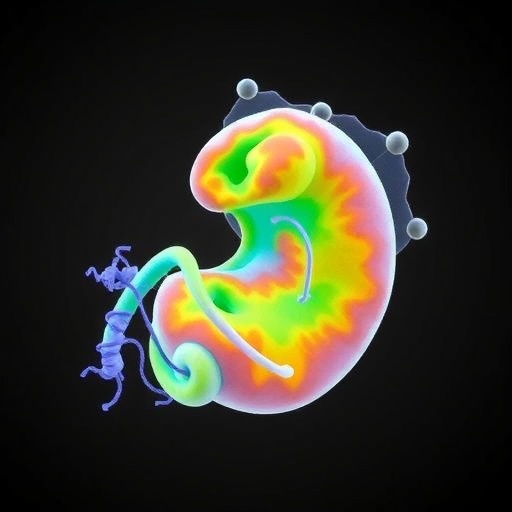
A groundbreaking advancement in developmental biology has been achieved by a team of researchers at the University of Basel, Switzerland, who have unveiled a comprehensive atlas mapping gene activity and cellular dynamics throughout the entirety of early zebrafish embryo development. This remarkable feat was made possible through the introduction of an innovative imaging technique known as weMERFISH—a method capable of visualizing the activity of nearly 500 genes simultaneously at subcellular resolution within whole tissues. This pioneering work shatters previous limitations, offering unprecedented insight into how a simple cluster of cells orchestrates complex embryogenesis.
Historically, studying gene expression during early development encountered profound challenges, primarily due to the dimensional constraints of existing methods which permitted analysis only in two-dimensional tissue sections. Such approaches obscured comprehensive spatial relationships and subcellular patterns critical to understanding morphogenetic processes. By overcoming these obstacles, the new technique facilitates direct visualization of gene regulation across the full three-dimensional context of the organism, integrated with cellular positioning and movement over time.
The weMERFISH methodology combines multiplexed error-robust fluorescence in situ hybridization with advanced computational mapping to track gene transcripts with remarkable precision. This technology generates volumetric datasets capturing the transcriptomic landscape of an entire zebrafish embryo during gastrulation and early organogenesis stages, providing a fourth dimensional view that couples spatial information with temporal gene expression patterns. The integration of this data with previous single-cell sequencing efforts further refines the atlas, allowing researchers to decode regulatory networks that drive cellular differentiation and spatial organization.
The resultant atlas comprises detailed profiles of tens of thousands of cells, revealing their gene expression states, developmental trajectories, and regulatory element activities. Notably, the research exposed how distinct developmental stages arrange sequentially along the embryo’s body axis—stem cells at the tail tip progressively maturing into specialized muscle and neural cells anteriorly. This observation exemplifies a novel concept described as “seeing time in space,” illustrating dynamic developmental processes frozen in spatial gradients.
Significantly, the study also elucidates the mechanisms behind the formation of sharp tissue boundaries, such as those between muscle and notochord. Rather than relying on classical models proposing extensive cell sorting to segregate tissues, the findings indicate that boundary formation predominantly arises from region-specific shifts in genetic programming. Cells transition their transcriptional profiles within a defined zone across the boundary, precluding extensive cellular intermixing and reinforcing tissue compartmentalization.
The available atlas and underlying datasets are accessible to the global scientific community via the MERFISHEYES online platform, designed to serve as a versatile resource enabling cross-comparison and hypothesis generation in developmental biology. By interrogating gene regulatory landscapes at such a resolution, researchers can now probe fundamental questions regarding the coordination between gene expression dynamics, cellular motility, and morphogenetic outcomes with newfound clarity.
Further implications of this technology extend to understanding how precise organogenesis is choreographed. The integration of real-time live imaging data with the spatial transcriptomic maps promises to unravel the interplay between genetic programs and cellular behaviors that culminate in the formation of complex anatomical structures. This could illuminate the multiplicity of developmental strategies nature employs to build vital organs such as the heart and spinal cord.
Looking ahead, the team aims to expand these investigations into later developmental stages, progressively completing a four-dimensional atlas of vertebrate embryogenesis. Decoding the combinatorial code of gene expression and cell movement underlying tissue patterning and organ formation holds potential for transformative insights in regenerative medicine and congenital disease research. As Professor Alex Schier emphasizes, this work represents a critical stepping stone toward comprehending the vast diversity and plasticity of developmental pathways.
The convergence of cutting-edge imaging, molecular biology, and computational analysis showcased by this project exemplifies the power of interdisciplinary approaches to solve complex biological puzzles. By charting the earliest moments of life at subcellular resolution, scientists now hold a window into the intricate ballet of gene activity and cellular dynamics that sculpt a functional organism from a mere cell cluster. This atlas not only revolutionizes our fundamental understanding but also provides a roadmap for future explorations into the mysteries of vertebrate development.
Ultimately, this breakthrough underscores how innovations in technology can propel biological discovery, transforming abstract genomic data into vivid spatial and temporal narratives. As developmental biology embraces such integrative tools, the community stands poised to unveil the exquisite mechanisms governing life’s formative stages with unparalleled precision and depth.
News Publication Date: 12-Mar-2026
Web References: http://schier.merfisheyes.com, DOI 10.1126/science.adt3439
Cite Scienmag News
Juliet Wilcox. (March 12, 2026). Mapping Embryogenesis in 4D: A Comprehensive Developmental Atlas of Genes and Cells. Scienmag. https://scienmag.com/mapping-embryogenesis-in-4d-a-comprehensive-developmental-atlas-of-genes-and-cells/
Juliet Wilcox. "Mapping Embryogenesis in 4D: A Comprehensive Developmental Atlas of Genes and Cells." Scienmag, 12 March 2026, https://scienmag.com/mapping-embryogenesis-in-4d-a-comprehensive-developmental-atlas-of-genes-and-cells/. Accessed 4 September 2026.
Juliet Wilcox. "Mapping Embryogenesis in 4D: A Comprehensive Developmental Atlas of Genes and Cells." Scienmag. March 12, 2026. https://scienmag.com/mapping-embryogenesis-in-4d-a-comprehensive-developmental-atlas-of-genes-and-cells/


