

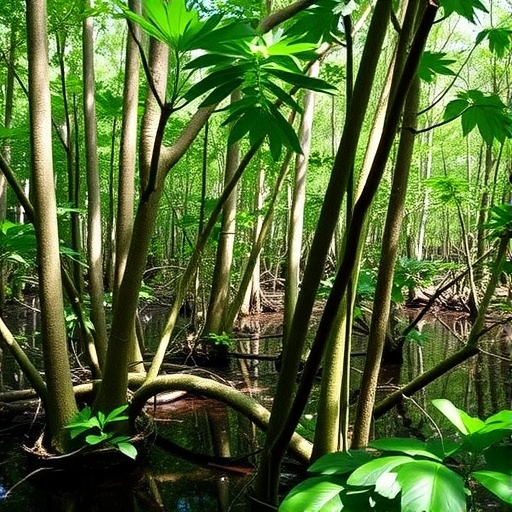
In a groundbreaking new study published in Communications Earth & Environment, researchers have unveiled striking evidence that the carbon emissions from a Floridian mangrove estuary remain significantly reduced for up to two years following a major hurricane. This discovery not only challenges prevailing assumptions about the immediate and long-term impact of extreme tropical storms on coastal carbon cycles but also highlights the complex and prolonged ecological responses of mangrove ecosystems in the face of climatic disturbances.
Mangrove estuaries are recognized as one of the most efficient coastal carbon sinks globally, playing a critical role in sequestering atmospheric carbon dioxide and thus mitigating climate change. The study conducted by Stegehuis, Ho, Bopp, and colleagues analyzed carbon outflow dynamics from one such mangrove estuary in Florida over an extended period, capturing data before and after a hurricane event that struck the region. Their results reveal an unexpected decrease in carbon export from this ecosystem, persisting up to 24 months post-hurricane.
Traditionally, hurricanes have been perceived as agents that disrupt coastal habitats, often causing widespread damage to vegetation, soil structure, and hydrological patterns, which could, in turn, increase the release of stored carbon to the atmosphere or adjacent marine waters. However, the reported decline in carbon outflow suggests that the mangrove ecosystem may undergo a form of resilience or altered carbon processing that reduces emissions rather than exacerbating them in the long term. This counterintuitive pattern warrants a re-examination of ecosystem carbon responses to extreme weather events.
The research team utilized state-of-the-art biogeochemical monitoring methods, combining in situ water sampling and remote sensing to quantify dissolved and particulate organic carbon fluxes in the estuary. These data inputs were integrated with advanced hydrodynamic and carbon cycling models to discern temporal changes in carbon export linked specifically to the hurricane disturbance. By isolating the post-event carbon fluxes from baseline conditions and seasonal variability, the scientists established a clear timeline of suppressed carbon release.
One of the pivotal findings of this investigation is the prolonged nature of the reduced carbon outflow. Whereas prior studies generally focused on immediate or short-term impacts spanning weeks to months, the current work draws attention to the multi-year trajectory of ecosystem recovery and carbon dynamics. This extended period signals a complex interaction between mangrove root recovery, sediment re-stabilization, and shifts in microbial decomposition pathways that collectively modulate carbon release processes.
The ecological implications of these findings are profound. Mangroves affected by hurricanes are thought to experience biomass loss and structural damage, potentially enhancing the vulnerability of stored carbon pools. However, the observed reduction in carbon outflow may reflect a compensatory mechanism such as increased sediment accumulation or reduced microbial respiration rates due to altered water chemistry and oxygen availability post-hurricane. These mechanisms could serve as temporary carbon retention strategies during the ecosystem’s recovery phase.
Beyond the biological dimensions, the physical alterations in estuarine circulation caused by storm surge, freshwater input, and sediment deposition appear instrumental in reshaping carbon export pathways. The disturbance could alter water residence times, nutrient transport, and organic matter breakdown rates, thereby influencing the magnitude and timing of carbon fluxes from the estuary to coastal waters. Understanding these hydrodynamic controls is essential for developing accurate carbon budgets in hurricane-prone coastal systems.
The study also points to potential feedback loops between hurricane frequency/intensity and coastal carbon cycling under climate change scenarios. With hurricanes predicted to become more severe in a warming world, the long-term suppression of carbon outflow observed here may play a significant role in regional and even global carbon balance models. Incorporating such dynamic responses could improve predictions of carbon sequestration potential and greenhouse gas emissions from coastal wetlands.
Furthermore, this research underscores the importance of long-term monitoring and interdisciplinary approaches that span hydrology, ecology, and biogeochemistry. Short-term assessments risk missing the nuanced and evolving nature of carbon flux responses, which may differ dramatically in scope and duration following extreme disturbances. The study’s robust methodology sets a benchmark for future investigations aiming to unravel climate-driven ecosystem processes.
In practical terms, these findings have implications for coastal management and conservation strategies. If mangroves can retain carbon more effectively after hurricanes than previously thought, protecting and restoring these habitats should be prioritized not only for coastal protection and biodiversity benefits but also as integral components of climate mitigation efforts. This could influence policy frameworks and carbon credit systems that account for ecosystem carbon storage dynamics.
The interdisciplinary team who authored this research also highlights the need to consider multiple stressors acting synergistically on mangrove carbon fluxes. For instance, sea-level rise, altered salinity regimes, and anthropogenic impacts may interact with storm disturbances to reshape carbon cycling in unpredictable ways. Future studies will be necessary to dissect these combined effects and develop comprehensive models encompassing diverse environmental variables.
In sum, the revelation that carbon outflow from a Floridian mangrove estuary is substantially reduced up to two years following a hurricane marks a significant advancement in our understanding of coastal carbon dynamics. This phenomenon underscores the resilience and complex functioning of mangrove ecosystems, revealing a capacity to modulate carbon exchange in ways that may be beneficial for climate regulation, despite the immediate destructive impacts of tropical storms.
As this research continues to reverberate throughout the scientific community, it invites a reevaluation of how coastal wetlands are incorporated into global climate mitigation strategies. The nuanced insights provided by Stegehuis and colleagues pave the way for more refined assessments of carbon budgets, contributing to a deeper appreciation of nature’s role in buffering climate perturbations under increasing environmental stress.
It will be crucial for follow-up research to explore whether similar patterns exist in other mangrove regions worldwide, and how variations in storm intensity, frequency, and ecosystem type influence carbon flux responses. Such comparative studies could reveal geographic and biophysical controls on carbon retention post-disturbance, enabling targeted conservation and restoration initiatives tailored to regional contexts.
Overall, the study opens new frontiers in coastal carbon research, challenging simplifications and illuminating the adaptive capacities of critical blue carbon ecosystems. The implications extend beyond academic realms, offering hope and practical guidance for sustainable ecosystem management in an era of escalating climate extremes.
Subject of Research: Reduced carbon outflow dynamics from Floridian mangrove estuaries following hurricane disturbances.
Article Title: Reduced carbon outflow from a Floridian mangrove estuary up to two years after a hurricane.
Article References:
Stegehuis, A.I., Ho, D.T., Bopp, L. et al. Reduced carbon outflow from a Floridian mangrove estuary up to two years after a hurricane. Communications Earth & Environment (2026). https://doi.org/10.1038/s43247-026-03249-w
Image Credits: AI Generated


