


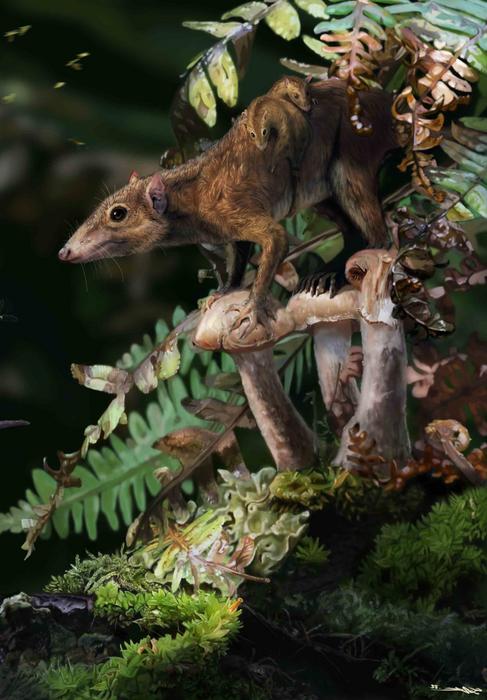
In a groundbreaking study conducted by researchers at the University of Bristol, new evidence has emerged indicating that mammals were beginning to adopt more terrestrial lifestyles several million years prior to the catastrophic asteroid impact that ended the reign of the dinosaurs. This pivotal research, recently published in the esteemed journal Palaeontology, sheds light on the adaptability and evolutionary trajectories of mammals during the Late Cretaceous period, challenging long-held perceptions about their ecological roles.
The study focuses on fossilized bone fragments from both marsupial and placental mammals discovered in Western North America. This region possesses one of the most well-preserved terrestrial fossil records from the Late Cretaceous, allowing researchers to glean insights into the locomotory behaviors of these ancient species. The examination concentrated on the ends of limb bones, which, due to their structure, carry distinct markers of locomotion that can be statistically compared with the movement patterns observed in modern mammals. This innovative approach enables the team to establish a clearer understanding of how prehistoric mammals adapted as their environments changed.
Lead author Professor Christine Janis has been pivotal in this research initiative. According to Janis, while there has been prior acknowledgment of the ecological shifts occurring among plant species towards the end of the Cretaceous—particularly the rise of flowering plants which fostered more diverse ground habitats—little was known about the mammals themselves. Specifically, the study aimed to ascertain whether these species were transitioning towards a terrestrial lifestyle in tandem with the vegetational changes in their habitats as the asteroid impact loomed on the horizon.
While earlier research primarily utilized complete skeletal remains to recount the narrative of ancient mammalian movement, this study marks a significant shift by leveraging small bone elements to capture broader ecological patterns affecting entire communities, rather than focusing on individual species. This method involved a rigorous analysis of statistical data derived from museum collections located in New York, California, and Calgary, uncovering vital information from smaller fossils that were previously overlooked.
The findings suggest that the mammals of this period were not merely surviving in their environments but evolving in response to the changing landscape. Professor Janis emphasizes that the vegetational habitat may have played a more crucial role in shaping the evolution of Cretaceous mammals than the presence or absence of dinosaurs. The evidence gathered points to a burgeoning need for adaptation among these mammals, preparing them for the eventual upheaval that would accompany the asteroid’s impact.
The research targeted bone articular fragments specifically from therian mammals, which include both marsupials and placentals. Interestingly, it did not extend its methodology to other, more ancient mammalian groups such as multituberculates, whose skeletal structures significantly differ and do not yield comparable insights regarding locomotion and habitat adaptation dynamics. This distinction underlines the focused nature of the study and its commitment to untangling the specific evolutionary adaptations of the therian lineage.
An important takeaway from this research is that the consequences of habitat alteration could have implications that resonate far beyond the immediate aftermath of the ecological shift. The team’s findings might indicate that these mammals had already started to diverge in lifestyle and foraging strategies in preparation for the dramatic environmental changes that were about to occur. As flowering plants continued to proliferate and reshape landscapes, the mammals were also evolving their behaviors, potentially laying the foundation for future resilience in the face of mass extinction events.
As the researchers conclude their project, the volume of evidence gathered contributes not only to our understanding of prehistoric mammals but also enriches the broader narrative of life on Earth as it navigated one of its most tumultuous transitions. The meticulous study of small bone fragments serves as a reminder of the complexities of adaptation and evolution, particularly how even minor changes can reflect larger ecological shifts within the environment.
In a climate fraught with scientific inquiry and discovery, this research holds immense significance for future studies on mammalian evolution and the responses of various species to environmental stresses. The implications of this work extend beyond mere academic interest, with potential applications in understanding contemporary animal behavior in light of ongoing ecological changes attributable to climate phenomena.
Ultimately, the findings of this research serve as a rich testament to the resilience and adaptability of life on Earth. Even in the face of impending doom, ancient mammals were making strides toward a more terrestrial existence, a fact that echoes through the ages and continues to inspire curiosity among paleontologists and biologists alike. As scientists dig deeper into the past, understanding these prehistoric adaptations could offer valuable insights into how modern species might navigate the challenges of their own changing environments.
In sum, the study contributes to a nuanced and enriched understanding of the Late Cretaceous period, showcasing the intricate interplay of flora, fauna, and environmental change. By examining how mammals began to embrace life on the ground, this research opens new avenues for exploration and discussion in the field of paleontology, reinforcing the importance of adaptability in life’s ongoing evolutionary journey.
Cite Scienmag News
Grant Pearson. (April 2, 2025). Mammals Transitioned from Arboreal to Terrestrial Life Prior to the Dinosaur-Extinction Asteroid. Scienmag. https://scienmag.com/mammals-transitioned-from-arboreal-to-terrestrial-life-prior-to-the-dinosaur-extinction-asteroid/
Grant Pearson. "Mammals Transitioned from Arboreal to Terrestrial Life Prior to the Dinosaur-Extinction Asteroid." Scienmag, 2 April 2025, https://scienmag.com/mammals-transitioned-from-arboreal-to-terrestrial-life-prior-to-the-dinosaur-extinction-asteroid/. Accessed 4 September 2026.
Grant Pearson. "Mammals Transitioned from Arboreal to Terrestrial Life Prior to the Dinosaur-Extinction Asteroid." Scienmag. April 2, 2025. https://scienmag.com/mammals-transitioned-from-arboreal-to-terrestrial-life-prior-to-the-dinosaur-extinction-asteroid/


