

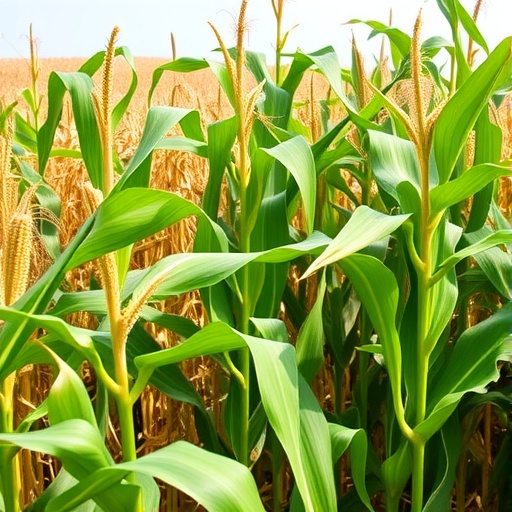
Title: The Transformative Shift in Carbon Sequestration Through Maize Residue in the US Corn Belt
In a groundbreaking study published in Commun Earth Environ, researchers from various institutions have unveiled crucial findings regarding carbon inputs from maize residue in the United States Corn Belt over the last four decades. The research highlights a significant increase in carbon inputs, a trend that has critical implications for climate change mitigation, soil health, and agricultural sustainability. The study, spearheaded by researchers Ruiz, Castellano, and Ferela, stands as a potential pivot in how agricultural practices can contribute positively to carbon sequestration outcomes.
Over the last 40 years, the agricultural landscape of the US Corn Belt has undergone dramatic transformations. These modifications have been driven by advances in farming technology, crop genetics, and management practices. The study showcases that from 1980 to 2020, there has been a substantial uptick in the amount of maize residue returned to the soil, illustrating a profound shift toward more sustainable farming techniques. The implications of this transition extend well beyond mere agricultural productivity; they carry significant weight in the realm of environmental science and climate policy.
The researchers employed a comprehensive dataset, analyzing regional practices across the Corn Belt, which is known for being one of the most productive corn-growing areas globally. This region, comprising parts of several Midwestern states, has witnessed a rise in awareness about the critical role of soil health in agricultural sustainability. As farmers increasingly recognize the benefits of incorporating maize residue back into the soil, they are not only enriching their land but also fostering a significant carbon sink capable of combating climate change.
Maize, a crop central to the US agricultural economy, traditionally had its residues considered waste, often burned or left to decompose without specific management. However, this report indicates that as practices evolve, more farmers are retaining these residues as a soil amendment. The research finds that this one change can lead to considerably higher soil organic carbon levels, which play a crucial role in enhancing soil fertility and water retention, ultimately leading to more resilient agricultural systems.
One of the most striking elements of the study is its revelation of how these shifts in residue management correlate with broader climate goals. The quantitative analysis showcases that adopting practices that enhance carbon inputs from maize residues can yield measurable reductions in greenhouse gas emissions. This finding should intrigue policymakers and environmental advocates, as it offers a tangible method through which agricultural dynamics can contribute to climate resilience.
Moreover, the implications extend to agricultural economics too. In adopting these new practices, farmers may find enhanced productivity and profitability. By enriching the soil with organic materials, they not only improve their yield potential but also reduce the need for synthetic fertilizers. This dual benefit proves that ecological logic can dovetail with economic incentives, marking a promising path for the agricultural sector.
The researchers faced significant challenges in evaluating the overall trends of maize residue inputs across the vast US Corn Belt. They tackled this by synthesizing data from multiple sources and employing advanced modeling techniques that provide a broader regional overview. Their methodology involved an in-depth examination of agricultural practices and farmer surveys, offering a well-rounded perspective on the implications of these transformations.
Climate scientists have long argued that increasing soil carbon sequestration is critical for mitigating climate change impacts. The reported findings underscore that maize residues serve as a vital tool given their established role in carbon cycling within agricultural landscapes. By enhancing microbial activity and promoting humification processes, the residues significantly contribute to the organic matter pool essential for healthy soils.
The nutritional content of maize residues is noted to affect the rate of decomposition, subsequently influencing carbon retention in soils. This study highlights that managing maize residues smartly can help ensure that agricultural land remains productive while simultaneously contributing to climate solutions. The ongoing transition towards a more regenerative agricultural model shines through as a central theme, one whereby both the environment and agribusiness can simultaneously thrive.
As this study emphasizes the importance of maize residue, it also brings to light the challenge of balancing short-term agricultural needs with long-term sustainability goals. Farmers are often pressed for immediate results, and shifting toward practices that require long-term commitment may seem daunting. However, this research breaks down those barriers, outlining how sustainable farming can align with economic viability, thus paving a balanced path forward.
Furthermore, engagement with farming communities plays a vital role in the successful adoption of sustainable practices. Education campaigns highlighting the benefits of returning maize residues to the soil could catalyze the adoption of these critical practices. The study recommends collaborative efforts between researchers, policymakers, and farmers to design educational programs that truly resonate within these communities, creating a pull for practical environmental stewardship.
Peer-reviewed journals, like Commun Earth Environ, play an instrumental role in disseminating solid scientific findings. The groundbreaking nature of this study is not only in its results but also in how it catalogues agricultural evolution as a response to climate imperatives. These evolving narratives are critical as they dynamically illustrate that agriculture can be part of the solution to the climate crisis, rather than merely a contributor to the problem.
Ultimately, the work of Ruiz, Castellano, and Ferela is more than just an academic exercise. It speaks to a vision of a future where agricultural innovation meets ecological responsibility. As more farmers embrace the return of maize residues to their fields, we could witness an agricultural renaissance, one defined by a sustainable balance of productivity, soil health, and environmental stewardship that could redefine our relationship with agriculture.
As the world continues to grapple with the pressing challenges of climate change, the findings of this study highlight an essential path forward. By harnessing the potential inherent in maize residues, the agricultural community can foster a robust climate action plan that utilizes the land as a powerful ally in the pursuit of a sustainable future. This approach exemplifies the kind of integrative thinking required to tackle the multifaceted challenges of our time, and the research stands as a beacon of hope for sustainable agriculture in the face of environmental uncertainty.
Subject of Research: Carbon inputs from maize residue in the US Corn Belt
Article Title: Large increases in maize residue carbon inputs in the US Corn Belt from 1980 to 2020
Article References:
Ruiz, A., Castellano, M.J., Ferela, A. et al. Large increases in maize residue carbon inputs in the US Corn Belt from 1980 to 2020.
Commun Earth Environ (2025). https://doi.org/10.1038/s43247-025-03078-3
Image Credits: AI Generated
DOI:
Keywords: Carbon Sequestration, Maize Residue, Agriculture, Climate Change, Soil Health, Sustainability.


