Friday, October 30, 2026
Science
No Result
View All Result
  • Login
  • HOME
  • SCIENCE NEWS
  • CONTACT US
  • HOME
  • SCIENCE NEWS
  • CONTACT US
No Result
View All Result
Scienmag
No Result
View All Result
Home Science News Chemistry

Magnetic heating keeps carbon from clogging CO2 electroreduction catalysts

October 28, 2026
in Chemistry
Bethany Barker
By Bethany Barker Scienmag Editorial Profile - Catalysis
Reading Time: 2 mins read
0
Magnetic heating keeps carbon from clogging CO2 electroreduction catalysts

Magnetic heating keeps carbon from clogging CO2 electroreduction catalysts

65
SHARES
587
VIEWS
Share on FacebookShare on Twitter
ADVERTISEMENT

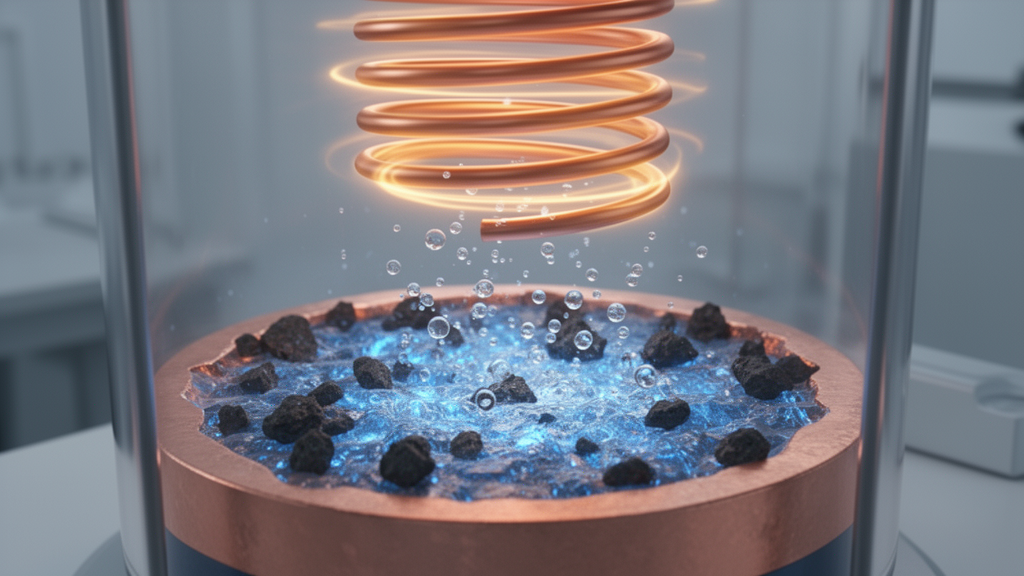
Carbonate build-up is one of the quiet killers of carbon dioxide electroreduction systems. As CO2 is converted at the cathode, local alkalinity drives the formation of carbonate and bicarbonate deposits that choke efficiency and shorten device lifetimes. A study published in Nature Catalysis on 22 October 2026 reports a way to fight back: applying an external alternating magnetic field that heats the catalyst surface locally, suppressing the precipitation before it starts.

The researchers, led by Wenda Zhou and Shouguo Wang, designed two ferromagnetic high-entropy alloys, CrMnNiZnPd and CrNiCuZnAg, synthesised through a nebulization-blast strategy. When placed under an alternating magnetic field, the confined alloys generate a localized heating field around the catalyst. According to the abstract, this heating reduces the build-up of hydroxide ions and increases the solubility of carbonate and bicarbonate species at the catalyst-electrolyte interface, thereby inhibiting precipitation.

The performance gains were substantial. In potassium bicarbonate electrolyte, the CrMnNiZnPd catalyst showed superior activity towards single-carbon products under the magnetic field, while CrNiCuZnAg favoured multicarbon products, both compared with operation without the field. Crucially, both systems ran stably for more than 200 hours, a durability benchmark that matters enormously for any prospective industrial deployment of CO2 electroreduction.

What makes the result potentially significant is its generality. The improved performance and durability persisted not only in alkaline potassium hydroxide but also in non-buffered potassium chloride electrolytes, suggesting the magnetic heating strategy works across different electrolyte chemistries rather than being an artefact of one particular system.

The authors frame alternating-magnetic-field-induced local heating as an effective tool for regulating the interfacial reaction microenvironment, with potential for mitigating carbonate-related limitations in CO2 electroreduction.

Subject of Research: Using alternating magnetic field-induced local heating in ferromagnetic high-entropy alloys to suppress carbonate formation in CO2 electroreduction

Article Title: Inducing local heating fields in ferromagnetic high-entropy alloys to inhibit (bi)carbonate formation for durable CO2 electroreduction

Article References: Zhou, W., Yuan, C., Luo, X., Chen, M., Zhang, J., Liu, S., Lei, W., & Wang, S. (2026). Inducing local heating fields in ferromagnetic high-entropy alloys to inhibit (bi)carbonate formation for durable CO2 electroreduction. Nature Catalysis, 9(10), 1158-1168. https://doi.org/10.1038/s41929-026-01619-3

Image Credits: AI Generated

DOI: 10.1038/s41929-026-01619-3

Keywords: CO2 electroreduction, carbonate precipitation, high-entropy alloys, alternating magnetic field, local heating, electrocatalysis, catalyst durability, interfacial microenvironment, Nature Catalysis, Inducing, local, heating

Cite Scienmag News

Bethany Barker. (October 28, 2026). Magnetic heating keeps carbon from clogging CO2 electroreduction catalysts. Scienmag. https://scienmag.com/magnetic-heating-keeps-carbon-from-clogging-co2-electroreduction-catalysts/

Bethany Barker. "Magnetic heating keeps carbon from clogging CO2 electroreduction catalysts." Scienmag, 28 October 2026, https://scienmag.com/magnetic-heating-keeps-carbon-from-clogging-co2-electroreduction-catalysts/. Accessed 30 October 2026.

Bethany Barker. "Magnetic heating keeps carbon from clogging CO2 electroreduction catalysts." Scienmag. October 28, 2026. https://scienmag.com/magnetic-heating-keeps-carbon-from-clogging-co2-electroreduction-catalysts/
Tags: advancedalternating magnetic fieldcarbonate build-up prevention in CO2 reductioncarbonate precipitationcatalyst durabilityCO2 electroreductionCO2 electroreduction catalyst protectionElectrocatalysiselectrolyte interface management in CO2 reductionenhancing catalyst durability with magnetic fieldsferromagnetic high-entropy alloys for catalysisheatinghigh entropy alloysinducingindustrial applications of magnetic heating in electrolysisinterfacial microenvironmentLocallocal heatinglocal heating effects in electrochemical systemsmagnetic field heating in electrolysismulti-carbon product selectivity in CO2 electroreductionNature Catalysisstability of CO2 reduction catalysts over 200 hourssuppression of carbonate precipitation during CO2 conversion
Share26Tweet16
Previous Post

AI-edited green space images reveal how design elements shape human impressions

Next Post

Fuzzy GIS mapping reveals where rainwater harvesting can work in Khyber Pakhtunkhwa under a drier future

Related Posts

Gut bacterium Blautia sp. MRG-PMF1 cleaves bulkier isoflavone ether bonds
Chemistry

Gut bacterium Blautia sp. MRG-PMF1 cleaves bulkier isoflavone ether bonds

October 30, 2026
Fluorine–silicon acrylate sizing agent boosts specialty paper strength and water resistance
Chemistry

Fluorine–silicon acrylate sizing agent boosts specialty paper strength and water resistance

October 30, 2026
Filamentous fungi reshape kombu chemistry and aroma in solid-state fermentation study
Chemistry

Filamentous fungi reshape kombu chemistry and aroma in solid-state fermentation study

October 30, 2026
Microbes That Mine: Bacteria Take On Metal Recovery and Surface Engineering
Chemistry

Microbes That Mine: Bacteria Take On Metal Recovery and Surface Engineering

October 30, 2026
Two-dimensional ferroelectric TlGaS2 shows dual polarization behavior
Chemistry

Two-dimensional ferroelectric TlGaS2 shows dual polarization behavior

October 30, 2026
Enzyme-Graphene Hybrids Forge Metal Nanoparticles for Greener Carbon-Carbon Bond Building
Chemistry

Enzyme-Graphene Hybrids Forge Metal Nanoparticles for Greener Carbon-Carbon Bond Building

October 30, 2026
Next Post
Fuzzy GIS mapping reveals where rainwater harvesting can work in Khyber Pakhtunkhwa under a drier future

Fuzzy GIS mapping reveals where rainwater harvesting can work in Khyber Pakhtunkhwa under a drier future

  • Mothers who receive childcare support from maternal grandparents show more optimized

    Mothers who receive childcare support from maternal grandparents show more parental warmth, finds NTU Singapore study

    27656 shares
    Share 11059 Tweet 6912
  • University of Seville Breaks 120-Year-Old Mystery, Revises a Key Einstein Concept

    1061 shares
    Share 424 Tweet 265
  • Bee body mass, pathogens and local climate influence heat tolerance

    682 shares
    Share 273 Tweet 171
  • Researchers record first-ever images and data of a shark experiencing a boat strike

    546 shares
    Share 218 Tweet 137
  • Groundbreaking Clinical Trial Reveals Lubiprostone Enhances Kidney Function

    531 shares
    Share 212 Tweet 133
Science

Embark on a thrilling journey of discovery with Scienmag.com—your ultimate source for cutting-edge breakthroughs. Immerse yourself in a world where curiosity knows no limits and tomorrow’s possibilities become today’s reality!

RECENT NEWS

  • European farmers split on agroforestry as policy support proves decisive
  • FLASH radiotherapy spares healthy astrocytes while stressing glioma cells
  • Five bacterial species flag bacterial vaginosis in sequencing-based diagnostic test
  • French Insurance Records Cast Doubt on Many Wilson’s Disease Diagnoses

Categories

  • Agriculture
  • Anthropology
  • Archaeology
  • Athmospheric
  • Biology
  • Biotechnology
  • Blog
  • Bussines
  • Cancer
  • Chemistry
  • Climate
  • Earth Science
  • Editorial Policy
  • Marine
  • Mathematics
  • Medicine
  • Pediatry
  • Policy
  • Psychology & Psychiatry
  • Science Education
  • Science News
  • Social Science
  • Space
  • Technology and Engineering

Subscribe to Blog via Email

Enter your email address to subscribe to this blog and receive notifications of new posts by email.

Join 5,151 other subscribers

© 2025 Scienmag - Science Magazine

Welcome Back!

Login to your account below

Forgotten Password?

Retrieve your password

Please enter your username or email address to reset your password.

Log In
No Result
View All Result
  • HOME
  • SCIENCE NEWS
  • CONTACT US

© 2025 Scienmag - Science Magazine

Discover more from Science

Subscribe now to keep reading and get access to the full archive.

Continue reading