


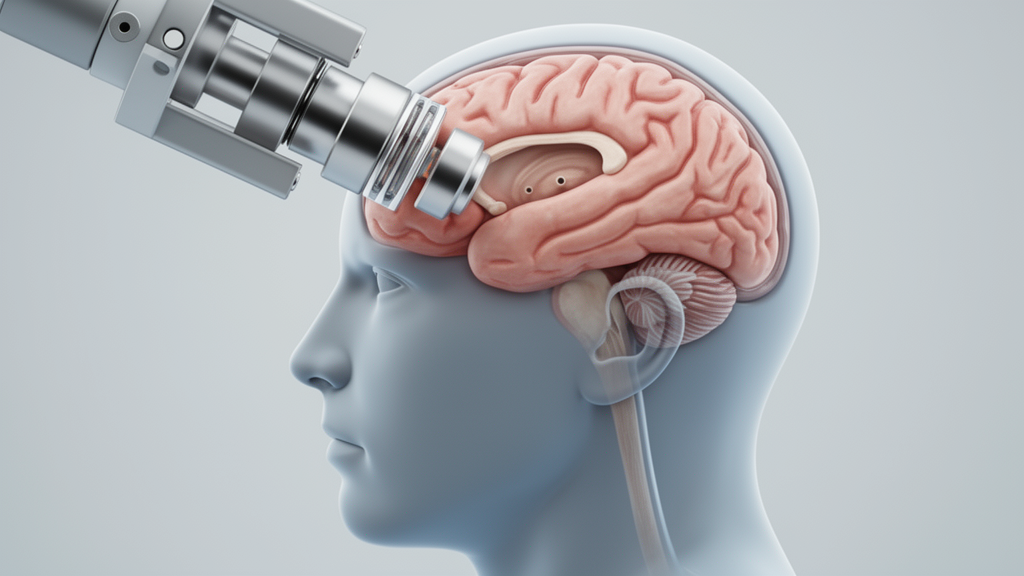
A single session of transcranial static magnetic stimulation (tSMS) applied over the visual cortex did not produce measurable changes in dynamic stability or static postural control in people with recurrent lateral ankle sprains, according to a randomized, double-blind, placebo-controlled trial conducted at Ritsumeikan University in Japan and published in Frontiers in Sports and Active Living. The study, led by Masafumi Terada and colleagues, enrolled 40 participants and randomly assigned them to receive either 30 minutes of real magnetic stimulation or an identical-looking sham treatment, then tested their balance before and after the intervention. The null result cuts against a growing body of neuroimaging work suggesting that people with chronically unstable ankles lean unusually heavily on visual information to stay upright.
The rationale behind the trial rests on a striking observation from earlier research: individuals with chronic ankle instability, the pathological condition characterized by repeated lateral ankle sprains and episodes of the ankle giving way, show increased activation in the prefrontal and visual cortices even during simple motor tasks. That pattern hints at a shift away from automatic, somatosensory-based control toward a more visually guided motor strategy, potentially a maladaptive neuroplastic response to injury that makes sensorimotor integration inefficient. Because recurrent lateral ankle sprains are recognized as a clinically relevant component of the chronic ankle instability continuum, the researchers reasoned that similar cortical alterations might be present in their participants and that temporarily dampening the visual cortex could reveal how much their balance depends on sight.
Transcranial static magnetic stimulation is one of the simpler tools in the non-invasive brain stimulation arsenal. Rather than passing current through the skull, it places a powerful neodymium magnet directly on the scalp, and the static magnetic field reduces neural excitability in the underlying cortical region. Previous studies have shown that ten minutes of tSMS over the visual cortex increases occipital alpha activity, a signature of reduced cortical excitability, and slows visual search performance, with thirty-minute applications expected to produce stronger and longer-lasting suppression. In this trial, a nickel-plated cylindrical magnet measuring 50 millimeters across and 30 millimeters thick, with a surface magnetic flux density of roughly 5,340 gauss, was secured over the Oz position of the 10-20 electroencephalography system using an arm-type light stand, while the sham group received a non-magnetic stainless-steel cylinder of identical size, mass, and appearance.
The participant pool was carefully characterized. All 40 volunteers had sustained at least two lateral ankle sprains severe enough to cause swelling, pain, and temporary loss of function for at least one day, with an average of roughly four previous sprains per person. Recruitment did not require participants to meet full chronic ankle instability criteria, including self-reported giving-way episodes, though the investigators administered the Identification of Functional Ankle Instability and Cumberland Ankle Instability Tool questionnaires to describe instability levels. Randomization was stratified by sex, age, number of previous sprains, and self-reported instability, and allocation was concealed in sequentially numbered opaque sealed envelopes. Both the participants and the single investigator collecting and analyzing data were blinded, and at study’s end most participants could not guess their group, with no statistically significant association between guesses and actual allocation.
Dynamic stability was assessed with a unilateral drop landing task: participants jumped off a 31-centimeter box onto a force platform with a single leg, arms folded across the chest, and then held the landing for eight seconds while staring at a distant target. The key metric was time to stabilization, calculated from ground reaction force data sampled at 1,000 hertz, using an unbounded third-order polynomial fitted to the force record to find when post-landing force fluctuations fell within a normalized range of variation. Static postural control was measured with the Clinical Test of Sensory Interaction and Balance, which combines eyes-open, eyes-closed, and visual-conflict conditions with firm and foam surfaces during single-leg stance, yielding condition scores, a composite score, and derived somatosensory, visual, vestibular, and preference ratios.
The results were unambiguous on the primary comparison. No significant group-by-time interactions emerged for time to stabilization in either the anteroposterior or mediolateral directions, and none appeared for any CTSIB outcome. Between-group differences in change scores had 95 percent confidence intervals that overlapped zero, with small to medium effect sizes throughout. Sensitivity analyses using linear mixed-effects models produced identical conclusions. The trial did register significant time main effects for several CTSIB conditions and ratios, meaning both groups improved from pre-test to post-test, but the authors attribute this to learning, familiarization, or repeated-testing effects rather than the stimulation itself. Significant group main effects for Condition 4 and the visual ratio were interpreted cautiously, as exploratory analyses occurred without multiplicity adjustment and could reflect chance findings.
The authors are forthright about the study’s central limitation: they never directly measured visual cortical activity or excitability, so target engagement could not be verified. Because no electroencephalographic or behavioral measures of visual function were collected after stimulation, it remains unclear whether the tSMS protocol actually modulated the visual cortex in these participants. The absence of measurable balance changes could therefore mean either that any cortical modulation achieved was insufficient to alter postural control, or that the protocol failed to achieve sufficient target engagement at all. Other limitations compound the uncertainty: no healthy control group was included, balance was not tested during stimulation, the interval between stimulation and each assessment was not recorded, the study was powered to detect only medium effects and may have missed smaller acute changes, and the blinding integrity of the outcome assessor was not formally evaluated.
Individual variability offers another possible explanation for the null finding. People with recurrent ankle sprains present heterogeneous combinations of pathomechanical, sensory-perceptual, and motor-behavioral impairments, and visually guided motor behavior may not have been a significant factor for every participant. Prior neuromodulation research shows that responses to the same protocol can split almost evenly between individuals, with differences possibly tied to baseline cortical excitability. There is also a ceiling effect to consider: scores on several CTSIB conditions, particularly the easier conditions one through four, approached the 30-second maximum, reducing the test’s sensitivity to intervention-related changes. And a single session may simply have been too little; although one tSMS session can modulate cortical excitability and behavior, repeated sessions generally produce more stable and longer-lasting neural and behavioral effects.
The null result also fits a broader picture in which neuromodulation for ankle instability has struggled to deliver consistent behavioral gains. Transcranial direct current stimulation studies in chronic ankle instability have yielded inconsistent findings, and a four-week program combining anodal stimulation over the motor cortex with progressive balance training provided no additional benefit over sham stimulation for static postural control, neural excitability, or self-reported ankle function. Recent evidence further suggests that the effects of stimulation may depend critically on the exercise modality performed during application, pointing future researchers toward task-specific paired interventions rather than stimulation alone.
For now, the trial’s conclusion is deliberately narrow: under these specific experimental conditions, one 30-minute tSMS session over the visual cortex did not alter dynamic stability, static postural control, or sensory organization strategies in people with recurrent lateral ankle sprains, but the finding should not be read as evidence that modulating visual cortical excitability is irrelevant to balance. The authors call for future work incorporating direct neurophysiological and behavioral measures of visual function to confirm target engagement, more comprehensive baseline characterization of cortical excitability and sensorimotor strategies, and designs that test stimulation during or immediately after performance of balance tasks. Until such studies clarify whether the visual cortex can be meaningfully enlisted in ankle rehabilitation, the promise of magnetically reweighting the injured brain’s reliance on sight remains unproven.
Subject of Research: Effects of visual cortex transcranial static magnetic stimulation on postural control in recurrent lateral ankle sprains
Article Title: A single session of transcranial static magnetic stimulation placed over the visual cortex was not associated with measurable changes in dynamic stability or static postural control in individuals with recurrent lateral ankle sprains: a randomized double-blind placebo-controlled trial
Article References: Nonoyama, S., Shimozawa, Y., Mima, T., Isaka, T., & Terada, M. (2026). A single session of transcranial static magnetic stimulation placed over the visual cortex was not associated with measurable changes in dynamic stability or static postural control in individuals with recurrent lateral ankle sprains: a randomized double-blind placebo-controlled trial. Frontiers in Sports and Active Living, 8, Article 1918375. https://doi.org/10.3389/fspor.2026.1918375
Image Credits: AI Generated
DOI: 10.3389/fspor.2026.1918375
Keywords: transcranial static magnetic stimulation, visual cortex, lateral ankle sprain, postural control, dynamic stability, sensory reweighting, neuromodulation, chronic ankle instability, randomized controlled trial, balance, single, session
Cite Scienmag News
Colin Clarke. (October 24, 2026). Magnet Over the Visual Cortex Fails to Shift Balance in People With Recurrent Ankle Sprains. Scienmag. https://scienmag.com/magnet-over-the-visual-cortex-fails-to-shift-balance-in-people-with-recurrent-ankle-sprains/
Colin Clarke. "Magnet Over the Visual Cortex Fails to Shift Balance in People With Recurrent Ankle Sprains." Scienmag, 24 October 2026, https://scienmag.com/magnet-over-the-visual-cortex-fails-to-shift-balance-in-people-with-recurrent-ankle-sprains/. Accessed 24 October 2026.
Colin Clarke. "Magnet Over the Visual Cortex Fails to Shift Balance in People With Recurrent Ankle Sprains." Scienmag. October 24, 2026. https://scienmag.com/magnet-over-the-visual-cortex-fails-to-shift-balance-in-people-with-recurrent-ankle-sprains/


