

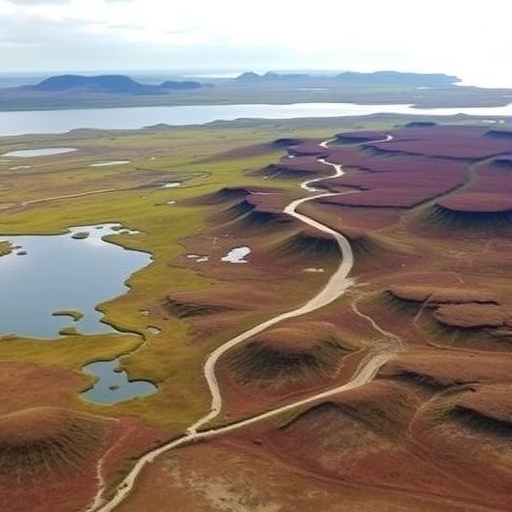
Eastern Canada’s eastern maritime regions have experienced a noticeable intensification in hurricane and near-hurricane strength storms over recent decades, with events like Hurricane Juan in 2003, Dorian in 2019, and Fiona in 2022 underscoring a pattern of rising storm severity. While the present-day upsurge in intense storm activity might appear unprecedented, new research from Concordia University reveals that such periods of heightened storm frequency are not without historical precedent. This groundbreaking study offers a window into the last 4,000 years of storm dynamics in the northwestern Atlantic, shedding light on the complex interplay between climate fluctuations and hurricane behavior in high-latitude zones.
The researchers deployed an innovative methodology centered on geochemical analysis of peat bog samples from the Magdalen Islands situated in the Gulf of Saint Lawrence. Peatlands, by their nature, accumulate layered deposits of organic material over time, serving as high-resolution natural archives that chronicle past environmental conditions. Unlike traditional sediment records from coastal areas, which often lack the temporal resolution required for precise storm reconstruction, peatlands capture fine-scale information about atmospheric inputs, including mineral particles transported by powerful storm winds. This allows scientists to track storm activity with unprecedented detail through time.
Lead author Antoine Lachance, a PhD candidate at Concordia’s Climatology, Hydrology and Paleo-Environmental Laboratory, emphasized the importance of these insights for understanding the long-term impact of storms on this vulnerable region. The Magdalen Islands have suffered marked erosion exacerbated by increasing storm frequency, yet before this study, very little was known about the historical context or drivers of these destructive events. Investigating peat cores from two specific bogs on Havre-Aubert Island, the team detected subtle but significant fluctuations in sand content and key elemental signatures indicative of intense wind events. Because these peatlands are primarily nourished by precipitation and atmospheric deposition, any spikes in mineral matter directly point to episodic strong storm influence.
The study uncovered three distinct epochs, spanning several centuries each, during which storminess peaked significantly. These intervals roughly correspond to 800–550 BCE, 500–750 CE, and 1300–1700 CE, the latter coinciding with the well-documented Little Ice Age. Conversely, the Medieval Climate Anomaly (approximately 900–1300 CE), a relatively warmer climatic phase, showed marked decreases in recorded storm frequency. This temporal pattern mirrors findings from other regional storm archives across eastern Canada, the northeastern United States, and the Bahamas, suggesting these were far-reaching basin-wide phenomena rather than localized events isolated to the Magdalen Islands.
Crucially, the study highlights that northern region storm patterns do not always strictly parallel the behavior of tropical hurricanes formed further south. Instead, regional climate factors like sea surface temperatures and atmospheric pressure gradients appear to modulate how storms evolve as they travel northward and transition into post-tropical systems. During colder periods, the temperature differentials between tropical and polar air masses steepen, intensifying large-scale atmospheric circulation patterns that channel storms into higher latitudes. This dynamic partly explains why the Little Ice Age saw increased storm activity in Atlantic Canada despite lower hurricane incidence in tropical zones.
This nuanced understanding of paleo-storm activity emphasizes that shifts in climate regime yield complex, regionally differentiated impacts on hurricane frequency and intensity. The study’s approach—leveraging peat bog geochemical records—provides a novel lens to assess storm dynamics based on wind strength signatures inland rather than solely flood or surge records along coastlines. This is a significant advance in the field because it enables a more comprehensive reconstruction of storm events throughout time, capturing effects that previous methods might have missed.
While the findings offer clarity on how natural climate variability has historically influenced storm patterns, predicting future trends remains inherently challenging due to modern anthropogenic climate change pressures. The researchers caution that warming-driven sea level rise, loss of sea ice in the Gulf of Saint Lawrence, and alterations in wind and wave dynamics will likely amplify the impacts of even moderate storms. Rising baseline conditions mean smaller cyclonic disturbances may now inflict considerably greater damage than in the past, raising urgent questions about resilience and adaptation for coastal communities.
This paleoenvironmental study was co-authored by Associate Professor Jeannine-Marie St-Jacques alongside Matthew Peros of Bishop’s University, Pierre Francus from l’Institut National de la Recherche Scientifique, and Nicole Sanderson at UQAM, all affiliated with Geotop, the Research Centre in Earth System Dynamics. Their collaborative work underscores the interdisciplinary nature of climate reconstruction efforts, fusing geochemistry, climatology, and environmental science to unravel multi-millennial ecological narratives.
Financial support for this research came from the Natural Sciences and Engineering Research Council of Canada and the Fonds de recherche du Québec, reinforcing the vital role of funding agencies in advancing long-term climate research. Their investment enables detailed paleo-storm reconstructions that contribute to global efforts to contextualize current weather extremes within the broader tapestry of Earth’s climatic history.
By situating recent storm intensification within a longer-term framework, this study offers critical insights for scientists, policymakers, and the public alike. It emphasizes that while storm surges and hurricanes have periodically tested eastern Canada across millennia, the accelerating influence of human-driven climate change could trigger unprecedented risks. Continued interdisciplinary research and enhanced monitoring of peatlands and other environmental archives will be key to refining models of hurricane trajectories, intensities, and impacts in a warming world.
Subject of Research: Not applicable
Article Title: High-resolution paleo-storm reconstructions from Eastern Canada align with late Holocene northwestern Atlantic hurricane records
News Publication Date: 25-Nov-2025
Web References: https://cp.copernicus.org/articles/21/2407/2025/
References: Lachance, A., St-Jacques, J.-M., Peros, M., Francus, P., & Sanderson, N. (2025). High-resolution paleo-storm reconstruction from Eastern Canada align with late Holocene northwestern Atlantic hurricane records. Climate of the Past, 21, 2407–2425. https://doi.org/10.5194/cp-21-2407-2025
Image Credits: Concordia University
Keywords: Physical sciences, Earth sciences, Climatology, Climate change, Range shifts, Storms, Hurricanes


