


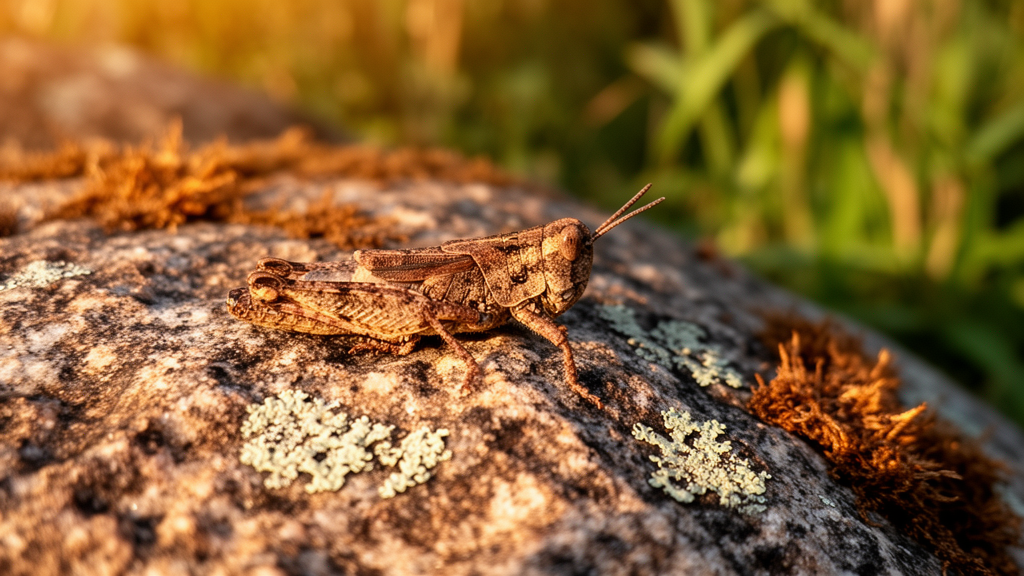
Deep in the canyons of Madagascar, a small striped grasshopper has been living a double life. For more than a century, entomologists catalogued it under two different names, unaware that the boulder-dwelling pygmy grasshopper they studied in 1939 was the very same species that a Swiss naturalist had described from the island of Nosy Be back in 1899. A new taxonomic revision, published in the Journal of Orthoptera Research, has now untangled this long-standing confusion, showing that the Madagascar boulder pygmy grasshopper, formerly known as Pseudosystolederus sikorai, is in fact the senior species Paratettix voeltzkowiana, described by Henri de Saussure more than a hundred years earlier. The finding reshuffles a branch of the grasshopper family tree and gives one of Madagascar’s most distinctive river-dependent insects its rightful, and oldest, scientific identity.
The story begins with Alfred Voeltzkow, a German zoologist who collected a series of small grasshoppers on Nosy Be, an island off Madagascar’s northwest coast, in the late nineteenth century. Saussure, one of the most celebrated entomologists of his era, named the species after its collector in 1899. And then, remarkably, the species vanished from the scientific record. It was never reported again, and its identity became one of the quiet mysteries of Malagasy orthopterology. Decades later, in 1939, the German taxonomist Günther described a new boulder-dwelling grasshopper from Madagascar and named it Pseudosystolederus sikorai, after the collector Sikora. Günther himself suspected that Saussure’s older name might turn out to be a synonym of his new species, or of another Malagasy grasshopper, but he could not confirm it at the time.
The suspicion lingered for generations. Günther revisited the question in 1959 and again in 1974, each time noting that the correct attribution remained incomplete. Later revisions by the Belgian specialist Devriese clarified that two other Malagasy species, Pseudosystolederus sikorai and Morphopoides madagascariense, were distinct from each other, narrowing the possibilities. But without a direct comparison of the original type specimens, the true identity of Saussure’s Paratettix voeltzkowiana remained unresolved. The new study, led by Josip Skejo and colleagues, finally closed the case by tracking down and examining the scattered type specimens across museum collections in Europe.
The detective work was considerable. The syntypes of Saussure’s species, the original specimens on which the description was based, turned out to be distributed across three museums in three countries: the Natural History Museum of Geneva in Switzerland, the National Museum of Natural Sciences in Madrid, and the Senckenberg Research Institute in Frankfurt, Germany. The syntypes of Günther’s Pseudosystolederus sikorai were even more dispersed, spread across six museums in six countries, including institutions in London, Stockholm, Vienna, Dresden, Paris, and Geneva. The researchers located, photographed, and measured specimens from all of these collections, comparing their morphology in detail.
The comparison focused on a suite of diagnostic characters. Both species share a large tooth on the ventral margin of the mid femur, a trait that sets the Madagascar boulder pygmy grasshopper apart from all its relatives. Both have striped, prominent compound eyes, black filiform antennae with pale joints between the segments, a very narrow vertex, a very narrow scutellum, a short and depressed prozona with short prozonal carinae, relatively large tegmenula, and a small depression in the metazona at the level of the tip of the tegmenula. Both have a long pronotum and long black hindwings that usually surpass the pronotal apex, a form known as pauropronotal. The match was complete across every character examined.
To make the case quantitative, the team took eleven measurements on each specimen, covering body length, pronotum length and width, pronotum height, tegmenula dimensions, wing length, vertex width, eye width, and hind femur length and width. They then ran a principal components analysis to test whether the two species would group together or stay separate. The result was unambiguous: the syntypes of both species formed a single cluster, with no morphometric difference between them. Within the species, the only separation was between the sexes, as females, with body lengths ranging from roughly 13.8 to 16.3 millimeters, are considerably larger than males, which measure between about 11.4 and 13.0 millimeters. Crucially, Saussure’s specimens did not group with Morphopoides madagascariense, ruling out the alternative hypothesis that had also been floated.
Under the rules of zoological nomenclature governed by the International Commission on Zoological Nomenclature, the principle of priority applies: the oldest available name for a species takes precedence. Because Saussure described Paratettix voeltzkowiana in 1899, forty years before Günther described Pseudosystolederus sikorai, the older name wins. The species is now formally known as Pseudosystolederus voeltzkowianus, a new combination that merges the two names. The researchers considered whether the rules for reversing precedence might apply, which would allow the junior name to be retained if it had been widely used in the literature. But the criteria were not met: Pseudosystolederus sikorai had been mentioned in only five works by nine authors during the last fifty years, far short of the threshold of twenty-five works by at least ten authors.
The Madagascar boulder pygmy grasshopper is a strictly river-dependent species, found on and around large boulders that line Malagasy rivers and springs. It occurs in all three of the island’s main biogeographical regions: the dry west, the mountainous center, and the humid east. In the dry region, it lives alongside Morphopoides madagascariense; in the central mountains, it shares its habitat with Paratettix scaber and Paratettix cinereus; and in the rainforest, it can be found with Pseudosystolederus follvikae and other forest species that venture to the water’s edge. Fieldwork by the authors in Ranomafana National Park in 2019 and Isalo National Park in 2024, combined with records from citizen-science platforms such as iNaturalist, has produced a much richer picture of the species’ distribution than was previously available.
The species is a good flyer and cannot easily be caught without an entomological net. The best method for recording it, the researchers note, is a visual search next to large water bodies surrounded by boulders, combined with photography. New observations from the Namaza Canyon in Isalo National Park, the Ranomafana Canyon, the Tsaranoro Reserve, and sites across Alaotra-Mangoro, Menabe, and Anosy regions confirm that the species is relatively common wherever suitable boulder-lined rivers exist. The annotated distribution map now spans the island, from Nosy Be in the northwest to sites in the far south and east.
Beyond the synonymy itself, the revision raises deeper questions about the evolution of narrow-vertex pygmy grasshoppers. The genus Pseudosystolederus is most similar to African Afrosystolederus, American Teredorus, Asian Systolederus, and New Caledonian Kanakacris, but it remains unclear whether these similarities reflect a shared ancestry or independent origins of a narrow head shape driven by similar ecological niches. The researchers argue that only a taxon-rich molecular phylogeny of the family Tetrigidae can resolve whether these genera form a monophyletic group within the Xistrella lineage. The genus Morphopoides, which sits at the boundary between several major lineages, is a particular puzzle. The team also moved Morphopoides lesnei back to its original genus, based on characters of the hind tarsal pulvilli and the mid femora. As molecular revisions of the subfamily Tetriginae progress, cases like this one, where museum specimens, fieldwork, and morphometrics converge to correct a century-old error, will continue to reshape our understanding of how Madagascar’s extraordinary grasshopper diversity came to be.
Subject of Research: Malagasy Pseudosystolederus sikorai Günther is Paratettix voeltzkowiana Saussure (Orthoptera, Tetrigidae)
Article Title: Malagasy Pseudosystolederus sikorai Günther is Paratettix voeltzkowiana Saussure ( Orthoptera , Tetrigidae )
Article References: Skejo, J., Vincek, N., Černila, M., Ramarolahy, F., & Kasalo, N. (2026). Malagasy Pseudosystolederus sikorai Günther is Paratettix voeltzkowiana Saussure (Orthoptera, Tetrigidae). Journal of Orthoptera Research, 35(1), 23-32. https://doi.org/10.3897/jor.35.140255
Image Credits: AI Generated
Keywords: Malagasy, Pseudosystolederus, sikorai, nther, Paratettix, voeltzkowiana, Saussure, Orthoptera, Tetrigidae, scientific research
Cite Scienmag News
Gavin Prescott. (October 17, 2026). Madagascar’s Boulder Pygmy Grasshopper Revealed as a 126-Year-Old Taxonomic Mystery Solved. Scienmag. https://scienmag.com/madagascars-boulder-pygmy-grasshopper-revealed-as-a-126-year-old-taxonomic-mystery-solved/
Gavin Prescott. "Madagascar’s Boulder Pygmy Grasshopper Revealed as a 126-Year-Old Taxonomic Mystery Solved." Scienmag, 17 October 2026, https://scienmag.com/madagascars-boulder-pygmy-grasshopper-revealed-as-a-126-year-old-taxonomic-mystery-solved/. Accessed 17 October 2026.
Gavin Prescott. "Madagascar’s Boulder Pygmy Grasshopper Revealed as a 126-Year-Old Taxonomic Mystery Solved." Scienmag. October 17, 2026. https://scienmag.com/madagascars-boulder-pygmy-grasshopper-revealed-as-a-126-year-old-taxonomic-mystery-solved/


