


A qualitative study published in BMC Global and Public Health reveals that long-term partnerships between Non-Governmental Organisations (NGOs) and local communities are essential for building resilience to cyclone-related crises in Madagascar. The research, conducted in the Ambanja district, identifies three specific pathways that enable communities to withstand and recover from repeated tropical cyclones and their subsequent flooding. The findings suggest that while communities possess significant adaptive capacity, their resilience is often limited to mere survival rather than thriving due to a predominance of short-term, externally designed interventions that fail to integrate local knowledge and social norms.
The study was motivated by the severe impact of climate change on Madagascar, where cyclones frequently cause floods, leading to a cascade of crises affecting health, wellbeing, and livelihoods. Rice production in the country has dropped by 75%, exacerbating malnutrition rates, with one in two children reported to be malnourished. These environmental shocks also increase the risk of infectious diseases, such as cholera, due to contaminated water sources and environmental degradation that favours disease vectors. In this context, the state is often unable or unwilling to provide adequate support, placing a critical burden on communities and non-state actors, particularly NGOs, to build resilience.
Researchers from the PArtnership for RESilience (PARES) Research Group and other institutions conducted this qualitative study in the Ambanja district, located in the North-West Region of Madagascar. The district was selected because of its high exposure to repeated cyclones, floods, and droughts. The study focused on five municipalities, with a total population of 37,784, composed mostly of fishers and farmers who depend on natural resources for their subsistence. Three NGOs were identified as “embedded” in the region, having worked there for several years to help communities cope with cyclone adverse events.
Data collection took place between May and September 2024, utilizing a realist-informed approach that focuses on Context, Mechanisms, and Outcome (CMO) configurations. The research team, consisting of the principal researcher, a coordinator, and three local assistants fluent in French and local languages, conducted 10 In-Depth Interviews (IDIs) with community members, 16 Key Informant Interviews (KIIs) with local leaders and NGO staff, and 5 Focus Group Discussions (FGDs) involving 42 participants. The participants included farmers, fishers, youth, women’s groups, and school teachers, ensuring a diverse representation of the community. The data were transcribed into French and then translated into English, with quality checks performed regularly to ensure accuracy.
The analysis identified three main pathways, or “facilitators of change,” that contribute to community resilience. The first pathway involves timely and trusted risk communication. Ambanja has a well-functioning early warning system managed by the National Office of Risk and Disaster Management (BNGRC). Information is communicated via phone, radio, and local village committees using a flag system with four different colours to indicate risk levels. This coordinated communication, supported by NGOs that provide training and materials, has been credited with saving lives, with community members reporting that no one has died due to cyclone passage since the programme started, except for those who ignored instructions.
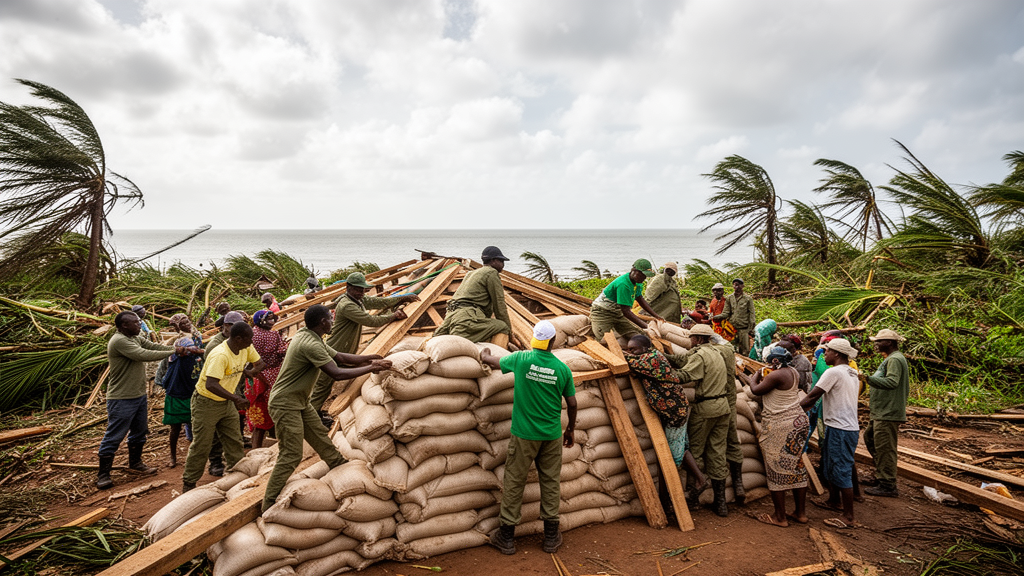
The second pathway highlights the role of embedded NGOs in building trust and long-term resilience. Unlike short-term organisations, embedded NGOs are present for many years and collaborate closely with communities. For example, one NGO supported the creation of community-based savings groups (GECs) that help members stock up on food before cyclones. Another NGO collaborated with locals on risk reduction interventions, such as planting Napier grass and trees, and placing sandbags on riverbanks. These long-term partnerships allow NGOs to understand local needs and provide sustained support, such as restoring mangrove forests, which community members reported helped protect their houses from wind during cyclones.
The third pathway emphasises the importance of local social capital, including local knowledge, labour, and solidarity networks. Communities in the study villages developed specific strategies to cope with flooding, such as building houses on stilts 1.5 to 2 metres high to remain above floodwaters. They also use traditional wooden boats to fetch food and firewood during floods and rely on cow-drawn carts to fetch water from neighbouring villages. These local practices represent vital resources that can be harnessed by stakeholders to design effective interventions. However, the study found that this social capital is often underutilised by external actors who do not consult community members about their insights and needs.
Two fundamental challenges were identified that systematically undermine resilience-building efforts. The most significant is the predominance of short-term partnerships, where most NGOs focus only on life-saving interventions during cyclone passage, ignoring longer-term crises such as flooding and environmental degradation. This limits resilience to survival rather than enabling communities to thrive. The second challenge is the failure to incorporate local knowledge, leading to wasted resources and non-sustainable interventions. A notable example was in Village B, where an NGO constructed water wells that were not flood-proof. These wells were repeatedly destroyed by cyclone-related floods, leaving the community without safe water and forcing them to use contaminated river or flood water, increasing the risk of enteric infectious diseases.
The study also noted that while communities have strong social solidarity, their ability to support each other is limited by material poverty. For instance, during severe flooding in Village C, neighbours used boats to bring food to trapped residents, but the food was often inadequate, leading to health issues. This highlights the need for external support to bolster existing social capital. The research team used the World Health Organisation’s Community Engagement and Involvement (CEI) framework to assess the level of engagement by stakeholders. They found that most NGOs operated at the “inform” level, merely communicating warnings, while embedded NGOs achieved higher levels of collaboration and empowerment, which are key to successful behaviour change and resilience building.
The findings suggest that NGOs should adopt a modus operandi that enables the systematic integration of local knowledge and community representation in planning and implementation. This includes ongoing monitoring in partnership with communities to identify areas requiring modification. For example, communities suggested modifying fishing closure policies to allow for small-scale fishing to meet food needs while retaining cyclone-protective mangroves. Additionally, NGOs should commit to long-term presence in communities, which requires a funding and policy environment that incentivises long-term commitments and responsiveness to community needs.
The study had several limitations, primarily due to the logistical challenges of conducting research in a large district with 24 municipalities. The sampling was limited to five municipalities, selecting one village per municipality, which may not be fully representative of the entire district. However, the selected villages were those most affected by cyclones, ensuring that the data reflected the experiences of the most vulnerable populations. Courtesy bias was mitigated by the fact that junior research assistants, who work at the district health office, had regular interactions with villagers, fostering open communication about negative experiences.
In conclusion, the study demonstrates that while communities in Ambanja possess considerable adaptive capacity and social solidarity, building sustained resilience requires sustained institutional commitment to longer-term engagement. The integration of existing community knowledge and networks is crucial, rather than relying on short-term, externally designed interventions. By addressing the challenges of short-termism and the neglect of local knowledge, stakeholders can help build resilient communities that are not only able to survive but also thrive in the face of recurrent cyclone-related crises.
Beyond residential housing adaptations, community members described precise daily routines and infrastructure constraints shaped by recurrent flooding. Field interviews revealed that villagers plan their schedules around predictable daily tidal floods, which routinely arrive between 14:00 and 17:00. Families ensure children are secured to prevent drowning and finish meals beforehand, as domestic chores cannot proceed once waters rise. In Village B, participants emphasized that sanitation infrastructure presents severe structural obstacles. Rather than building standard ground-level pit latrines that overflow and contaminate surroundings during inundations, residents explained that flood-resistant latrines must be elevated on long pillars to a height of two metres with dedicated stairs. However, constructing such elevated facilities requires cement, rebar, and specialised assistance that impoverished households cannot afford without dedicated external funding.
The long-term trajectory of protective infrastructure in Village D further demonstrates the precarious boundary between local agency and external continuity. In 2015, an NGO partnered with local residents to build a defence wall protecting communal rice fields against seawater incursions. The organisation supplied technicians and materials while villagers provided manual labour, alongside donated equipment such as fishing nets, wood-cutting machinery, and a rice husker whose proceeds supported collective community needs. Although this barrier successfully shielded agricultural land for five years, structural breaches emerged in 2020 after the initiating NGO had withdrawn. Lacking continued external technical assistance or resilient building supplies, villagers were forced to patch encroaching breaches by hand using raw mud, leaving their agricultural repairs vulnerable to being repeatedly washed away in subsequent storms.
To prevent recurring health crises following cyclone landfalls, the researchers emphasized integrating concrete water safety measures directly into disaster planning. While temporary emergency interventions such as portable filtration units can purify up to 10 litres of water per hour at contaminated wells, the authors noted that dependence on foreign donations fails to establish sustainable local resilience. Instead, actionable guidelines for boiling drinking water and protecting submerged water sources must be formally embedded into community-level warning systems.
Subject of Research: Qualitative study on NGO-community partnerships and cyclone resilience in Ambanja, Madagascar
Article Title: The role of embedded Non-Governmental Organisations and other stakeholders in building resilience to cyclone-related crises in Madagascar: a qualitative study
Article References: Sahani, M. K., Mohan, V., Singh, N. S., Seeley, J., PArtnership for RESilience (PARES) Research Group, & Mayhew, S. H. (2026). The role of embedded Non-Governmental Organisations and other stakeholders in building resilience to cyclone-related crises in Madagascar: a qualitative study. BMC Global and Public Health, 4(1), Article 66. https://doi.org/10.1186/s44263-026-00300-y
Image Credits: AI Generated
DOI: 10.1186/s44263-026-00300-y
Keywords: Madagascar, Cyclone Resilience, NGO Partnerships, Community Engagement, Climate Change, Public Health, Qualitative Research, Disaster Management, Social Capital, Ambanja District, role, embedded
Cite Scienmag News
Ophelia Keating. (November 10, 2026). Madagascar Study: Embedded NGOs Key to Cyclone Resilience. Scienmag. https://scienmag.com/madagascar-study-embedded-ngos-key-to-cyclone-resilience/
Ophelia Keating. "Madagascar Study: Embedded NGOs Key to Cyclone Resilience." Scienmag, 10 November 2026, https://scienmag.com/madagascar-study-embedded-ngos-key-to-cyclone-resilience/. Accessed 29 November 2026.
Ophelia Keating. "Madagascar Study: Embedded NGOs Key to Cyclone Resilience." Scienmag. November 10, 2026. https://scienmag.com/madagascar-study-embedded-ngos-key-to-cyclone-resilience/




