

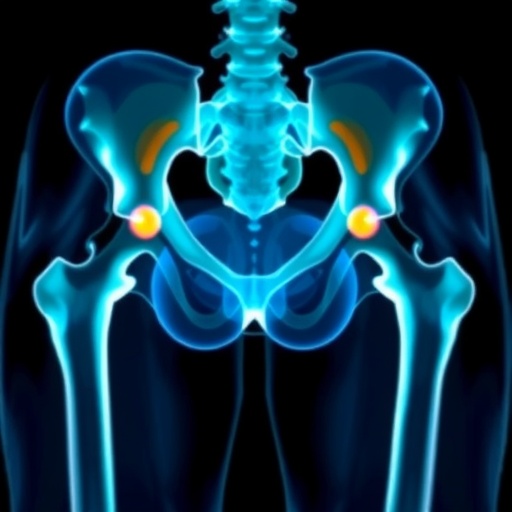
In a remarkable research endeavor, a team led by Xing, Y. and joined by Wang, Y. and Huang, Y. has been working on the urgent issue of postoperative delirium, particularly among elderly patients suffering from hip fractures. This condition, often characterized by acute confusion, hallucinations, and disorientation, poses serious risks for older surgical patients. Delirium not only impacts recovery trajectories but may also lead to longer hospital stays, post-surgical complications, and heightened mortality rates. As the population ages and the incidence of hip fractures increases, there is a pressing need to develop robust predictive models that can identify the risk factors associated with this precarious condition.
The researchers turned to advanced machine learning algorithms to tackle the challenge of predicting postoperative delirium. By harnessing artificial intelligence, they aimed to analyze vast datasets containing patient information and clinical parameters that could signal the potential for delirium. This approach represents a notable shift from traditional methods that often rely heavily on clinical judgment and experience, sometimes resulting in a lack of objectivity. With machine learning, patterns in patient data can be uncovered that might otherwise go unnoticed.
To build their predictive model, the researchers amassed and processed an extensive database of clinical data from elderly hip fracture patients undergoing surgery. This data encompassed a myriad of factors including age, pre-existing medical conditions, cognitive function, and even psychosocial aspects such as social support systems. The researchers meticulously crafted their algorithms to ensure they could identify the nuanced interactions between these various risk factors, embracing the complexity of human health that often eludes simpler analytical methods.
The machine learning algorithms utilized in the study included a combination of decision trees, logistic regression, and neural networks. Each algorithm contributed uniquely to the model’s ability to predict which patients were at a higher risk of developing postoperative delirium. By training the model on historical patient data, the researchers were able to fine-tune its accuracy, iteratively improving its predictive capabilities. This multi-faceted approach ensured that the final model was not only able to produce reliable predictions but also adaptable to varying patient populations and settings.
Validation of the model was essential to ensure its reliability in real-world applications. The researchers employed several validation techniques, including cross-validation and testing on separate datasets. These procedures are critical in machine learning as they measure the model’s effectiveness and guard against overfitting, where a model performs well on training data but poorly on unseen data. The study showcased commendable accuracy rates, indicating significant promise for the practical application of the model in clinical settings.
Furthermore, integrating such predictive models into clinical workflows could significantly enhance patient care. Identifying high-risk patients before surgery allows healthcare providers to implement personalized strategies aimed at mitigating risk. For example, patients flagged as high risk could be monitored more closely during and after surgery, or provided with specific interventions, such as cognitive enhancement therapies or tailored post-operative care plans. The potential benefits of implementing this model in hospitals range from improved patient outcomes to reduced healthcare costs due to shorter hospital stays and fewer complications.
As with any scientific advancement, consideration must be given to the ethical implications of using machine learning in healthcare decision-making. Issues such as data privacy, informed consent, and the potential for bias in algorithm training are critical aspects that require thorough discussion and regulation. Ensuring that the development and application of predictive models are conducted transparently could foster greater trust between patients and healthcare providers.
The study’s results were recently published in BMC Geriatrics, highlighting not only the algorithm’s effectiveness but also the collaborative effort in bringing innovative solutions to the fore. This research represents a significant step forward in the integration of technology and medicine, especially in the context of geriatric care, where traditional methods often fall short. Stakeholders across healthcare, including clinicians, researchers, and policymakers, are encouraged to engage with such technological innovations to enhance patient care.
Moreover, the implications of this study extend beyond delirium prediction. By demonstrating the value of machine learning in geriatric medicine, the principles and methods established could be adapted to a broader range of surgical outcomes and conditions. Future research could build on these findings, investigating additional health challenges faced by elderly populations, thus broadening the horizon of machine learning applications in healthcare.
Ultimately, the establishment of a postoperative delirium risk prediction model for elderly hip fracture patients is not only a breakthrough in geriatric care but also a pioneering moment in the interdisciplinary collaboration between data science and clinical practice. This research encapsulates the potential of machine learning to revolutionize patient management strategies, ultimately allowing for more precise, effective, and personalized healthcare solutions.
For those in the medical and healthcare communities, harnessing the power of data-driven approaches is proving essential as we navigate the complexities of modern healthcare. As we look toward the future, the promise of machine learning algorithms as decision-support tools in clinical settings is becoming increasingly tangible. With ongoing developments and more studies expected, the journey toward reducing postoperative delirium incidences through predictive modeling has only just begun. The collaboration between healthcare professionals and data scientists will undoubtedly play a pivotal role in this exciting frontier of medical advancement.
As this research garners attention and further validation, we anticipate a wider uptake of similar methodologies across healthcare systems, paving the way for a smarter, more responsive healthcare landscape that prioritizes the needs of its most vulnerable patients.
Subject of Research: Predicting postoperative delirium risk in elderly hip fracture patients using machine learning.
Article Title: Establishment of a postoperative delirium risk prediction model for elderly hip fracture patients based on machine learning algorithms.
Article References:
Xing, Y., Wang, Y., Huang, Y. et al. Establishment of a postoperative delirium risk prediction model for elderly hip fracture patients based on machine learning algorithms. BMC Geriatr 25, 1033 (2025). https://doi.org/10.1186/s12877-025-06648-4
Image Credits: AI Generated
DOI: https://doi.org/10.1186/s12877-025-06648-4
Keywords: postoperative delirium, elderly, hip fracture, machine learning, predictive modeling, healthcare, risk factors.


