

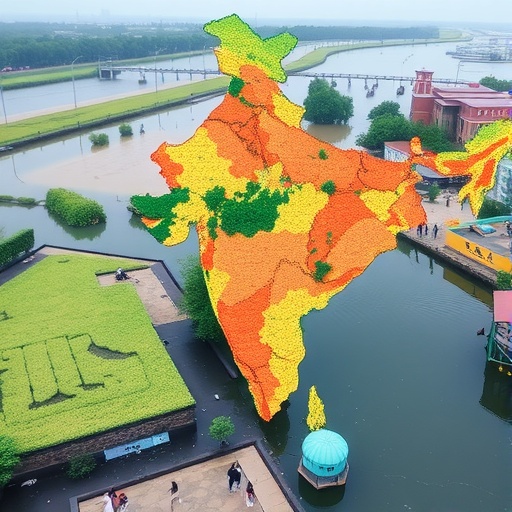
In the evolving landscape of urban development, understanding the intersections of flood risk and land use becomes increasingly critical, particularly in regions vulnerable to environmental changes. A groundbreaking study conducted by Arpita, Mustak, and Mitra sheds light on this pressing issue, particularly within the context of Baleswar CD block in India. This research offers an integrated flood risk-based land use mapping approach, harnessing the power of machine learning and geospatial technologies to navigate the complexities of urban planning amidst rising flood risks.
Flooding, a natural phenomenon exacerbated by climate change and urbanization, has significant implications for land use planning. In Baleswar, a region characterized by unique geographical and climatic conditions, the interplay between land utilization and flood risk demands meticulous analysis. The researchers employed advanced machine learning algorithms alongside geospatial technologies, creating a comprehensive model designed to accurately predict flood-prone areas and propose sustainable land use alternatives.
The integration of machine learning in flood risk assessment introduces an innovative dimension previously unexplored in traditional methodologies. By leveraging vast datasets, including historical flood records, topographical maps, and socio-economic indicators, the study predicts potential flood risk scenarios with remarkable precision. This predictive capability allows urban planners to enhance land use strategies that can mitigate the adverse effects of flooding while promoting sustainable urban growth.
Geospatial technologies further augment this analysis by providing visual representation and spatial analysis tools. Geographic Information Systems (GIS) play a pivotal role in mapping flood risks, allowing stakeholders to visualize vulnerable zones and the impact of different land use scenarios on flood dynamics. The researchers utilized GIS to overlay various datasets, illustrating the intricate relationships between geographical features, land use patterns, and potential flood risks.
In their study, the authors not only focus on identifying flood-prone areas but also emphasize the importance of strategic land use planning. The implications of this research extend beyond immediate flood risk assessment; they influence long-term urban planning initiatives that prioritize resilience and sustainability. By understanding how land use decisions affect flood risk, policymakers can implement more effective zoning regulations and land management practices.
The significance of this research is underscored by the alarming increase in flood incidents across India and globally. As urban areas expand, the demand for intelligent planning becomes paramount. Integrating advanced technological tools into land use planning processes ensures that cities can adapt to changing environmental conditions and reduce vulnerability to flooding.
Crucially, the study also highlights the necessity of community involvement in the planning process. Engaging local stakeholders is vital for creating an inclusive approach to flood risk management. This ensures that the voices of residents are heard, and their knowledge of the land and its risks is factored into decision-making. A well-rounded approach that includes community input fosters resilience and enhances the social fabric of urban environments.
The authors advocate for incorporating the findings from this research into broader national policies on disaster management and climate adaptation. By aligning local insights with national strategies, there is potential for creating a more robust framework for managing flood risks. This alignment is crucial for ensuring that urban areas do not only prepare for immediate challenges but also build capacity for long-term resilience.
In conclusion, the study led by Arpita, Mustak, and Mitra presents a compelling case for the fusion of machine learning and geospatial technologies in flood risk assessment and land use planning. As urban areas continue to grapple with the realities of climate change, advances such as these will be pivotal in steering cities toward safer, more sustainable futures. The call to integrate technological innovations into land planning processes is more than an academic exercise; it is a necessary step toward achieving resilience in the face of inevitable environmental challenges.
As we move forward, the lessons drawn from Baleswar CD block serve as a critical reminder of the role that informed decision-making plays in safeguarding urban communities against the increasingly unpredictable forces of nature. The road ahead may be fraught with challenges, but with the right tools and strategies at our disposal, we can build urban landscapes that not only thrive but also withstand the trials of a changing climate.
Subject of Research: Flood risk-based land use mapping using machine learning and geospatial technologies
Article Title: Integrated flood risk-based land use mapping using machine learning and Geospatial technologies: a case study of Baleswar CD block, India.
Article References:
Arpita, A., Mustak, S., Mitra, P. et al. Integrated flood risk-based land use mapping using machine learning and Geospatial technologies: a case study of Baleswar CD block, India.
Discov Cities 2, 128 (2025). https://doi.org/10.1007/s44327-025-00173-0
Image Credits: AI Generated
DOI: https://doi.org/10.1007/s44327-025-00173-0
Keywords: flood risk, land use mapping, machine learning, geospatial technologies, urban planning, Baleswar, India, climate change adaptation, GIS.


