


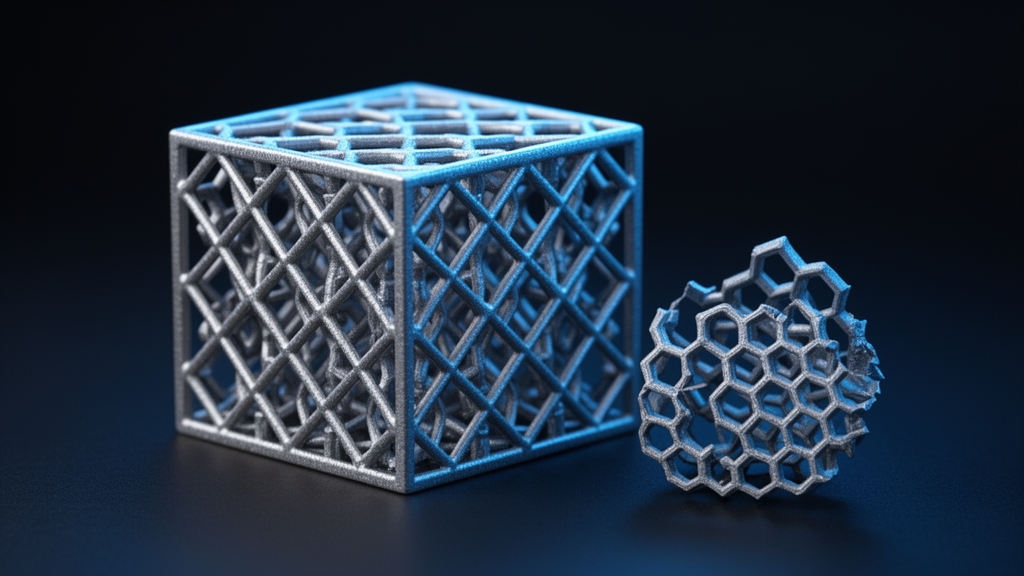
A team of mechanical engineers at the National Institute of Technology Meghalaya in India has combined classic compression testing, statistical analysis, and a nature-inspired optimization algorithm to answer a deceptively simple question: which 3D-printed lattice geometry is the strongest, and how should it be designed? The study, published in the Journal of Materials Science by Omkar Raj Aryan and Kishore Debnath, systematically explored triply periodic minimal surface (TPMS) lattice structures produced by fused filament fabrication (FFF) with polylactic acid (PLA), and its findings offer a practical roadmap for anyone designing lightweight, load-bearing architected materials.
TPMS structures are mathematical surfaces that divide space into two intertwined, non-intersecting regions while maintaining a mean curvature of zero at every point. Translated into physical form, they produce smooth, continuously curved cellular solids that resemble soap films frozen in place. Unlike traditional strut-based lattices built from beams and nodes, TPMS geometries distribute stress along smooth curved walls, avoiding the sharp junctions where cracks and stress concentrations typically initiate. This makes them attractive for applications ranging from bone implants and tissue scaffolds to heat exchangers, energy absorbers, and lightweight aerospace panels, where the ability to tune stiffness, strength, and porosity independently is a decisive advantage.
The researchers focused on four of the most widely used TPMS topologies: the Gyroid, the Schwarz Primitive (SP), the Schwarz Diamond (SD), and the Neovius surface. Each of these geometries has a distinctive internal architecture. The Gyroid, perhaps the most famous, twists through space in a helical, chiral pattern with no straight lines or flat faces. The Schwarz Primitive consists of a network of orthogonal channels, the Schwarz Diamond mimics the tetrahedral bonding arrangement of a diamond crystal lattice, and the Neovius surface is a more complex derivative of the Primitive family with additional saddle points and a higher degree of connectivity. Because each topology channels load differently, the choice between them can dramatically alter mechanical performance even when the amount of material used is identical.
To disentangle the effects of geometry from those of size and density, the team designed lattices with two unit cell sizes, 10 millimeters and 15 millimeters, and four relative densities: 20, 25, 30, and 35 percent. Relative density, the ratio of the lattice’s density to that of the fully dense parent material, is the single most important scaling parameter in cellular solids theory, while unit cell size governs how many cells fit within a structure and how boundary effects propagate through it. By holding all printing parameters constant across every specimen, the authors ensured that any differences in compressive behavior could be attributed to design rather than to process variability, a methodological discipline that strengthens the statistical conclusions drawn later in the study.
All specimens were fabricated from PLA filament using FFF, the most accessible and widely deployed 3D printing process, in which a thermoplastic filament is melted and extruded layer by layer. PLA was a deliberate choice: it is inexpensive, dimensionally stable, and prints reliably, making it a sensible model material for establishing design rules that can later be transferred to engineering thermoplastics or even metal additive manufacturing. The printed lattices were then subjected to uniaxial compression testing, the standard method for characterizing cellular materials, which reveals not only peak strength and stiffness but also the shape of the stress-strain curve, including how the structure collapses, plateaus, and eventually densifies as opposing walls crush together.
The results were striking in their spread. The Neovius lattice emerged as the clear champion, achieving a maximum compressive strength of 41.51 megapascals at 35 percent relative density with the smaller 10-millimeter unit cell. The Schwarz Diamond followed at 34.60 megapascals, confirming that highly connected, diamond-like architectures translate well into load-bearing polymer lattices. The Gyroid, by contrast, reached 23.81 megapascals but displayed a smoother, more gradual stress-strain response with progressive densification, a behavior that may prove more valuable than raw strength in applications demanding predictable, controlled energy absorption, such as protective packaging or cushioning. The Schwarz Primitive trailed the field at 20.26 megapascals, suggesting that its open orthogonal channel network concentrates load less effectively under compression in this material system.
To quantify which design variables actually mattered, the researchers performed an analysis of variance (ANOVA) on their experimental data. The verdict was unambiguous: lattice topology was the dominant factor, accounting for 56.03 percent of the variation in compressive performance. Relative density came second at 33.25 percent, while unit cell size contributed a comparatively modest 7.59 percent. For engineers, this hierarchy is genuinely useful knowledge. It means that selecting the right surface geometry matters more than fine-tuning wall thickness or cell dimensions, and that a designer’s first decision, the choice of TPMS family, carries more than half the weight in determining final mechanical performance.
The study then moved from characterization to prediction. The team fitted regression models to their experimental results, converting raw compression data into mathematical objective functions that relate compressive performance to unit cell size and relative density for each topology. These models became the fitness functions for the Lyrebird Optimization Algorithm (LOA), a bio-inspired metaheuristic introduced in 2023 that mimics the remarkable vocal mimicry behavior of the Australian superb lyrebird, a bird capable of imitating almost any sound it hears. In the algorithm, candidate solutions adjust and imitate the best-performing solutions in the population, balancing exploration of the design space with exploitation of promising regions, in a manner conceptually similar to genetic algorithms and particle swarm optimization but with distinct mimicry-driven update rules.
Running the LOA across the regression models produced a clear and consistent optimum: for every TPMS topology, the best combination of design parameters was approximately the 10-millimeter unit cell paired with 35 percent relative density, the densest and finest configuration tested. The Neovius lattice achieved the highest composite desirability score of 0.994, a near-perfect value indicating that the optimization criterion, which balances multiple performance objectives into a single figure of merit, was almost fully satisfied by this configuration. The convergence of the experimental data and the algorithmic search on the same design point provides mutual validation: the statistics did not merely fit the data, they pointed to a physically meaningful optimum.
The broader significance of this work lies in its demonstration of a complete, systematic pipeline for architected material design: fabricate a controlled matrix of specimens, test them, distill the results into regression models, and let a modern metaheuristic search the design space for optima. As additive manufacturing continues to expand into certified structural components, medical implants, and multifunctional devices, methods like this one transform lattice design from an intuitive art into a quantitative engineering discipline. The humble lyrebird, it turns out, has something to teach the world of materials science, and the Neovius surface, long a mathematical curiosity, now has the compressive test data to claim its place among the strongest printable lattice geometries available to designers working with desktop 3D printers.
Subject of Research: Mechanical characterization and optimization of 3D-printed TPMS lattice structures
Article Title: Mechanical characterization and lyrebird algorithm-based optimisation of fused filament fabricated triply periodic minimal surface lattice structures
Article References: Aryan, O. R., & Debnath, K. (2026). Mechanical characterization and lyrebird algorithm-based optimisation of fused filament fabricated triply periodic minimal surface lattice structures. Journal of Materials Science. https://doi.org/10.1007/s10853-026-13871-w
Image Credits: AI Generated
DOI: 10.1007/s10853-026-13871-w
Keywords: TPMS lattice structures, fused filament fabrication, PLA, Neovius surface, Gyroid, Schwarz Diamond, compressive strength, Lyrebird Optimization Algorithm, ANOVA, relative density, unit cell size, additive manufacturing
Cite Scienmag News
Denise Maddox. (October 15, 2026). Lyrebird Algorithm Cracks the Code of Ultra-Strong 3D-Printed Lattice Structures. Scienmag. https://scienmag.com/lyrebird-algorithm-cracks-the-code-of-ultra-strong-3d-printed-lattice-structures/
Denise Maddox. "Lyrebird Algorithm Cracks the Code of Ultra-Strong 3D-Printed Lattice Structures." Scienmag, 15 October 2026, https://scienmag.com/lyrebird-algorithm-cracks-the-code-of-ultra-strong-3d-printed-lattice-structures/. Accessed 15 October 2026.
Denise Maddox. "Lyrebird Algorithm Cracks the Code of Ultra-Strong 3D-Printed Lattice Structures." Scienmag. October 15, 2026. https://scienmag.com/lyrebird-algorithm-cracks-the-code-of-ultra-strong-3d-printed-lattice-structures/


