


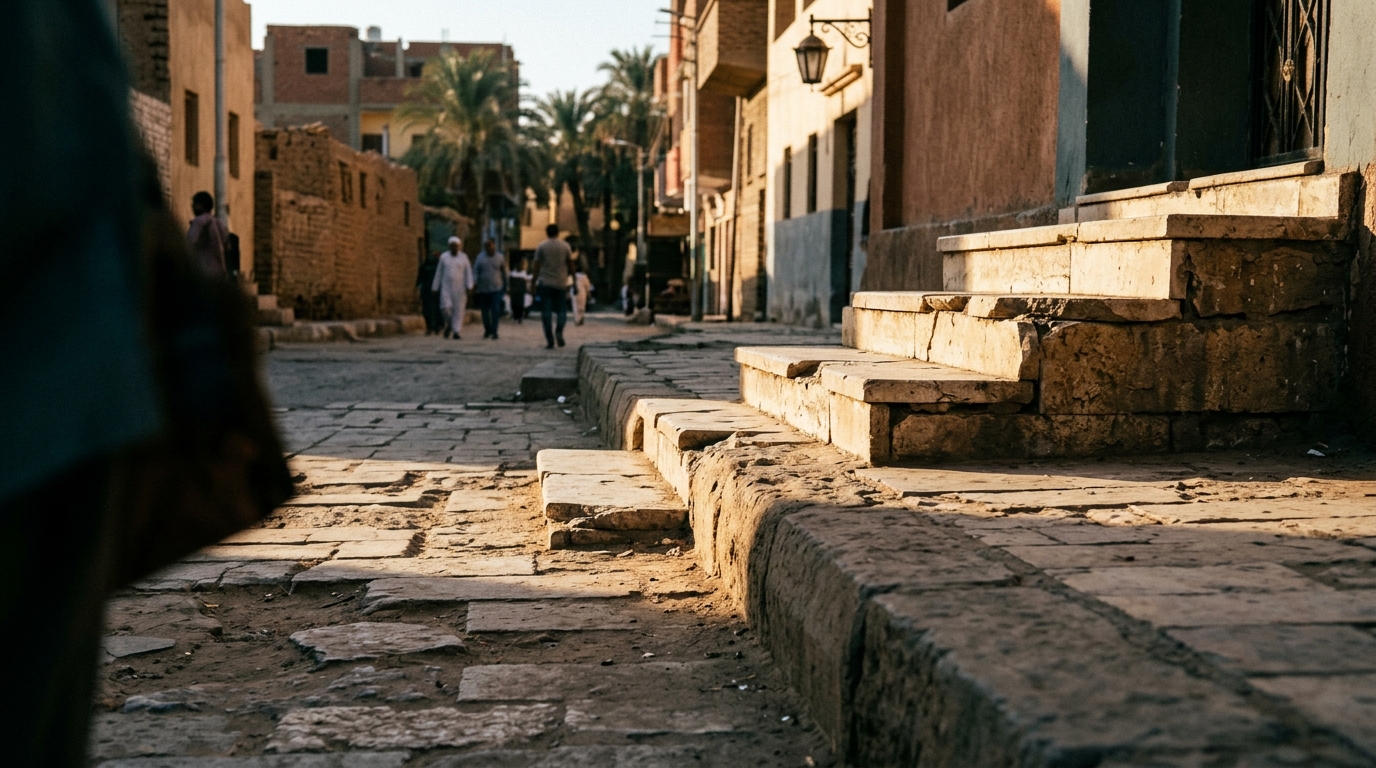
A mixed-methods study published in Discover Cities reveals that public spaces in Luxor, Egypt, exhibit significant deficiencies in universal design, negatively impacting both resident well-being and the tourist experience. The research, conducted by Menna Allah Salah Refai and Zienab El-gamily, investigates how accessibility, environmental comfort, safety, and cultural legibility shape the performance of urban environments in this prominent heritage city. By integrating theoretical analysis with empirical fieldwork, the study demonstrates that current urban conditions fall well below acceptable standards for inclusive design, with an overall mean score of 2.17 on a five-point scale, equivalent to 43.4% perceived compliance.
The study focuses on two key urban areas in Luxor: Railway Station Square, including Al-Mahatta Street and Abu Al-Haggag Square, and the surroundings of Luxor Temple, including the tourist market entrance. These locations were selected because they represent the city’s primary tourist and cultural gateways, where high densities of visitors and residents intersect with commercial and religious activities. The researchers employed a non-probability convenience sampling strategy to collect data from a diverse range of users, acknowledging that probability-based sampling was not practically feasible within the busy heritage tourism environment. This approach allowed for the collection of responses from individuals experiencing the study areas under different conditions and for different purposes.
Primary data were collected between January and March 2025 using structured questionnaire surveys administered via both face-to-face and online modes. The final analytical sample comprised 339 valid responses, including 187 visitors (55%), 136 residents (40%), and 16 professionals (5%). The questionnaire was based on a five-point Likert scale, designed to measure users’ perceptions of accessibility, comfort, safety, and wayfinding. To ensure scientific rigor, the researchers conducted a pilot survey with 30 respondents and evaluated the instrument’s reliability using Cronbach’s Alpha, achieving an overall coefficient of 0.84, which indicates good internal consistency among the survey items.
The findings reveal critical gaps in the application of universal design principles across the study areas. Approximately 95% of respondents confirmed the lack of accessible infrastructure for all users, particularly for children, the elderly, and people with mobility disabilities. This deficiency is linked to the proliferation of street vendors and the mixing of vehicle and pedestrian traffic, which hinders movement and increases risk levels. Furthermore, 88.2% of participants reported the absence of adequate seating and shading, while approximately 82.4% considered street surfaces unsafe for movement. These deficiencies create an urban environment that does not adequately support pedestrian comfort, safety, or inclusive use.
Field observations provided quantifiable evidence corroborating the perception-based survey data. Measurements indicated that pedestrian pavements were inadequate in width, with a maximum recorded width of 2.0 meters and narrowest sections measuring only 0.8 meters. This limited width contributes to a substantial overlap between pedestrian and vehicular movement, reducing safety. The study identified only five benches in the entire area, all concentrated in Abu Al-Haggag Square, indicating a significant shortage of seating opportunities. Additionally, no ramps were observed at building entrances, and shaded areas covered less than 5% of the total study area, resulting in limited thermal protection under intense summer solar exposure.
The research also highlights a paradox between strong heritage identity and poor functional performance. While 88.2% of respondents recognized prominent landmarks such as Luxor Temple and Abu Al-Haggag Mosque that aid in spatial memory and association, the same users identified severe deficiencies in accessibility and comfort. This suggests that the area’s cultural and symbolic value does not compensate for its functional inadequacies. The strong visual presence of heritage assets creates high expectations among users, which are not met by the physical quality of the surrounding urban spaces, potentially undermining the overall visitor experience.
To contextualize these findings, the study compared Luxor’s performance with three international case studies: The High Line Park in New York, Superkilen Park in Copenhagen, and La Rambla in Barcelona. These global models demonstrate successful integration of universal design principles, including equitable use, flexibility, and low physical effort, within urban and tourism-oriented projects. For instance, The High Line Park utilizes lifts, ramps, and multiple entry points to ensure access for all users, while Superkilen Park promotes social integration through culturally diverse design elements. In contrast, Luxor’s public spaces lack these integrated features, highlighting a gap between current urban development interventions and the actual needs of diverse user groups.
Statistical analysis revealed that residents reported higher mean scores than tourists across all seven universal design principles, but statistically significant differences were identified only for Equitable Use, Tolerance for Error, Low Physical Effort, and the Overall Score. An exploratory descriptive analysis of vulnerable subgroups, including elderly users and those with mobility impairments, showed consistently lower mean scores. However, due to the small sample sizes of these subgroups (n = 13 for elderly users and n = 7 for users with mobility impairments), these results should be interpreted cautiously as descriptive evidence rather than independently generalizable statistical comparisons.
The study concludes that integrating universal design principles into heritage urban planning can substantially improve urban well-being and enhance the quality of the tourist experience. The researchers propose a prioritized set of recommendations, including short-term interventions such as installing multilingual wayfinding signage, adding shaded seating, and implementing traffic calming measures. Medium-term strategies include developing a comprehensive pedestrian network and integrating universal design standards into heritage conservation guidelines. Long-term recommendations focus on developing an inclusive urban mobility plan and formally integrating universal design principles into the city’s master plan.
Limitations of the study include its reliance on self-reported perceptions and its specific spatial and cultural context in Luxor City, which may limit generalizability to other heritage tourism destinations. The analysis primarily used descriptive statistical techniques and field observations, identifying patterns and associations rather than causal relationships. Additionally, the sample was predominantly male (77%), which may limit the generalizability of the findings to female users. The under-representation of individuals with severe disabilities and elderly users in the survey sample is also noted as a limitation, suggesting the need for future research employing targeted sampling strategies and larger sample sizes to better understand the specific needs of these vulnerable groups.
To evaluate survey reliability across specific constructs, the authors tested internal consistency, with Cronbach’s alpha coefficients exceeding the 0.70 threshold across all seven universal design dimensions: Equitable Use (0.82), Flexibility in Use (0.79), Simple and Intuitive Use (0.76), Perceptible Information (0.81), Tolerance for Error (0.78), Low Physical Effort (0.83), and Size and Space for Approach (0.80). Quantitative responses were aggregated by calculating arithmetic means for each principle and deriving composite percentage scores by dividing each mean by five and multiplying by one hundred. Dichotomous grouping categorized ratings of four and five as agree, three as neutral, and one and two as disagree. In comparing perceptions between residents and visitors, the researchers evaluated normality and variance equality using Levene’s test, applying Student’s t-test or Welch’s correction where appropriate, estimating Cohen’s d effect sizes, and enforcing a Bonferroni-adjusted significance threshold of alpha 0.006 for two-tailed evaluations.
The operational investigation revealed pronounced deficits in perceptible information and spatial flexibility within the heritage corridor. Field assessments confirmed that only four directional signs existed across the entire street, frequently mounted in inappropriate locations that hindered pedestrian navigation. Furthermore, 95 percent of participants confirmed the total absence of audible or visual signals designed to guide movement, while 70.6 percent noted that commercial advertising displays were highly visible yet caused persistent visual clutter and distraction. Functional flexibility was similarly constrained by unbalanced land use, as commercial activities dominated 50 percent of the physical space, followed by recreational establishments such as cafes and restaurants at 25 percent. Communal gathering areas were remarkably scarce; the open courtyard of Abu Al-Haggag Mosque represented one of the only spaces capable of hosting social gatherings, but its usability remained restricted almost exclusively to evening hours because unshaded surfaces rendered daytime use untenable under severe solar exposure.
Safety and amenity assessments further documented an acute deficiency in infrastructure dedicated to error tolerance and user convenience. Field inspections verified an absence of marked evacuation routes, emergency infrastructure, and specialized traffic control signals. Among surveyed participants, 70 percent expressed discomfort walking due to unsafe pedestrian pathways, 64.9 percent cited the lack of ramps suitable for individuals with special needs, and 58.8 percent evaluated street lighting as inadequate. Universal design shortcomings extended to essential sanitation, with 100 percent of respondents reporting an utter absence of public restrooms. To resolve vehicular conflicts and sidewalk congestion, approximately 75 percent of participants recommended reconfiguring the corridor into a one-way street, while roughly 25 percent favored alternative road-widening schemes or the creation of dedicated pedestrian-only zones.
The granular metrics recorded for vulnerable user groups demonstrated severe disparities, as elderly participants registered mean compliance ratings of 1.52 for Equitable Use, 1.48 for Low Physical Effort, 1.68 for Perceptible Information, and 1.72 for both Tolerance for Error and Size and Space for Approach, while participants with mobility impairments assigned Equitable Use a mean score of just 1.32. To expand upon these cross-sectional findings, the authors recommended future research employing advanced spatial analytical tools, including geographic information systems accessibility modeling, space-syntax spatial analysis, and digital mobility tracking. They additionally highlighted the need for longitudinal investigations tracking seasonal visitor shifts, structural equation modeling to test causal associations between universal design features and well-being outcomes, and qualitative participatory workshops conducted directly with disabled and elderly residents.
Subject of Research: Assessment of universal design principles in heritage urban spaces in Luxor, Egypt
Article Title: Universal design as a framework for enhancing tourist friendly and well being oriented urban spaces in Luxor Egypt
Article References: Refai, M. A. S., & El-gamily, Z. (2026). Universal design as a framework for enhancing tourist friendly and well being oriented urban spaces in Luxor Egypt. Discover Cities, 3(1), Article 225. https://doi.org/10.1007/s44327-026-00406-w
Image Credits: AI Generated
DOI: 10.1007/s44327-026-00406-w
Keywords: universal design, urban planning, Luxor, heritage cities, tourism, accessibility, public spaces, urban well-being, Universal, design, framework, enhancing
Cite Scienmag News
Courtney Benton. (November 7, 2026). Luxor Public Spaces Fail Universal Design Standards, Study Finds. Scienmag. https://scienmag.com/luxor-public-spaces-fail-universal-design-standards-study-finds/
Courtney Benton. "Luxor Public Spaces Fail Universal Design Standards, Study Finds." Scienmag, 7 November 2026, https://scienmag.com/luxor-public-spaces-fail-universal-design-standards-study-finds/. Accessed 15 November 2026.
Courtney Benton. "Luxor Public Spaces Fail Universal Design Standards, Study Finds." Scienmag. November 7, 2026. https://scienmag.com/luxor-public-spaces-fail-universal-design-standards-study-finds/




