


The Applied Nuclear Physics Group at Lund University has constructed a compact accelerator-driven neutron source, known as a CANS, which is now entering its commissioning phase. Built at the university’s Nuclear Applications Laboratory, the facility is designed to generate neutrons using a 3 MV single-ended Pelletron accelerator that directs a 2.8 MeV deuterium beam into a thick beryllium target via the Be(d,n) reaction. Initial operations are anticipated to yield a neutron production rate on the order of 1010 neutrons per second into 4π steradians, with resulting neutron energies extending up to 9 MeV and peaking at approximately 5 MeV.
The newly constructed source relies on the repurposing of a single-ended NEC-3UH Pelletron accelerator that was originally commissioned in 1990 and served as the laboratory’s primary workhorse for over three decades. Historically, this machine supported a wide range of ion-beam analysis techniques, including particle-induced X-ray emission, Rutherford backscattering spectrometry, scanning transmission ion microscopy, nuclear reaction analysis, and elastic recoil coincidence spectroscopy. These methods contributed to research programs spanning geology, medicine, biology, ecology, meteorology, detector development, and the characterization of nanostructures and extraterrestrial materials.
To accommodate the new neutron beamline within an already busy laboratory layout, the CANS was installed directly between pre-existing ion-beam analysis beamlines. The experimental hall housing the accelerator was previously utilized for an electron synchrotron, meaning that the surrounding infrastructure was already equipped for significant radiation fields. In particular, the accelerator control room is shielded by a two-meter-thick concrete wall, enabling the facility to satisfy most radiation protection licensing requirements without extensive structural modifications.
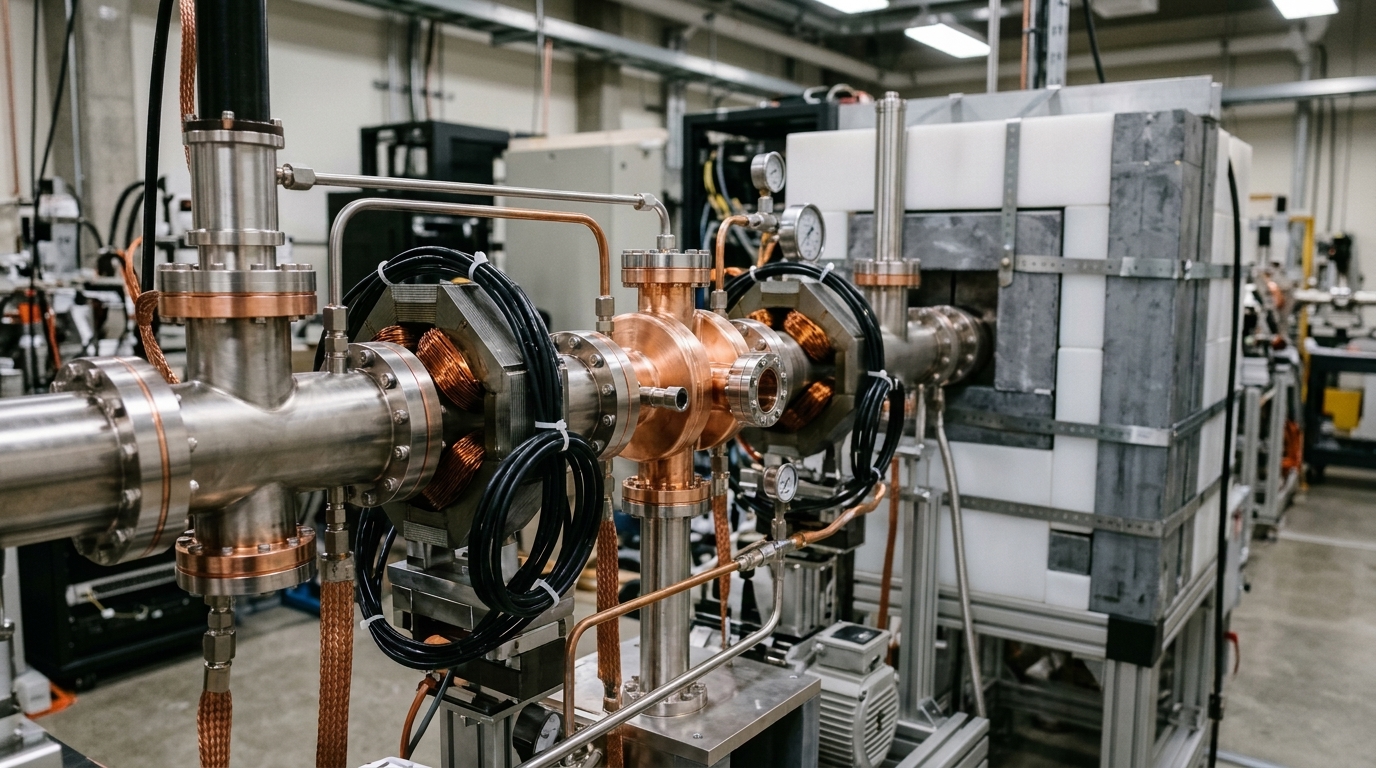
Transporting the accelerated deuteron beam from the accelerator to the target involves a dedicated nine-meter-long high-vacuum line oriented at zero degrees relative to the accelerator exit. A system of five dipole magnets—four located inside the accelerator pressure vessel and a fifth positioned two meters downstream from the accelerator exit—is used to position and steer the particle trajectory. Five meters from the exit, a pair of quadrupole magnets focuses the deuteron beam to a diameter of one centimeter upon reaching the target face.
The beamline is equipped with diagnostic and operational controls, including optical camera viewing ports paired with electrically isolated fluorescent screens that can be inserted into the beam path to evaluate beam profiles and currents. A movable Faraday cup is stationed 1.5 meters ahead of the target for additional current measurements. Downstream of the quadrupole magnets, the design incorporates a fast electrostatic deflector that can periodically sweep the beam into a tantalum beam dump, enabling pulsed neutron operations with an adjustable duty cycle and pulse widths down to 25 nanoseconds.
At the terminal point of the beamline, the beam impinges on a two-millimeter-thick beryllium target mounted on an electrically isolated flange that is externally cooled using deionized water. The target assembly allows direct current measurements during irradiation. While initial operations utilize deuteron beam currents of 10 microamperes, an anticipated upgrade to the accelerator’s ion source is planned to boost the available beam current to 100 microamperes, which is expected to increase total neutron production tenfold to 1011 neutrons per second in 4π steradians.
Radiation shielding and moderation around the beryllium target are provided by a custom 3000-liter deionized water tank developed in collaboration with Cipax AB. This water moderator is augmented externally by layers of Mirrobor and high-density polyethylene shielding. Four separate ports penetrate the tank assembly: one serves as the vacuum entrance for the incoming deuteron beamline, while three dedicated ports facilitate the extraction of moderated and unmoderated neutron beams for experimental stations.
The three neutron extraction ports are oriented at angles of 0, 30, and 150 degrees relative to the incoming deuteron beam axis. Simulations conducted using the Particle and Heavy Ion Transport code System indicate that forward momentum imparts greater energy and higher flux to neutrons emitted in the forward direction. Consequently, the low-angle extraction ports deliver a higher proportion of fast neutrons, whereas the backward 150-degree port extracts a greater share of thermalized neutrons. Fast neutron fluxes at the port exits are anticipated at approximately 106 neutrons per square centimeter per second, alongside thermal fluxes around 104 neutrons per square centimeter per second.
A primary motivation for establishing the CANS is to expand local capacity for neutron activation analysis by implementing an in-house cyclic system. The laboratory previously prototyped this technique using a commercial SODERN GENI-16 sealed-tube neutron generator, and the new accelerator-driven setup will deliver neutron fluxes of approximately 108 neutrons per square centimeter per second at the irradiation position, rising to 109 following the planned ion source upgrade. Measurements will be recorded by an array of high-purity germanium detectors situated near the control room, with automated sample transfer designed to avoid personnel entering the accelerator hall while monitoring environmental radionuclides collected near the European Spallation Source.
Beyond activation analysis, the facility will serve as a platform for developing nuclear safeguards instrumentation for spent nuclear fuel, testing detectors destined for major neutron scattering facilities, and studying thermal-neutron tagging methods. Benchmarked in scale against existing installations such as the Kyoto University Accelerator-driven Neutron Source, the Lund project aims to provide proof of principle for compact sources in Scandinavia as European researchers seek local alternatives to declining beam time at traditional research reactors.
The development of the facility builds upon an institutional initiative established in 2014, when the Applied Nuclear Physics Group began providing dedicated neutron access supported by a user-focused infrastructure. This program drew upon group expertise in nuclear physics and neutron-detection techniques, directly assisting materials research and detector development associated with the European Spallation Source. The laboratory possessed an extensive history in accelerator-based research extending back to the 1970s, when researchers developed particle-induced X-ray emission before advancing toward modern detection systems. In 2017, the group decided to combine these competencies by constructing a dedicated accelerator beamline for neutron production, intended to yield a substantial flux increase compared to existing laboratory sources.
Prior to this accelerator project, experimental work relied upon a radiation inventory comprising alpha, beta, and gamma emitters alongside sealed isotopic neutron sources. The laboratory maintained californium-252, americium-beryllium, and plutonium-beryllium sources, which delivered baseline neutron-production rates on the order of 106 neutrons per second in 4π steradians. To utilize these isotopic emitters, the facility installed a dedicated irradiation area centered around a 2.75-cubic-meter water-filled shielding tank designated the aquarium. Penetrated by four ports allowing fast neutrons to escape, this shielding tank served as the experimental station for investigations into gamma-ray and neutron tagging while supporting the development of prototype neutron detectors.
Experimental capability took an intermediate step forward in 2019 when the laboratory installed a SODERN GENI-16 neutron generator owned by SKB, the Swedish Nuclear Fuel and Waste Management Company. Providing an emission rate of 108 neutrons per second in 4π steradians, this generator supplied a significant increase in fast-neutron flux over the earlier isotopic sources. Researchers deployed the machine for projects related to nuclear safeguards and used it to prototype cyclic neutron activation analysis. Operating this generator enabled the group to evaluate irradiation protocols and detector response prior to transferring the cyclic measurement configuration to the accelerator target station.
The new source operates alongside specialized counting instruments and data-acquisition infrastructure maintained at the Nuclear Applications Laboratory. Among these instruments is a triple gamma-ray iridium spectrometer utilized in astro-geological research, capable of measuring sample iridium concentrations down to parts-per-trillion levels. Experimental setups also draw upon scintillation materials, photomultipliers, helium-3 tubes, and high-purity germanium detectors arranged for coincidence spectroscopy. Signals from these detectors are processed by multi-channel full digitisers and a 200-channel VME data-acquisition system, establishing a flexible measurement backbone for basic nuclear physics studies and multi-detector activation campaigns.
Numerical simulations conducted with the Particle and Heavy Ion Transport code System provided detailed insight into the spectral characteristics of the source geometry prior to physical implementation. In these transport calculations, neutron energy spectra were binned according to the standardized CCFE-709 energy-group structure, with emission intensities normalized to units of neutrons per square centimeter per second per microampere of deuteron beam current. The simulated models examined both the bare source condition without shielding and moderation and the filtered output at each extraction channel. These comparisons confirmed the significant kinematic effect of deuteron momentum, demonstrating quantitatively how forward-directed angles retain substantially greater particle flux and harder spectral components compared to wide-angle extraction paths where thermalization dominates.
Beyond its local technical objectives, the installation forms part of a broader European transition toward compact accelerator-driven neutron facilities designed to mitigate diminishing beam time at conventional reactor facilities. Several compact accelerator-driven sources are currently being designed or constructed across Europe, including HBS Jülich, ESS-Bilbao, and SONART. This regional movement follows an integrated structural framework already demonstrated across Japan, where a comprehensive network of compact accelerator sources provides an operational backbone complementing the Japan Spallation Neutron Source and the JRR-3 reactor facility. In addition to delivering applied analytical measurements, the Lund installation is intended to serve as an educational platform and provide proof of principle for a dedicated compact accelerator-driven source within Scandinavia.
Subject of Research: Development of a compact accelerator-driven neutron source at Lund University
Article Title: A compact accelerator driven neutron source at the Applied Nuclear Physics Laboratory, Lund University
Article References: Frost, R. J. W., Elfman, M., Fissum, K., Kristiansson, P., Mauritzson, N., Pallon, J., Pédehontaa-Hiaa, G., Perrey, H., Stenström, K. E., & Sjöland, A. (2023). A compact accelerator driven neutron source at the Applied Nuclear Physics Laboratory, Lund University. EPJ Techniques and Instrumentation, 10(1), Article 14. https://doi.org/10.1140/epjti/s40485-023-00101-9
Image Credits: AI Generated
DOI: 10.1140/epjti/s40485-023-00101-9
Keywords: compact neutron source, Lund University, Pelletron accelerator, neutron activation analysis, nuclear physics, beryllium target, radiation shielding, European Spallation Source, compact, accelerator, driven, neutron
Cite Scienmag News
Katie Riggs. (November 6, 2026). Lund University Develops Compact Accelerator Driven Neutron Source for Nuclear Applications. Scienmag. https://scienmag.com/lund-university-develops-compact-accelerator-driven-neutron-source-for-nuclear-applications/
Katie Riggs. "Lund University Develops Compact Accelerator Driven Neutron Source for Nuclear Applications." Scienmag, 6 November 2026, https://scienmag.com/lund-university-develops-compact-accelerator-driven-neutron-source-for-nuclear-applications/. Accessed 6 November 2026.
Katie Riggs. "Lund University Develops Compact Accelerator Driven Neutron Source for Nuclear Applications." Scienmag. November 6, 2026. https://scienmag.com/lund-university-develops-compact-accelerator-driven-neutron-source-for-nuclear-applications/




