


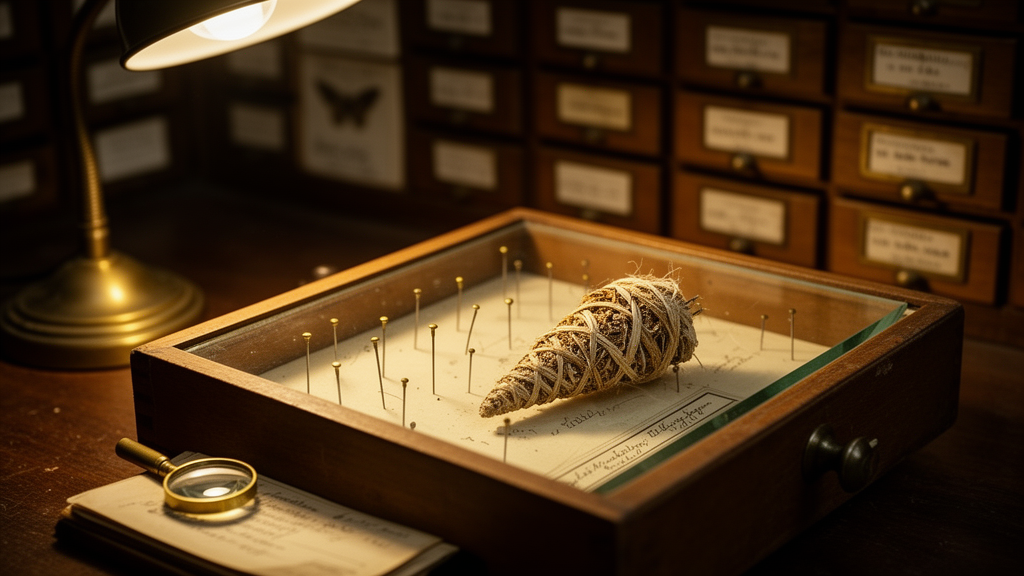
A tangle of mislabelled museum specimens, missing type material and confusingly similar species has finally been untangled for one of the Mediterranean’s most enigmatic bagworm moths. In a new taxonomic study, researchers have established the true identity of Oiketicoides tedaldii, a psychid moth first described in 1882, by designating a neotype from Sicily and using DNA barcodes to show that it is a distinct species rather than a variant of its closest relative, Oiketicoides lutea.
The genus Oiketicoides comprises more than 40 species described from the Palaearctic region, with others in the Afrotropical and Oriental realms. Its strongholds are the Central Asian steppes, the arid areas of the Iberian Peninsula and the Mediterranean, and the mountains of North Africa. Many species were described between the late nineteenth century and the first half of the twentieth on the basis of only one or very few specimens, rarely illustrated and often without the male genitalia that taxonomists rely on today. The result has been lasting confusion, and few names in the genus have been as problematic as tedaldii.
The story begins with Heylaerts, who first mentioned the name tedaldii in 1881 without a description and made it nomenclaturally available in 1882. He named the species after Luigi Failla-Tedaldi of Palermo, a Sicilian collector. The original description was based on only two male adults: one received at the end of 1881 from M. Chevalier in Algiers, and another from Syria obtained from the dealer Otto Staudinger. Heylaerts also mentioned larval cases sent from the vicinity of the Anapo river in Sicily by Zeller in 1847, as well as caterpillars reared by Failla-Tedaldi, but both breedings failed and produced no males. The larval cases are the only evidence for a possible occurrence of the species on Sicily, and the whereabouts of the two male adults cannot be ascertained today.
The search for type material in modern collections proved fruitless. The Heylaerts Collection at the Naturalis museum in Leiden contains no specimens from the original series. Six larval cases there, some with female exuviae, were later marked by an unknown person with red syntype labels, but this is a mistake: Heylaerts explicitly stated that females were unknown when he described the species, so cases bearing female exuviae cannot belong to his type series. The syntypes of O. tedaldii must therefore be considered lost. A specimen in the Staudinger Collection in Berlin labelled lutea var. timona, a name never formally described, and another labelled lutea var., both turned out to belong to another species, probably O. jordana.
Complicating matters further, two other nineteenth-century names are entwined with the story. Millière described Psyche heylaertsii in 1878 from specimens also supplied by Failla-Tedaldi, collected in north-eastern Sicily at about 1800 metres in the Nebrodi Mountains, likely near the summit of Mount Soro. Wiskott described Psyche sera in 1880, also from Sicily, in a brief Latin diagnosis noting a moth closely related to lutea but smaller, darker and with more rounded wings. Kirby later treated heylaertsii as a synonym of lutea, and confused the dates of publication, but the study concludes that heylaertsii, not sera, is the older valid name for the taxon in question, with both probably synonyms of O. lutea. Heylaerts himself, listing tedaldii as a separate species alongside heylaertsii in his 1881 monograph, evidently recognised differences between them.
The decisive evidence came from molecular data. DNA barcodes, based on a 658 base-pair segment of the mitochondrial COI gene, are publicly available in the BOLD database and GenBank for specimens assigned to both taxa. Within O. lutea the intraspecific divergence reaches at most 0.3 percent, and in O. tedaldii it is negligible. Between the two species, however, the pairwise divergence is 13.3 to 13.8 percent, calculated under the Kimura two-parameter model. Samples from Malta identified as O. tedaldii differ by 13.6 to 13.8 percent from O. lutea specimens from Cosenza and Calabria in Italy and from Zagoria in Greece. This large genetic gap demonstrates that two distinct Oiketicoides species exist in southern Europe, and one of them must be the previously enigmatic tedaldii.
Because the syntypes are lost and the taxonomic situation demanded stability, the authors designated a neotype under Article 75 of the International Code of Zoological Nomenclature. A key diagnostic clue came from Heylaerts’s original description: the larval cases of his species are characteristically covered with fragments of small mollusc shells. Oberthür had pictured a male, female and such a typical case as O. tedaldii from Khenchala in Algeria in 1909. Since no certain specimen from North Africa or the Near East is available, the authors selected a male with a larval case from Ficuzza in Sicily as neotype, deposited in the Museum Witt München.
The redescription of the male reveals a moth with a wingspan of 20 to 24.5 millimetres, light brown wings with a straight forewing costa, roundish apex and oblique termen, and bipectinate antennae with 29 to 30 pecten. The forewing carries ten veins from the divided discal cell, with veins r3+r4 stalked, and the hindwing seven. The genitalia show a fused tegumen and vinculum, a short broad valva, a triangular vinculum, a sacculus clasper bearing six short distal spines, and a very long, thick, weakly curved phallus whose vesica lacks cornuti but carries a broad pointed lateral process. The larval case, 20 to 25 millimetres long and cylindrical, is covered with fine soil particles, bits of broken snail shells, twigs, mineral debris and dry plant matter, a feature that immediately separates it from the case of O. lutea, which lacks the shell fragments.
O. lutea, described by Staudinger in 1871 from Mount Veluchi in Greece, is its closest look-alike and the source of most past misidentifications. It differs in subtle but consistent characters: antennae with 33 to 34 pecten, an eye index of 0.67 to 0.68 compared with 0.54 to 0.55 in tedaldii, more deeply indented fringe scales, a broader sacculus clasper with five to six longer spines, and a short, distally widened, fishtail-shaped saccus instead of the long stretched saccus of tedaldii. Its forewing index also varies geographically, averaging about 1.82 to 1.93 in southern populations of Greece, mainland Italy and Sicily and 2.14 in northern Balkan populations. Confusion with the third Mediterranean candidate, O. febretta, can be excluded because that species is easily recognisable and was correctly understood in the past.
The confirmed distribution of O. tedaldii, documented by both specimens and larval cases, now extends from Sicily, at Ficuzza, the Madonie mountains and Caltanisetta, to Malta, at Imtaħleb, Binġemma, Naxxar Gap, Għargħur, Mellieħa and other sites, with indications that it also occurs in Algeria and Tunisia. Both Mediterranean species appear to be confined to single continents, as are the other Oiketicoides of the region. By fixing a neotype, documenting the diagnostic morphology and larval case architecture, and anchoring the species with DNA barcodes, the study gives collectors and taxonomists a reliable benchmark for identifying O. tedaldii and clears the way for a cleaner taxonomy of a genus long obscured by fragmentary nineteenth-century descriptions.
Subject of Research: Taxonomic revision and neotype designation of the bagworm moth Oiketicoides tedaldii
Article Title: Notes on the identity of Oiketicoides tedaldii (Heylaerts, 1882) ( Psychidae , Oiketicinae )
Article References: Arnscheid, W. R., Sobczyk, T., & Zerafa, M. (2021). Notes on the identity of Oiketicoides tedaldii (Heylaerts, 1882) (Psychidae, Oiketicinae). Nota Lepidopterologica, 44, 1-15. https://doi.org/10.3897/nl.44.60222
Image Credits: AI Generated
DOI: 10.3897/nl.44.60222
Keywords: Oiketicoides tedaldii, Psychidae, bagworm moths, neotype, DNA barcoding, taxonomy, Sicily, Malta, Oiketicoides lutea, Mediterranean, COI gene, Lepidoptera
Cite Scienmag News
Juliet Wilcox. (October 27, 2026). Lost type specimens force a neotype to settle a 140-year-old bagworm moth mystery. Scienmag. https://scienmag.com/lost-type-specimens-force-a-neotype-to-settle-a-140-year-old-bagworm-moth-mystery/
Juliet Wilcox. "Lost type specimens force a neotype to settle a 140-year-old bagworm moth mystery." Scienmag, 27 October 2026, https://scienmag.com/lost-type-specimens-force-a-neotype-to-settle-a-140-year-old-bagworm-moth-mystery/. Accessed 27 October 2026.
Juliet Wilcox. "Lost type specimens force a neotype to settle a 140-year-old bagworm moth mystery." Scienmag. October 27, 2026. https://scienmag.com/lost-type-specimens-force-a-neotype-to-settle-a-140-year-old-bagworm-moth-mystery/


