


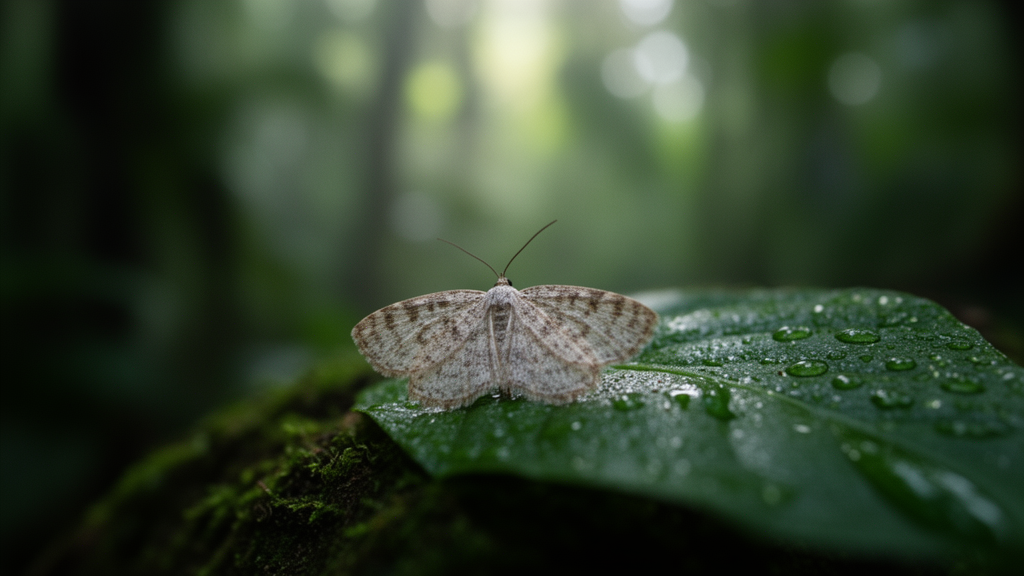
In the summer of 2021, a fieldworker combing a limestone slope in Hessen, western Germany, noticed something on the leaves of a Wild Service Tree that should not have been there: the leafmine of a pygmy moth considered one of the rarest leafminers in Europe. Stigmella torminalis, a moth so small that its wingspan barely exceeds five millimetres, had last been reliably recorded in western Europe more than a century ago. The finding, now published in Nota Lepidopterologica, triggered a cascade of rediscoveries that has rewritten the map of three closely related moth species and exposed how a century of misidentification hid them in plain sight.
The story begins with John H. Wood, an English naturalist who described Nepticula torminalis in 1890 from leafmines he found near his home in Tarrington, Herefordshire. Wood wrote that although the foodplant grew plentifully in all the local woods, he could only find the insect in one small corner of one of them, where nearly every bush carried tenanted leaves. He reared a considerable number of adults and distributed them freely among collectors, and the species entered all the major British handbooks. Yet it was never recorded again in the British Isles, and Davis considered it extinct in 2012. On the continent, reports existed, but almost all proved to be misidentifications or impossible to verify, until Schoorl and colleagues showed in 1985 that European museum collections harbour a large series of the species, reared in the late nineteenth century by Friedrich Eppelsheim in the Palatinate near Grünstadt. The only other reliable record between those moths and the present century was from the Crimea in 2014.
The 2021 discovery in Hessen rested on thirteen larvae found on Torminalis glaberrima, the Wild Service Tree, at Volkmarsen-Hörle. Eight adults emerged the following spring, and DNA barcodes from a larva and adults confirmed the identification, all sharing the Barcode Identification Number BOLD:AEO3975. The German specimens carry an identical barcode, while a specimen from Belgium differs by only 0.33 percent. The nearest neighbour is Stigmella aurora, a moth feeding on Mespilus in Dagestan, at a distance of 3.5 percent. The species was found again in 2022, and also at three localities in Rheinland-Pfalz. Focused searching on the same hostplant then yielded something equally remarkable: leafmines of Stigmella hahniella, a moth not reported with certainty from Germany since its description in 1937, a gap of ninety years. It turned up in Baden-Württemberg, Thüringen and Rheinland-Pfalz, and was recorded as new from France and Georgia. The survey also added Stigmella torminalis as new to North Macedonia and Belgium, with vacated mines from Georgia tentatively assigned to the species as well.
Why did a moth vanish for a century? The answer, the researchers argue, is partly methodological. Leafmining moths escape light traps, the standard tool for moth surveying, and are discovered instead through the characteristic mines their larvae cut in leaves. Rare species may have hidden life styles or be hard to separate from relatives without rearing, genitalia dissection or DNA barcoding. In the case of Stigmella torminalis, a second factor was decisive: the existing literature had confused it for decades with Stigmella mespilicola, which feeds on the same host. Hering’s influential leafmine keys separated the two mines only by the width of the frass line, a character that varies and misleads. Many published records of Stigmella torminalis, the authors show, are based on mines collected in autumn, on the wrong hosts, or from adults reared in summer, all incompatible with the true biology of the species.
That biology is unusual and diagnostic. Stigmella torminalis is univoltine: larvae occur only from late June to early August, and adults emerge after hibernation the following spring, in May and June. There are no records of adults caught in nature. The species has only ever been found on Torminalis glaberrima; records from other hosts are erroneous or refer to misidentified Stigmella mespilicola. The leafmine itself is characteristic once known: the egg is always laid on the leaf underside on or close to a main vein, the mine starts as a rather straight gallery with a narrow continuous black frass line, and the frass remains continuous and never more than a third of the mine width. The larva is yellow, appearing almost transparent in the mine, with paired dark brown to black prothoracic sclerites that give the head a black appearance. By contrast, Stigmella mespilicola is bivoltine, with larvae in early summer and again from late August to October, its egg more often on the leaf upperside and usually away from veins, and its frass line wider, broken and zigzagging, with irregular bulged mine margins.
The adult moths differ subtly but consistently. Stigmella torminalis has a black hair tuft and collar on the head and forewings with a broad brassy fascia that does not contrast strongly with the golden-brown wing base, though some Hungarian specimens carry an orange head tuft, a character it shares with the similar Stigmella regiella. Stigmella mespilicola also has a black head and collar, but a narrower, more contrasting silver to golden fascia, and conspicuous black androconial scales in the male. The genitalia are decisive: the male of Stigmella torminalis has a very long phallus, 350 to 415 micrometres, and a valva with two distal points, while the female has a very long thin corpus bursae with a round, wrinkled accessory sac, very different from the strongly coiled accessory sac of Stigmella mespilicola. Stigmella hahniella, the third species on the host, is recognised by a black frontal tuft with a white collar and sharply demarcated bronze and dark brown forewings, and its mine is filled with coiled green or brown frass, with a green larva.
The review of old records reads like a detective story told through museum drawers. The authors re-examined the collection of A. Wörz in Stuttgart and concluded that all mines and adults he identified as Stigmella torminalis are misidentified Stigmella mespilicola, including the material that underpinned his 1937 records from Württemberg. Records from Switzerland, Austria, Czechia, Slovenia, Serbia and Romania were dismissed or doubted on the basis of timing, hostplant or lack of voucher material. Hungary proved more complicated: the majority of records belong to Stigmella mespilicola, but a few specimens reared in spring from larvae collected the previous June or July, from Budapest localities Hármashatárhegy and Normafa, are genuinely Stigmella torminalis, confirmed by photographs of adults, mines and genitalia showing the round accessory sac. Some of these Hungarian moths have orange heads, which had led one specialist to identify them as Stigmella regiella. The old German records, by contrast, were correct: Eppelsheim’s moths from Grünstadt and the Donnersberg show the species was common in the Palatinate at the end of the nineteenth century, hidden under the name Nepticula mespilicola in contemporary lists.
The hostplant itself has a story. Torminalis glaberrima, formerly Sorbus torminalis and known in German as Elsbeere, was split from Sorbus after molecular phylogenies showed the old genus to be polyphyletic. The tree is widespread in Central and South Europe, western Asia around the Black Sea, and a few localities in Northwest Africa, with its northern limit in Central Germany. It usually occurs in very low densities, as single trees or small groups in oak-dominated woodland, is shade intolerant and colonises clearings. In England and Wales it is considered an indicator of ancient woodland and hedgerows. Apart from the two monophagous Stigmella species, the eriophyid mite Eriophyes torminalis is also a specialist of the tree. The researchers note that France, which probably holds the largest populations of the host, had no records of any of these moths before 2024, most likely due to a lack of interest in these leafmines, and that Stigmella torminalis will almost certainly be found there when searched for.
The rediscovery owes much to a revival of leafmine study in Central Europe, driven by a growing community of German Microlepidoptera enthusiasts who meet each October when leafmines are abundant, and by the enormous increase of natural history observations on internet platforms such as Observation.org and iNaturalist, which helped locate promising host trees. The immediate trigger was fieldwork for a new identification book on the Nepticulidae of Germany. The authors stress that museums should keep not only the insects but also the leafmines, collections that are often undervalued or forgotten but proved essential for verifying old records. A key to the linear leafmines on the Wild Service Tree is provided, distinguishing Stigmella torminalis, S. mespilicola, S. hahniella and other expected miners by egg position, frass pattern and larval colour. The paper is an impetus, the researchers hope, for looking in more places for Stigmella torminalis and its companions, showing that rarity in leafmining moths is often a matter of knowing when, where and how to look.
Subject of Research: Stigmella species on the Wild Service Tree, Torminalis glaberrima, confused, overlooked and found again (Lepidoptera, Nepticulidae)
Article Title: Stigmella species on the Wild Service Tree, Torminalis glaberrima , confused, overlooked and found again ( Lepidoptera , Nepticulidae )
Article References: van Nieukerken, E. J., & Robrecht, D. (2025). Stigmella species on the Wild Service Tree, Torminalis glaberrima, confused, overlooked and found again (Lepidoptera, Nepticulidae). Nota Lepidopterologica, 48, 29-67. https://doi.org/10.3897/nl.48.141094
Image Credits: AI Generated
DOI: 10.3897/nl.48.141094
Keywords: Stigmella, species, Wild, Service, Tree, Torminalis, glaberrima, confused, overlooked, found, again, Lepidoptera
Cite Scienmag News
Gavin Prescott. (October 17, 2026). Lost pygmy moth found again after a century of confusion. Scienmag. https://scienmag.com/lost-pygmy-moth-found-again-after-a-century-of-confusion/
Gavin Prescott. "Lost pygmy moth found again after a century of confusion." Scienmag, 17 October 2026, https://scienmag.com/lost-pygmy-moth-found-again-after-a-century-of-confusion/. Accessed 17 October 2026.
Gavin Prescott. "Lost pygmy moth found again after a century of confusion." Scienmag. October 17, 2026. https://scienmag.com/lost-pygmy-moth-found-again-after-a-century-of-confusion/


