Human papillomavirus vaccination coverage among girls in Africa has risen steadily since the vaccine first reached the continent in 2011, but it still falls well short of the World Health Organization’s target of 90 percent coverage among girls by age 15. That is the central finding of a retrospective analysis of national immunisation data from 31 African countries, published in Discover Public Health, which also reports that each additional year a country runs its HPV vaccination programme is associated with roughly a three-percentage-point increase in first-dose coverage.
By 2024, only 31 of Africa’s 54 countries had integrated HPV vaccination into their routine immunisation schedules, mostly targeting girls aged 9 to 14 years. Across the 31 countries, mean first-dose coverage in 2024 was 64 percent, with a standard deviation of 25.5, while last-dose coverage averaged 55 percent, with a standard deviation of 27.3. Those figures represent a modest improvement over 2023, when first-dose coverage averaged 63 percent and last-dose coverage 50 percent.
The spread between countries was enormous. Five countries exceeded 90 percent first-dose coverage in 2024: Burkina Faso and Cape Verde at 99 percent, Uganda at 95 percent, the United Republic of Tanzania at 94 percent, and Mauritius at 92 percent. Botswana also reached 93 percent for the first dose, though its last-dose coverage dropped to 34 percent. At the other end of the scale, Morocco recorded just 3 percent first-dose coverage, while Gambia and Mali each managed 15 percent, Eswatini 30 percent, and Cameroon and Togo 36 percent.
Regional patterns varied sharply. Eastern and Southern Africa recorded first-dose and last-dose coverage of 77 percent and 61 percent respectively, West and Central Africa reached 63 percent and 60 percent, while North Africa lagged at 52 percent and 27 percent. Only two of nine countries in Central Africa had initiated vaccination, Sao Tome and Principe at 75 percent and Cameroon at 36 percent, and just three of seven North African countries had begun, with Libya and Mauritania at 51 percent first-dose coverage and Morocco far behind.
The temporal trend tells a story of early rapid gains, pandemic disruption, and slow recovery. From 2011 to 2016, average first-dose coverage among vaccinating countries climbed from roughly 36 percent to 89 percent, and last-dose coverage rose from about 34 percent in 2011 to nearly 70 percent by 2017. Then came a pronounced reversal: by 2018 and 2019, first-dose coverage had fallen to around 70 percent, and last-dose coverage dropped sharply to 33 percent. The decline deepened in 2020 and 2021, when first-dose coverage fell to about 51 percent and last-dose coverage hit its lowest point at 32 percent. Only from 2022 onward did coverage begin to recover, reaching 64 percent for the first dose by 2024.
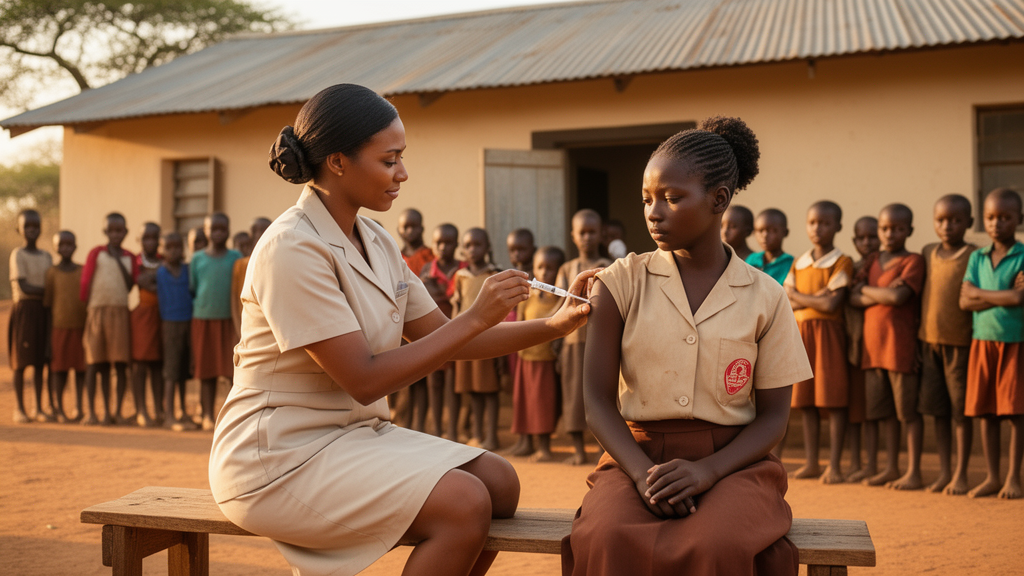
The authors attribute much of that mid-period collapse to the COVID-19 pandemic. First- and last-dose coverage stood at approximately 70 percent and 33 percent in 2019 but declined to 51 percent and 29 percent in 2020 following widespread disruptions. Because school-based delivery is the primary HPV vaccination strategy in many African countries, prolonged school closures substantially reduced opportunities for vaccine delivery, while health system resources were diverted to the pandemic response. Globally, 23 countries failed to report HPV vaccination coverage data in 2021, compared with only nine in 2019, with several African countries experiencing particularly severe interruptions.
To test whether programme maturity matters, the researchers fitted linear regression models relating the number of years a country had implemented HPV vaccination to its 2024 first-dose coverage. The association was statistically significant: the regression coefficient was 2.97, with a standard error of 1.32, a p-value of 0.032, and an R-squared of 0.15, meaning programme duration explained about 15 percent of the variation in coverage. Each additional year of implementation was associated with an increase of roughly three percentage points in first-dose coverage. A sensitivity analysis that removed outlier countries, excluding Cape Verde and Burkina Faso at 99 percent coverage and Morocco below 5 percent, strengthened the estimate to 3.17 percentage points per year, with a 95 percent confidence interval of 0.85 to 5.5, a p-value of 0.009, and an R-squared of 0.232.
The analysis of vaccination completion revealed a more nuanced picture. Using 2022 data, chosen because 21 of the 31 countries had switched to single-dose schedules in 2023, the researchers found that in the crude model first-dose coverage was not significantly associated with last-dose coverage, with a coefficient of 0.304 and a p-value of 0.070. This suggests that high vaccine initiation does not by itself guarantee completion of the schedule. However, in the model adjusted for programme duration, both predictors became significant: each one-percentage-point increase in first-dose coverage was associated with an estimated 0.32-percentage-point increase in last-dose coverage, and each additional year of programme implementation was associated with an estimated 4.19-percentage-point increase in last-dose coverage. The adjusted model explained 43.3 percent of the variability in last-dose coverage, indicating that programme maturity may support completion through stronger follow-up systems, improved logistics, and better tracking of eligible adolescents.
The authors caution that programme duration alone is far from sufficient. A substantial proportion of the variation in coverage remained unexplained, pointing to the influence of delivery strategies, public awareness, vaccine confidence, school enrolment, healthcare infrastructure, financing mechanisms, healthcare worker capacity, and supply chain performance. Previous studies across Africa have identified weak health system capacity, socioeconomic inequalities, vaccine-related stigma, misinformation, concerns about fertility, inadequate health education, and the financial cost of HPV vaccines, often coupled with reliance on external donor support, as barriers to scale-up. Countries such as Rwanda, Uganda, and Tanzania have achieved notable progress through comprehensive school-based programmes, community engagement, and targeted efforts to address sociocultural barriers to acceptance.
The study has limitations the authors acknowledge directly. Inconsistent reporting by some countries may have left missing or incomplete data for certain years, and differences in healthcare infrastructure and data quality between regions may affect the accuracy of coverage estimates. The analysis is also ecological, examining associations at the country level rather than following individuals, so the link between programme duration and coverage cannot be interpreted as a proven causal effect at the level of any single girl’s vaccination. Nevertheless, the findings carry practical weight. Sixteen of the 31 countries studied have transitioned to single-dose schedules, which WHO recommends for its potential to reduce delivery costs, simplify logistics, and ease vaccine supply constraints. Political commitment has grown as well, with 43 African leaders signing a declaration in July 2023 committing to vaccinate 40 percent of girls aged 15 and younger by 2025. The authors conclude that reaching the 90 percent target will require sustained investment in health systems, accelerated programme expansion, and intensified efforts against vaccine hesitancy and inequities in access, with single-dose strategies offering an important opportunity to expand first-dose coverage efficiently.
Subject of Research: Trends, regional patterns and programme-duration predictors of HPV vaccination coverage among girls across 31 African countries
Article Title: Patterns, distributions and predictors of human papillomavirus vaccination coverage among girls across 31 African countries
Article References: Olalere, M. D., Etuk, V., Oyedele, O., Osawe, S., Andrew, N., & Okpokoro, E. (2026). Patterns, distributions and predictors of human papillomavirus vaccination coverage among girls across 31 African countries. Discover Public Health, 23(1), Article 1716. https://doi.org/10.1186/s12982-026-03205-1
Image Credits: AI Generated
DOI: 10.1186/s12982-026-03205-1
Keywords: HPV vaccination, cervical cancer, Africa, immunisation coverage, WHO 90% target, programme duration, linear regression, COVID-19 disruption, single-dose schedule, girls aged 9-14, health systems, vaccine equity
Cite Scienmag News
Kristina Jarvis. (October 29, 2026). Longer HPV Vaccine Programmes Tied to Higher Coverage Across 31 African Countries. Scienmag. https://scienmag.com/longer-hpv-vaccine-programmes-tied-to-higher-coverage-across-31-african-countries/
Kristina Jarvis. "Longer HPV Vaccine Programmes Tied to Higher Coverage Across 31 African Countries." Scienmag, 29 October 2026, https://scienmag.com/longer-hpv-vaccine-programmes-tied-to-higher-coverage-across-31-african-countries/. Accessed 29 October 2026.
Kristina Jarvis. "Longer HPV Vaccine Programmes Tied to Higher Coverage Across 31 African Countries." Scienmag. October 29, 2026. https://scienmag.com/longer-hpv-vaccine-programmes-tied-to-higher-coverage-across-31-african-countries/