


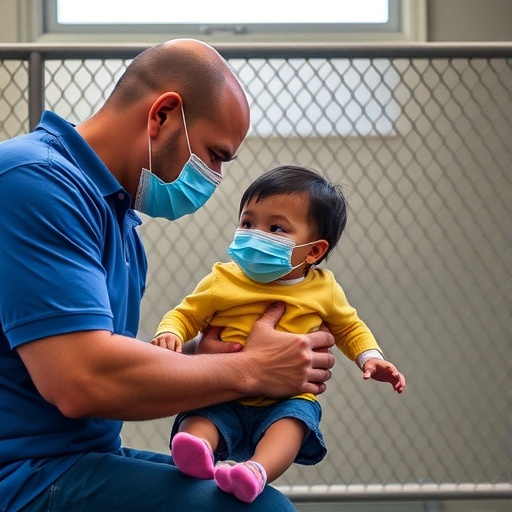
In the aftermath of the COVID-19 pandemic, there was widespread speculation and optimism regarding the potential for a fundamental transformation in family dynamics, particularly within dual-parent households. Lockdowns and stay-at-home orders across the globe created unprecedented conditions for parents to spend extended amounts of time with their children. This circumstance was anticipated to promote shared caregiving responsibilities and to foster deeper bonds between fathers and their offspring, an evolution superimposed on traditional parental roles. Yet, new empirical findings challenge this optimistic narrative, revealing that such shifts in fatherly engagement may have been neither as pronounced nor as enduring as once supposed.
Lee Gettler, the Rev. John A. O’Brien College Professor of Anthropology at the University of Notre Dame and chair of its Department of Anthropology, leads a pivotal research endeavor that scrutinizes paternal caregiving through a rigorous longitudinal lens. His team’s study, recently published in the journal PLOS One, meticulously contrasts fathering behaviors before and after the pandemic utilizing data accrued over 15 years in Cebu City, Philippines—a large metropolitan area selected for its lengthy and rigorous COVID-19 lockdowns. This geographic choice is crucial, as the Philippines imposed some of the strictest government-mandated quarantines worldwide, thus providing a robust environment to isolate any behavioral shifts in paternal caregiving induced by pandemic conditions.
Contrary to the widespread perception propagated by early media reports, Gettler’s research demonstrates that the increase in fathers’ involvement with child-rearing during pandemic-induced lockdowns did not translate into lasting behavioral changes. The study’s longitudinal data assess a range of paternal activities including routine hands-on care, recreational play, and educational support of young children. While fathers indeed spent more time at home during lockdowns, their patterns of caregiving once “normalcy” resumed remained consistent with pre-pandemic norms. This finding suggests that transient proximity alone does not produce sustained changes in paternal roles; rather, structural societal and economic factors continue to govern caregiving dynamics.
One particularly illuminating facet of Gettler’s research is the correlation between fathers’ employment status and their caregiving involvement. Fathers who experienced employment disruptions—shifting from full employment to either unemployment or underemployment during the pandemic—exhibited a notable rise in educational caregiving activities that persisted beyond the immediate pandemic period. This emergent pattern intimates that the capacity to participate in child-rearing is inextricably linked to economic realities. It underscores that availability predicated on involuntary occupation loss may temporarily augment caregiving, but suggests that intentional, policy-driven accommodations could foster more sustainable engagement.
This dynamic emphasizes the pivotal role that workplace policies could play in reshaping paternal involvement. Flexible work arrangements, including remote work options, adjustable scheduling, and paid paternity leave, represent structural shifts with transformative potential. They could mitigate the economic precarity that precludes many fathers from participating more fully in their children’s daily lives. The research highlights that absent such systemic changes, any pandemic-induced increases in paternal caregiving risk reverting to the status quo, whereby economic pressures circumscribe the caregiving roles fathers can realistically assume.
Moreover, Gettler’s findings offer critical insight into cultural and socio-economic disparities in fathering roles, advancing beyond predominantly Western-centric research perspectives. The Philippines context provides a compelling contrast to Euro-American paradigms, enriching the dialogue around fatherhood globally. While Cebu fathers have progressively increased their involvement over recent decades, mirroring trends in the United States, underlying economic inequalities and occupational instability still pose considerable barriers to sustained change in caregiving behaviors, as plainly revealed by the pandemic’s impact.
Beyond the quantitative tracking of fathering behaviors, Gettler situates this work within a broader framework of psychobiological and sociocultural research. His laboratory — the Hormones, Health, and Human Behavior Lab — investigates the hormonal and physiological underpinnings of parenting, probing how biological processes intersect with social environments to influence both maternal and paternal caregiving. This multi-dimensional approach enriches the understanding of fatherhood, encompassing mental and physical health, child development, and family dynamics in diverse populations across the United States, the Philippines, and the Republic of the Congo.
The research raises provocative questions about how society can structurally and culturally support fathers in maintaining active and equitable parenting roles. The initial pandemic period presented a unique “natural experiment” illuminating fathers’ potential capacities for caregiving when freed from some conventional occupational constraints. Yet, the reversion to pre-pandemic parenting patterns also underscores systemic shortcomings. Encouragement and facilitation of paternal involvement cannot rely solely on incidental circumstances like lockdowns but require intentional, sustained policy interventions and societal shifts in gender norms.
Gettler stresses that facilitating dads’ full participation in caregiving necessitates addressing the economic and workplace constraints that predominantly shape their capacity to engage. This involves creating environments conducive to paternal flexibility and support, without relegating fathers to unemployment or underemployment to gain caregiving opportunities. Effective policy strategies could foster environments that normalize fathers’ caregiving roles, thereby embedding these changes into lasting family dynamics and social expectations.
This nuanced understanding articulates an essential contribution to social science and public health discourses on family dynamics during crises. It challenges simplified narratives about pandemic-related shifts and encourages a realistic appraisal of the socio-economic determinants influencing paternal caregiving. By anchoring analysis in long-term datasets and non-Western socio-economic contexts, the study enriches global discourse on fatherhood and family wellbeing.
In conclusion, while the COVID-19 pandemic altered daily life in many respects, it did not alone catalyze a lasting revolution in fathering behaviors. The durability of paternal caregiving hinges on broader economic transformations and cultural acceptance of shared parenting roles. Recognizing this, policymakers, researchers, and advocates must seek coordinated strategies that support fathers, lessen precarity, and institutionalize flexibility, thereby enabling fathers to maintain—and deepen—their involvement in their children’s lives well beyond the pandemic’s end.
—
News Publication Date: 16-Mar-2026
Web References: http://dx.doi.org/10.1371/journal.pone.0343636
Cite Scienmag News
Courtney Benton. (April 30, 2026). Long-Term COVID Lockdown Study Reveals Surprising and Lasting Impacts on Fatherhood. Scienmag. https://scienmag.com/long-term-covid-lockdown-study-reveals-surprising-and-lasting-impacts-on-fatherhood/
Courtney Benton. "Long-Term COVID Lockdown Study Reveals Surprising and Lasting Impacts on Fatherhood." Scienmag, 30 April 2026, https://scienmag.com/long-term-covid-lockdown-study-reveals-surprising-and-lasting-impacts-on-fatherhood/. Accessed 5 September 2026.
Courtney Benton. "Long-Term COVID Lockdown Study Reveals Surprising and Lasting Impacts on Fatherhood." Scienmag. April 30, 2026. https://scienmag.com/long-term-covid-lockdown-study-reveals-surprising-and-lasting-impacts-on-fatherhood/


