


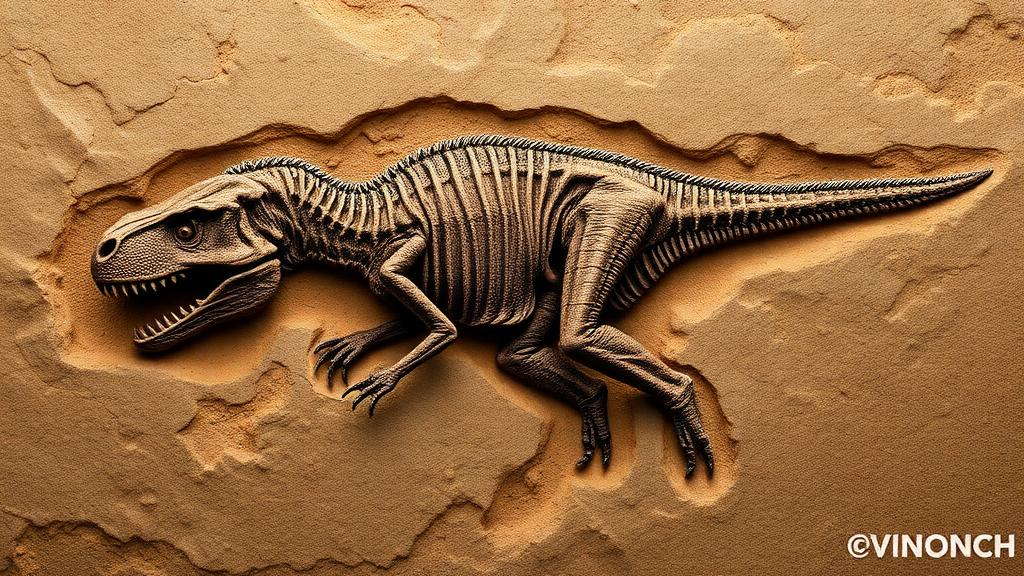
A fossil that sat unnoticed in a museum drawer for nearly a century has turned out to belong to an entirely new species of predatory dinosaur, and one that rewrites a chapter of dinosaur biogeography. A team led by researchers at University College London describes the animal, named Invictibellatrix amberina, in the journal Royal Society Open Science. The specimen, a fragment of the back of a skull, was collected on the Isle of Wight in the United Kingdom and acquired by the Natural History Museum in 1924. It now stands as the first member of the megaraptoran group of theropod dinosaurs ever identified in Europe, filling a conspicuous gap in the fossil record of one of the most enigmatic lineages of large meat-eating dinosaurs.
Megaraptorans were agile, two-legged carnivores closely related to tyrannosaurs, the lineage that includes the famous Tyrannosaurus rex. Despite that kinship, they evolved a strikingly different hunting apparatus. Rather than relying on massive jaws, megaraptorans possessed slender skulls and attacked their prey with powerfully muscled arms tipped by enormous curved claws. Some members of the group eventually grew to gigantic proportions and rose to the top of the food chain in the southern continents, but the newly described British species is among the smallest and earliest known, dating to the Early Cretaceous period roughly 120 million years ago. Its discovery in the United Kingdom places the early evolution of the group squarely on European soil.
Based on comparisons with its closest relatives, the research team estimates that Invictibellatrix amberina would have measured three to four metres in length and stood just over a metre and a half tall, roughly the height of an adult human. Lead author Dr Cassius Morrison of UCL Earth Sciences has suggested the animal likely bore feathers and that its claws may have reached lengths of around 10 to 20 centimetres. Its diet would have consisted of small dinosaurs, lizards and mammals, placing it in an ecological role comparable to that of a modern hyena: an active, capable predator and scavenger of mid-sized prey rather than the dominant carnivore of its landscape.
That ecological position is part of what makes the animal so intriguing from a human perspective. As Dr Morrison noted, although Invictibellatrix was not the apex predator of its time, a person encountering one would have faced a far more immediate danger than a T. rex. A human would represent roughly a third of the dinosaur’s body weight, making people perfectly sized prey that such an animal would very likely have pursued, whereas the much larger T. rex would have had little interest in prey so small relative to its own bulk. The comparison underscores how predator-prey dynamics in the Cretaceous differed sharply from the popular image shaped by the largest tyrannosaurs.
The identification of the new species depended on modern imaging applied to old material. The researchers subjected the fossil to computed tomography scanning, producing a three-dimensional model of the rear portion of the skull as well as a reconstruction of its internal cavity, effectively revealing the shape of the brain. Such braincase anatomy is highly informative in theropod dinosaurs, because the bones enclosing the brain carry features that vary consistently between major lineages and can therefore be used to test where a fragmentary specimen belongs on the dinosaur family tree.
The comparisons extended across a broad comparative sample of skulls and braincases from tyrannosaurs, spinosaurs, raptors and other bipedal carnivorous dinosaurs. A distinctive combination of anatomical traits emerged, including an oval opening where the spinal cord entered the brain and an hour-glass-shaped crest on the bones of the braincase. Neither feature alone would settle the question, but together they distinguished the specimen from every known species. When computer algorithms were used to analyse how the traits of the skull fit with those of other species, the results consistently placed the specimen within the megaraptoran family, confirming both its identity and its status as something previously unknown to science.
The geographic significance of the find is considerable. Megaraptorans are thought to have originated in Asia before migrating through Europe and eventually becoming apex predators across Gondwana, the southern supercontinent that comprised present-day Africa, South America and Antarctica. Until now, that hypothesis lacked a crucial piece of supporting evidence, because no megaraptoran fossils had ever been recovered from Europe. Co-author Charlie Scherer, a PhD student at UCL Earth Sciences, described the new species as the first proof that megaraptorans were present in Europe and that they reached Gondwana by that route rather than by island-hopping along more southern pathways. In effect, the Isle of Wight specimen anchors the middle leg of a dispersal story that had previously been inferred only from its endpoints.
To explore that story in more detail, the team used mathematical modelling to reconstruct how the global distribution of megaraptorans may have shifted through time. The models drew on the fossils discovered so far, the evolutionary relationships among the species, and reconstructions of ancient geography and climate. The results indicate that megaraptorans were globally widespread during the Early Cretaceous, the very interval in which Invictibellatrix lived. By the Late Cretaceous, tens of millions of years later, they had likely disappeared from Laurasia, the giant northern landmass that included modern-day Europe, while in the south they flourished as apex predators throughout Gondwana, attaining enormous sizes with claws reaching up to 35 centimetres in length.
The study did not determine why megaraptorans apparently died out in the north, but the authors point to plausible explanations that include shifts in climate or environment, or competition from other predators such as the tyrannosaurs that came to dominate northern landmasses in the Late Cretaceous. The southern record illustrates just how successful the lineage became where it survived. Maip macrothorax, recovered from rocks in what is now Argentina, is estimated to have been nine to ten metres long and to have weighed as much as an elephant, a stark contrast to the tiger-sized British pioneer described in this study.
The fossil itself carries a human history as rich as its scientific one. It was originally found at the foot of a cliff on the south-west coast of the Isle of Wight by the amateur palaeontologist Reginald Walter Tooley, and it was one of more than 1,000 specimens he discovered that were acquired by the Natural History Museum after his death. Senior author Professor Paul Barrett of the Natural History Museum emphasised that, despite more than 200 years of collecting on the island, new dinosaur species continue to emerge, and that carnivorous dinosaurs in particular have been elusive finds. Work of this kind, he noted, demonstrates the exceptional value of historical museum collections, in which many discoveries still await. The choice of name carries meaning as well: Invictibellatrix, meaning unconquered female warrior, was intended by the researchers to give hope and strength to those who are bullied, discriminated, victimised and oppressed, while amberina refers both to the amber found in the rocks where the fossil was discovered and to a female name. The research was funded by the Palaeontographical Society, the Royal Society and UKRI.
Subject of Research: Identification of a new Early Cretaceous megaraptoran theropod dinosaur species from an Isle of Wight fossil
Article Title: UK dinosaur fossil identified as new long-clawed predator
Article References: UK dinosaur fossil identified as new long-clawed predator. (n.d.). Original publication
Image Credits: AI Generated
DOI: Not provided
Keywords: Invictibellatrix amberina, megaraptoran, Isle of Wight, Early Cretaceous, theropod dinosaur, Natural History Museum, paleontology, Gondwana, Laurasia, tyrannosaurs, CT scanning, Royal Society Open Science
Cite Scienmag News
Violet Maxwell. (October 14, 2026). Long-clawed dinosaur from Isle of Wight fossil is first megaraptoran found in Europe. Scienmag. https://scienmag.com/long-clawed-dinosaur-from-isle-of-wight-fossil-is-first-megaraptoran-found-in-europe/
Violet Maxwell. "Long-clawed dinosaur from Isle of Wight fossil is first megaraptoran found in Europe." Scienmag, 14 October 2026, https://scienmag.com/long-clawed-dinosaur-from-isle-of-wight-fossil-is-first-megaraptoran-found-in-europe/. Accessed 14 October 2026.
Violet Maxwell. "Long-clawed dinosaur from Isle of Wight fossil is first megaraptoran found in Europe." Scienmag. October 14, 2026. https://scienmag.com/long-clawed-dinosaur-from-isle-of-wight-fossil-is-first-megaraptoran-found-in-europe/


