


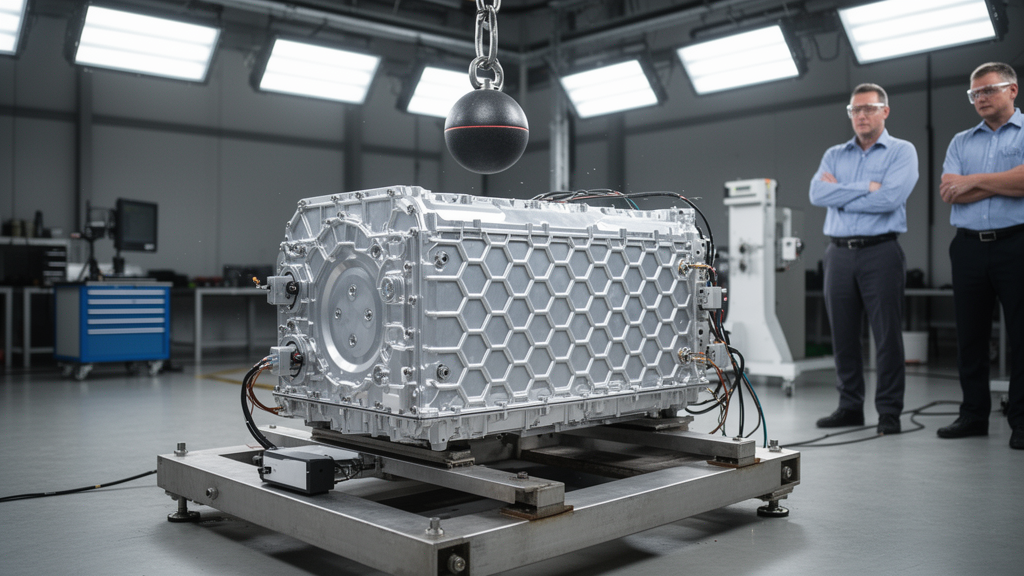
Electric vehicles have quietly repositioned one of the most safety-critical components in automotive engineering. To maximize range and packaging efficiency, manufacturers mount large, dense lithium-ion battery packs in the underfloor region, where they lower the vehicle’s center of gravity and free up cabin space. But the same layout places thousands of energy-dense cells just millimeters above the road surface, exposed to flying stones, curbs, humps, lateral pole strikes, water ingress, and vibration. A new Mini Review published in Frontiers in Mechanical Engineering argues that the battery enclosure protecting this pack is far more than a passive cover: it is simultaneously a load-bearing shell, an environmental barrier, and a mechanical safety device, and designing it well requires thinking about localized crash scenarios rather than generic material choices.
The review, led by Li Mingtao of Shandong Huayu University of Technology with colleagues from Dezhou and Liaoning, China, synthesizes recent lightweight enclosure research through a scenario- and mechanism-based protection framework. Instead of the conventional material-by-material catalogue, the authors organize their analysis around two especially demanding localized load cases: bottom strike and side-pole collision. Both scenarios act through narrow contact zones, meaning that global vehicle crash metrics can look perfectly acceptable while a small cluster of cells experiences damaging strain. The work comes at a timely moment, since China’s GB 38031-2025 standard, which entered force on 1 July 2026, places stronger emphasis on traction-battery system safety and makes realistic mechanical and thermal-abuse validation directly relevant to enclosure design.
The authors screened literature from 2014 to July 2026 across five major databases, starting from 214 records and ultimately retaining 32 studies for qualitative synthesis. Each study was categorized by load case, structural concept, validation scale, and reported performance metric. The synthesis is built on a four-stage protection chain that the authors say should govern how any enclosure concept is judged. The first stage is the external load, whether road-debris strike, ground impact, or side-pole intrusion. The second is the enclosure response, encompassing puncture resistance, load spreading, progressive crushing, and joint retention. The third stage translates enclosure deformation into battery safety indicators: local intrusion, cell strain, separator damage, internal short-circuit risk, and module displacement. The final stage covers post-crash function, including venting space, thermal path integrity, electrical isolation, water sealing, inspection, and repairability.
This staging matters, the authors emphasize, because a design can absorb energy efficiently yet remain unsafe if it transfers a high local load into cells or loses thermal and sealing functions after the crash. Cell-level studies have shown that mechanical abuse can progress from indentation and separator damage to internal short circuit and thermal runaway, so enclosure design has to be interpreted through cell safety as well as structural mass. The review links external impact loads to enclosure response, cell-level safety indicators, and post-crash thermal or electrical functions in a way that earlier broader reviews of battery-box lightweighting and pack-level reliability did not.
Bottom strike and localized underbody loading share a localized contact feature even when loading rates differ. The lower shield and tray must spread the load before the module floor or cell group becomes the effective hard stop. Ground-impact work by Xia and Wierzbicki showed that cells and packs can be damaged through localized indentation and load transfer, while dynamic cell-impact tests demonstrate that loading rate and cell format affect the onset of failure. For enclosure design, this means a thick plate is not always the best answer. A better bottom protector combines a hard contact face, a crushable or load-spreading core, and an upper boundary that keeps cell strain below damaging levels. Side-pole collision is a lateral intrusion and load-path problem: a pole can bypass broad frontal crash structures and push loads through the rocker, sill, side rail, battery wall, and module edge. Added side protection must start crushing early enough to absorb energy, but not so stiffly that it creates a hard point near the cells.
The review compares aluminum alloys, composite and hybrid structures, foam-filled members, sandwich panels, honeycomb cores, auxetic lattices, and bio-inspired absorbers in terms of intrusion control, energy absorption, manufacturability, and coupled mechanical-thermal performance. Aluminum remains the most practical lightweight baseline because extrusion, casting, forming, welding, and adhesive bonding are mature in automotive production, though its weakness is local indentation and joint sensitivity. High-strength and advanced high-strength steels should not be excluded, especially in local puncture-resistant shields and side rails where ductility, cost, and joining robustness may outweigh density alone. Foam-filled aluminum concepts stabilize crushing: one optimized aluminum foam-filled battery box increased specific energy absorption by 40.76 to 50.71 percent while reducing peak crushing force by 8.45 to 11.56 percent, and aluminum tubes filled with phase-change material absorbed more than 95 percent of initial impact energy while reducing peak temperature rise by up to 18 degrees Celsius.
Composite enclosures can reduce mass when stiffness, intrusion, and joint requirements are satisfied under equivalent boundary conditions, but their safety value depends on controlled failure rather than material density alone. Finite element studies of carbon-fiber enclosures reported strong mass-saving potential relative to aluminum baselines, and machine-learning-assisted organosheet design has been used to explore crashworthy composite layouts efficiently. The main risks are brittle fracture, delamination, bolt-hole failure, difficult repair, and uncertain end-of-life routes; a life-cycle assessment of a composite battery enclosure prototype confirms that lightweighting should be judged together with embodied impact and recyclability, not by mass alone. Sandwich, honeycomb, lattice, and bio-inspired structures are attractive because geometry can tune stiffness, force level, and crush distance. Auxetic and negative-Poisson-ratio structures can promote lateral densification and improve resistance to localized intrusion, but this benefit is sensitive to unit-cell orientation, boundary confinement, strain-rate effects, and manufacturing defects. One 3D auxetic sandwich protector weighing just 0.75 kilograms absorbed 591 joules with maximum battery deformation of only 1.92 millimeters, while a honeycomb-auxetic hybrid side profile achieved a 23.9 percent mass reduction with 658 joules of absorbed energy.
The synthesis indicates that no single material family solves the design problem alone. A practical material ranking should begin with the expected deformation mode rather than with density alone. If the design goal is to block puncture, a hard lower face and local reinforcement may matter more than a low average mass. If the goal is to reduce peak side intrusion, a ductile crush member or foam-filled profile may be preferable to a very stiff composite wall. If the goal is to save mass in broad areas away from severe contact, sandwich or composite panels may be efficient. The strongest enclosure concepts combine these roles locally, using different structural mechanisms at the bottom shield, side rail, cross member, and module interface. Vehicle architecture also changes the feasible design space: a skateboard platform may provide broad underfloor area but little vertical clearance, whereas a body-integrated pack may use cross members and side sills as part of the enclosure load path, so enclosure results should not be transferred between platforms without checking boundary conditions.
Crash-thermal coupling is a central theme. Mechanical deformation is relevant because it can trigger electrical and thermal hazards: a mechanical strike may damage cells, distort venting paths, reduce insulation distance, and create delayed thermal risk. The key question is whether the enclosure still preserves venting, heat-spreading, and isolation functions after mechanical deformation. Maximum tray displacement is not enough; a bottom shield or side wall should also preserve venting clearance, heat-spreading paths, isolation distance, sealing, and inspection access after deformation. Multifunctional concepts such as phase-change-filled aluminum tubes are promising because they suggest that the same protective volume may contribute to both crash absorption and thermal moderation, provided that post-impact integrity is retained. For liquid-cooled packs, post-impact coolant leakage and sealing degradation should be treated as safety-relevant outcomes, because coolant loss or ingress can interact with electrical isolation and delayed thermal hazards.
Validation should be hierarchical, the authors argue. Full-vehicle models are needed to obtain realistic boundary conditions for bottom and side impacts; pack submodels resolve enclosure ribs, joints, inserts, and module motion; cell or module models translate local deformation into safety indicators. Cell-level criteria should be calibrated with mechanical-abuse data that specify state of charge, temperature, loading rate, cell format, and failure definition, because these variables strongly affect the transition from deformation to internal short-circuit risk. Many enclosure papers use simplified battery modules or rigid cell blocks to reduce model size, which is reasonable during concept screening, but final design decisions need a traceable link between structural response and cell safety. A useful workflow starts with full-vehicle boundary conditions, extracts critical pack deformation, refines a pack submodel around the impact region, and then uses calibrated cell or module criteria to interpret the risk. This avoids two common errors: optimizing a tray without realistic vehicle load paths, and declaring a cell-safe design from a shell displacement metric alone.
Four gaps limit current enclosure research, the review concludes. First, metrics remain uneven across studies: one paper reports mass reduction, another peak force, another specific energy absorption, another cell damage, and these metrics are not interchangeable. A bottom-impact design should report local indentation, penetration resistance, residual module clearance, and cell strain risk; a side-pole design should report lateral intrusion, load transfer through body-side members, crush mode stability, and module boundary deformation. Without scenario-specific metrics, lightweighting can be mistaken for safety improvement. Second, crash and thermal safety are still too often validated in separate silos, even though enclosures experience coupled abuse. Third, advanced architectures need production realism: auxetic lattices, graded honeycombs, and bio-inspired cores can look compelling in a unit-cell study, but vehicle enclosures need meter-scale repeatability, corrosion control, debris tolerance, joining reliability, and repair routes. Hybrid designs are likely to be more deployable than single exotic materials, with aluminum or steel frames carrying global loads while composite, foam, honeycomb, or auxetic inserts are placed only where local intrusion risk is high. Finally, standards-based validation must move closer to realistic localized loading, with calibrated multiscale criteria that connect enclosure intrusion and module deformation to experimentally validated cell-level failure thresholds.
The more urgent bottleneck, the authors say, is scenario-level validation that proves a design remains safe across localized mechanical loading and post-impact functional requirements. A useful future benchmark would pair a mechanical load case with cell-level safety criteria and post-impact functional checks, helping distinguish a light enclosure that merely survives a simulation from a protective system that remains safe, inspectable, and manufacturable. Progress toward practical adoption therefore depends less on identifying another isolated lightweight material and more on establishing comparable scenario-specific metrics, calibrated cell-level failure criteria, manufacturable hybrid architectures, and standards-linked post-impact validation. The next generation of battery enclosures, in other words, will be judged not by how light they are on paper, but by how well they interrupt the load-to-hazard chain when the road strikes back.
Subject of Research: Localized impact-resistant battery enclosures for electric vehicles: crashworthy lightweight design, mechanical–thermal safety, and validation pathways
Article Title: Localized impact-resistant battery enclosures for electric vehicles: crashworthy lightweight design, mechanical–thermal safety, and validation pathways
Article References: Localized impact-resistant battery enclosures for electric vehicles: crashworthy lightweight design, mechanical–thermal safety, and validation pathways. (n.d.). https://doi.org/10.3389/fmech.2026.1961229
Image Credits: AI Generated
DOI: 10.3389/fmech.2026.1961229
Keywords: Localized, impact-resistant, battery, enclosures, electric, vehicles, crashworthy, lightweight, design, mechanical, thermal, safety
Cite Scienmag News
Faith Mcneil. (October 16, 2026). Localized impact-resistant battery enclosures for electric vehicles: crashworthy lightweight design, mechanical–thermal safety, and validation pathways. Scienmag. https://scienmag.com/localized-impact-resistant-battery-enclosures-for-electric-vehicles-crashworthy-lightweight-design-mechanical-thermal-safety-and-validation-pathways/
Faith Mcneil. "Localized impact-resistant battery enclosures for electric vehicles: crashworthy lightweight design, mechanical–thermal safety, and validation pathways." Scienmag, 16 October 2026, https://scienmag.com/localized-impact-resistant-battery-enclosures-for-electric-vehicles-crashworthy-lightweight-design-mechanical-thermal-safety-and-validation-pathways/. Accessed 16 October 2026.
Faith Mcneil. "Localized impact-resistant battery enclosures for electric vehicles: crashworthy lightweight design, mechanical–thermal safety, and validation pathways." Scienmag. October 16, 2026. https://scienmag.com/localized-impact-resistant-battery-enclosures-for-electric-vehicles-crashworthy-lightweight-design-mechanical-thermal-safety-and-validation-pathways/


