

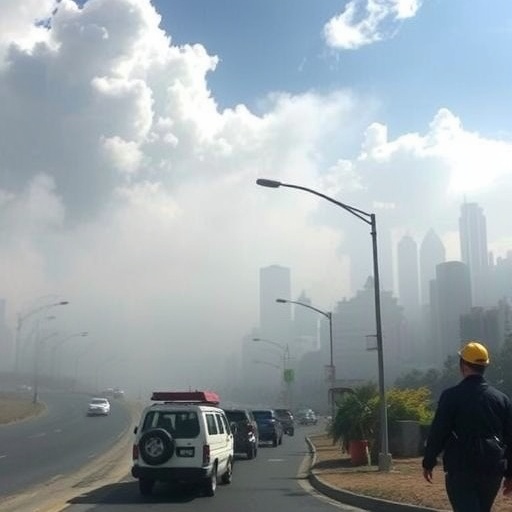
Atmospheric science has unveiled intricate dynamics that govern air quality, particularly through the interplay between various pollutants like PM2.5 and ozone (O3). The recent study by Zhou et al. sheds light on how local mesoscale circulations impact the migration and transformation of these pollutants in riverine and mountainous regions. Mesoscale circulations refer to atmospheric patterns that range from a few kilometers to hundreds of kilometers and can significantly influence local weather, including temperature, wind patterns, and ultimately, air quality.
The significance of understanding these local circulations is heightened in areas where both natural features and human activities converge. The unique topography of mountainous and riverine regions often leads to complex weather systems that can trap pollutants, exacerbating air quality issues. This localized phenomenon has been largely overlooked in previous air quality assessments, which often generalized the influence of broader climatic factors. The nuanced findings from this study could pave the way for more tailored pollution control measures in targeted areas.
Zhou and colleagues employed a combination of field measurements and advanced atmospheric modeling to account for the intricate interactions between local circulations and pollutant behavior. This dual approach allowed them to capture how variations in topography influence wind patterns, affecting the dispersion and concentration of PM2.5 and O3. In a world increasingly aware of air quality’s impacts on health, such detailed investigations are crucial to inform both policy and public awareness.
Particularly in mountainous terrains, the researchers noted that wind patterns tend to be more variable, often resulting in the formation of stagnant air pockets that can lead to elevated pollution levels. Conversely, regions along rivers may experience unique patterns of airflow due to the temperature differentials between land and water bodies. Such dynamics create explicitly defined environments where pollutants can undergo chemical transformations, often leading to the formation of secondary pollutants, which have their own set of health and environmental implications.
The study also highlighted the role of meteorological conditions—like humidity and solar radiation—in modifying the fate of airborne pollutants. For example, higher humidity levels can influence the chemical reactions between PM2.5 and O3, facilitating the formation of larger particulate matter that is often more harmful. Similarly, sunlight plays a critical role in initiating photochemical reactions that can convert primary pollutants into secondary pollutants, thereby complicating the air quality landscape.
Importantly, the researchers advocated for integrating local mesoscale studies into broader air quality models. By incorporating these findings, scientists can improve predictive models related to air quality, offering greater precision in forecasting pollution events. This refinement could be essential for cities struggling with air quality management, enabling more effective health advisories and pollution control strategies.
Understanding these meteorological influences does not only benefit the scientific community; it can also empower local governments and communities. Stakeholders can make informed decisions on urban planning, industrial activities, and transportation systems to minimize pollution based on localized data. Collaboratively, these actions may significantly alleviate the public health burden associated with air pollution.
Moreover, the research underscores the necessity for ongoing monitoring of local air quality with advanced technologies like satellite imagery and drone surveillance. Real-time data collection can enhance our comprehension of how daily variations in weather impact pollution levels. With higher resolution data, communities can respond more adeptly to pollution spikes, tailoring their responses effectively to safeguard public health.
This inquiry into local mesoscale circulations is particularly timely, considering the global shift towards recognizing air quality as a significant determinant of health. Given that air pollution is linked to respiratory diseases, cardiovascular problems, and increased mortality rates, understanding the mechanisms that exacerbate these conditions necessitates rigorous research. By delving into local factors, scientists can provide actionable insights, ultimately reducing the public’s exposure to harmful pollutants.
Additionally, as climate change alters weather patterns and increases the frequency of extreme weather events, the relationship between air quality and local meteorology will become ever more crucial. This research serves as a reminder that while global trends are essential, local dynamics are equally significant in understanding atmospheric health. It advocates for a multifaceted approach to air quality studies that encompasses both macro and micro-level influences.
The implications of Zhou et al.’s findings stretch beyond the immediate geographical confines of their study. The methodologies developed can serve as a blueprint for similar investigations in other regions known for their complex topographical challenges. Ultimately, by fostering a greater understanding of local atmospheric processes, more effective, nuanced pollution control strategies can emerge, potentially reducing the extensive burden of diseases correlated with air quality.
In conclusion, the study by Zhou and team illuminates a vital aspect of atmospheric science that must not be overlooked. By focusing on local mesoscale circulations and their effects on PM2.5 and O3, researchers are carving a path towards better air quality management tailored to meet specific environmental challenges. Such work underscores the vital synergy between scientific research, policy implementation, and public health, creating a legacy of informed action against air pollution.
With the ongoing quest for better air quality standards in mind, this research not only contributes to academic literature but acts as a call to action for policy-makers to consider localized environments in their air quality initiatives. The findings provide a substantial basis for advancing environmental health measures that are crucial for our communities’ wellbeing in a changing world.
Subject of Research: Impact of local mesoscale circulations on air quality, specifically PM2.5 and O3.
Article Title: Effects of local mesoscale circulations on PM2.5 and O3 migration and transformation over the riverine and mountainous regions.
Article References:
Zhou, T., Huang, H., Zhang, M. et al. Effects of local mesoscale circulations on PM2.5 and O3 migration and transformation over the riverine and mountainous regions.
Environ Monit Assess 198, 83 (2026). https://doi.org/10.1007/s10661-025-14902-w
Image Credits: AI Generated
DOI: https://doi.org/10.1007/s10661-025-14902-w
Keywords: Air quality, PM2.5, O3, mesoscale circulations, atmospheric science, pollution control, environmental health.


