Most research on household air pollution has concentrated on kitchens, where cooking fires release smoke and combustion by-products. A new cross-sectional study from Jimma Town, Ethiopia, turns attention to a different and often overlooked space: the living room. Researchers measured pollutant concentrations in living rooms during periods when no cooking was taking place, and asked residents about health symptoms they had experienced.
The study, published in BMC Public Health, was led by Temima Jemal and colleagues. The team used systematic random sampling to recruit 265 households in the town, collecting air quality measurements alongside information about household characteristics, housing conditions and socioeconomic factors.
The researchers focused on two pollutant groups: total volatile organic compounds, reported as TVOC, and particulate matter in the PM2.5 to PM10 range. They also recorded key determinants of indoor air quality, including living room volume, ventilation characteristics, and the presence of non-combustible pollutant sources such as household chemicals.
The measurements showed that 36.2 percent of households had TVOC concentrations between 501 and 750 micrograms per cubic metre, while particulate matter concentrations predominantly fell within the 0.051 to 0.1 milligram per cubic metre range, accounting for 30.2 percent of households. These figures describe short-term spot measurements taken during non-cooking periods rather than continuous long-term monitoring.
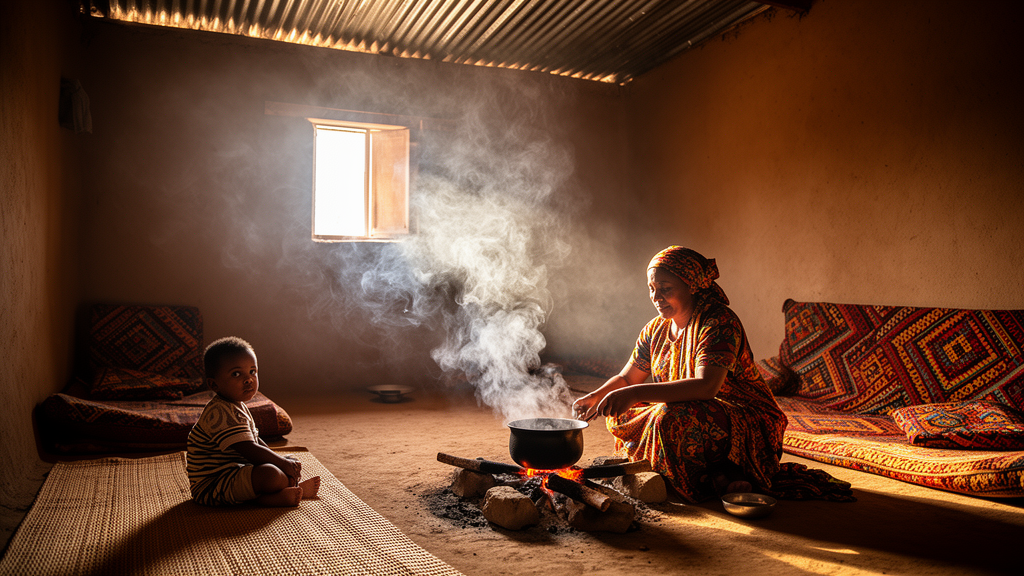
Housing conditions emerged as a central theme. Nearly 60 percent of the households studied had living rooms smaller than 60 cubic metres, and 39.6 percent lacked proper ventilation. In addition, 37 percent of respondents reported having no separate kitchen at all, a situation that can bring cooking emissions into shared living spaces and compound exposure from other sources.
The study also documented everyday household products as potential indoor sources. 53.6 percent of households reported using insecticides, 81.5 percent used cleaning products, and 72.8 percent used personal care items such as perfumes.
On the health side, 46.4 percent of households reported respiratory and eye-related problems that the authors suggest could be associated with indoor air pollution. The researchers are careful to frame this as an association rather than a causal effect. The study relies on self-reported symptoms, short-term spot measurements, and a cross-sectional design, all of which limit the strength of any causal interpretation.
The authors conclude that there is an urgent need for increased awareness about ventilation and about using kitchens separately from living areas, in order to reduce what they describe as dual emission sources. They also call for further research involving locally contextualized interventions that can generate evidence to inform actionable policy.
By documenting measurable pollutant levels in living rooms during non-cooking hours, the study highlights a research gap that has received comparatively little attention: people may spend substantial amounts of time in living rooms, experiencing prolonged exposure to pollutants from both indoor and outdoor sources. The findings from Jimma Town suggest that household air quality concerns extend well beyond the kitchen, and that housing design, ventilation and everyday product use all deserve a place in future indoor air research and policy discussions.
Subject of Research: Indoor air pollutant concentrations in living rooms during non-cooking periods and self-reported health problems in Jimma Town, Ethiopia
Article Title: Indoor air pollutant concentrations in living rooms during non-cooking periods and associated self-reported health problems in Jimma Town, Ethiopia
Article References: Jemal, T., Deti, M., Eshetu, T. T., Olani, D. D., & Tucho, G. T. (2026). Indoor air pollutant concentrations in living rooms during non-cooking periods and associated self-reported health problems in Jimma Town, Ethiopia. BMC Public Health. https://doi.org/10.1186/s12889-026-30109-1
Image Credits: AI Generated
DOI: 10.1186/s12889-026-30109-1
Keywords: indoor air pollution, living rooms, TVOC, particulate matter, ventilation, Ethiopia, Jimma Town, cross-sectional study, household chemicals, respiratory symptoms, public health, Indoor
Cite Scienmag News
Russell Cooper. (October 28, 2026). Living Room Air Pollution in Ethiopian Homes Linked to Reported Health Problems. Scienmag. https://scienmag.com/living-room-air-pollution-in-ethiopian-homes-linked-to-reported-health-problems/
Russell Cooper. "Living Room Air Pollution in Ethiopian Homes Linked to Reported Health Problems." Scienmag, 28 October 2026, https://scienmag.com/living-room-air-pollution-in-ethiopian-homes-linked-to-reported-health-problems/. Accessed 29 October 2026.
Russell Cooper. "Living Room Air Pollution in Ethiopian Homes Linked to Reported Health Problems." Scienmag. October 28, 2026. https://scienmag.com/living-room-air-pollution-in-ethiopian-homes-linked-to-reported-health-problems/