


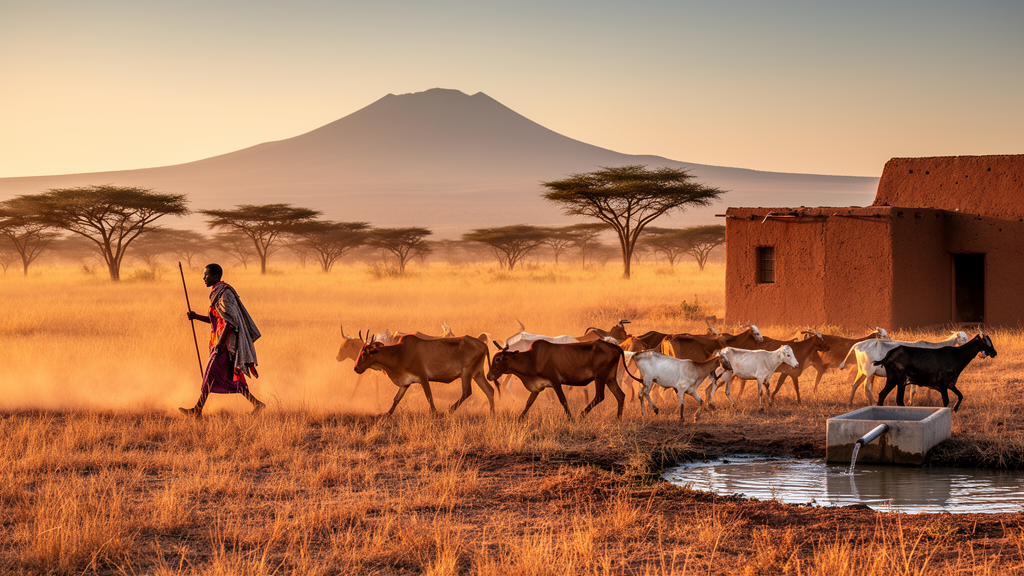
In the arid lowlands of Ethiopia’s Oromia region, where rainfall is erratic and crop farming is largely impossible, the survival of entire communities hinges on the health of their herds. A new field study from Fentale District, published in the journal Pastoralism: Research, Policy and Practice, offers one of the most detailed quantitative portraits yet of how pastoral households manage livestock production under intensifying environmental and economic pressure. Drawing on surveys of 344 households, twenty key informant interviews, focus group discussions, and six months of field observation, the research team from Arsi University and Borana University reveals a system that is simultaneously remarkably adaptive and dangerously underserved.
The study’s most striking finding concerns the changing composition of Fentale’s herds. When researchers converted household livestock holdings into tropical livestock units, a standard biomass measure in which a camel counts as 1.25 units and a cow as 0.70, camels emerged as the single largest contributor to household herd biomass, averaging 9.86 units per household. Cattle followed with a combined 7.91 units across cows, calves, heifers, and bulls, while goats contributed 3.24 units. This camel ascendancy is not accidental. Camels tolerate heat stress, can walk long distances to water, and can go several days without drinking, traits that make them better suited to a district where temperatures reach 36.7 degrees Celsius and annual rainfall ranges from just 400 to 700 millimeters. The researchers interpret this multi-species diversification, spanning cattle, camels, sheep, goats, and equines, as a deliberate risk-spreading strategy in which no single species failure can wipe out a family’s entire livelihood.
Yet the feed base supporting these herds is collapsing. Natural grazing supplied 60 percent of livestock feed, with crop residues from the nearby Wenji sugar factory area contributing 28 percent, but 99.7 percent of surveyed households reported that they did not have enough feed for their animals. The reasons were ranked clearly: grazing land shortage accounted for 69 percent of the inadequacy, and bush encroachment, the spread of invasive woody plants across rangelands, took over the remaining 31 percent. Nearly all respondents, 99.4 percent, said grazing land was on a decreasing trend. Feed is the single largest input cost in livestock production, covering up to 70 percent of the total cost of producing meat, milk, and eggs, so this scarcity strikes directly at household productivity. Indigenous cows in the district produced an average of just 1.6 liters of milk per day in the rainy season, falling to 1 liter in the dry season, figures that reflect both forage shortage and heat stress.
Water scarcity compounds the feed crisis. Rivers, ponds, and deep wells served as the primary drinking sources, ranked at 0.47, 0.31, and 0.21 respectively, but inaccessibility of water points was the dominant constraint at an index of 0.52. During the dry season, livestock trekked up to four hours simply to reach water, wasting body condition and reducing reproductive efficiency. Cattle and sheep drank daily or at two-day intervals, while camels and goats, true to their desert adaptations, could wait two to three days or longer. Recurrent drought was ranked as the primary production constraint overall, with an index of 0.51, followed by feed shortage at 0.26 and water scarcity at 0.11. The researchers frame these pressures through the Sustainable Livelihoods Framework, which analyzes how households deploy natural, physical, human, social, and financial capital to survive shocks.
What makes the study compelling is its documentation of the sophisticated traditional practices that persist despite these gaps. The Kaloo system, practiced by 59 percent of households, involves enclosing grazing land during the rainy season so that standing hay accumulates for use in the dry season, a community-based feed bank rooted in indigenous rangeland governance. Seasonal herd mobility, practiced by 47 percent of respondents, allows herders to follow spatially variable forage resources, a strategy that contemporary dryland research increasingly recognizes as rational and productive rather than a maladaptive remnant. Trait-based animal selection also endures: pastoralists chose cows primarily for milk yield, udder size, and fertility, while bulls were selected mainly for coat color, adaptive ability, and their dam’s milk yield. Castration of male animals, performed by 93 percent of households mainly for fattening and taming aggressive behavior, rounded out a husbandry toolkit refined over generations.
These traditional strengths, however, are being undermined by institutional neglect. Only 24.7 percent of households used livestock extension services, and 76 percent had no access to veterinary clinics. The lack of clinical availability ranked highest among animal health constraints at 0.43, followed by inadequate vaccination at 0.26 and expensive drugs at 0.14. Despite this, 95 percent of pastoralists reported vaccinating their livestock at least once a year, indicating strong demand for services that are simply not reaching them. Diseases of economic importance included blackleg, anthrax, foot-and-mouth disease, pasteurellosis, lumpy skin disease, contagious caprine pleuropneumonia, peste des petits ruminants, and brucellosis in camels. The remoteness of the district, poor infrastructure, and high turnover of trained personnel, including development agents and veterinarians, were cited as the central reasons for this service vacuum.
Market access tells a similar story of proximity and infrastructure failure. The nearest livestock market was roughly 20 kilometers from most households, a distance that directly depresses prices because animals lose weight during long treks. Evidence from comparable settings suggests household income from livestock falls by about 1 percent for every ten kilometers a family lives from a market center. In Fentale, 52 percent of pastoralists reported deriving no benefit from marketing centers, and small ruminants, ranked at 0.49, were the primary species sold, ahead of cattle at 0.35 and camels at 0.25, precisely because goats and sheep are easier to trek and convert to cash. Selling dairy products was rare, practiced by only 8 percent of households, and the marketing system was weakened by lack of market information at 0.33, weak market linkage at 0.27, and the presence of illegal brokers at 0.20.
The demographic profile of the surveyed population amplifies these vulnerabilities. Nearly 90 percent of respondents were male, and 87.5 percent had no formal education, a factor the authors link to reduced adoption of adaptive technologies and limited employment opportunities outside pastoralism. Almost 99 percent of respondents identified purely as pastoralists, meaning households lack experience with alternative farming systems that could buffer drought shocks. The researchers note that this pattern is consistent with earlier findings in the district and across the Horn of Africa, where formal education remains rare in pastoral communities, and they argue that low literacy constrains resilience-building in ways that policy has yet to address.
The policy implications are pointed. Ethiopia’s Livestock Master Plan and its ten-year agricultural development plan emphasize productivity growth and commercialization, but the authors observe that these frameworks focus disproportionately on highland mixed-farming systems while lowland pastoral areas receive less targeted attention and investment. Given that livestock account for roughly 40 percent of Ethiopia’s agricultural GDP and that the country leads Africa with over 70 million cattle, 52 million goats, and 42 million sheep, the marginalization of the systems sustaining millions of lowland pastoralists represents a significant blind spot in national development planning.
The study concludes that Fentale’s pastoralists employ historically effective adaptive strategies across all five livelihood capital categories, from the natural capital of herd mobility to the social capital of the Kaloo enclosure system and the traditional Gadaa governance institutions, but that these strategies are increasingly insufficient against intensifying land degradation and climate variability. The authors call for urgent interventions prioritizing dry-season feed and water security, expansion of mobile veterinary and extension services, improved livestock market infrastructure, and stronger drought early-warning systems, coordinated across district and regional livestock offices, water authorities, pastoral cooperatives, research institutions, and development partners. Integrating indigenous practices such as seasonal mobility, Kaloo grazing management, and indigenous breed selection with scientific and institutional support, they argue, could strengthen resilience and enhance the long-term sustainability of pastoral livelihoods in Fentale District and beyond.
Subject of Research: Livestock production, productivity, and sustainability in Ethiopian pastoral systems: evidence from Fentale District
Article Title: Livestock production, productivity, and sustainability in Ethiopian pastoral systems: evidence from Fentale District
Article References: Fufa, A. J., Mekonnen, K. T., Beyenssa, B. C., & Fufa, H. J. (2026). Livestock production, productivity, and sustainability in Ethiopian pastoral systems: evidence from Fentale District. Pastoralism: Research, Policy and Practice, 16, Article 16409. https://doi.org/10.3389/past.2026.16409
Image Credits: AI Generated
Keywords: Livestock, production, productivity, sustainability, Ethiopian, pastoral, systems, evidence, Fentale, District, scientific research
Cite Scienmag News
William Thompson. (October 16, 2026). Livestock production, productivity, and sustainability in Ethiopian pastoral systems: evidence from Fentale District. Scienmag. https://scienmag.com/livestock-production-productivity-and-sustainability-in-ethiopian-pastoral-systems-evidence-from-fentale-district/
William Thompson. "Livestock production, productivity, and sustainability in Ethiopian pastoral systems: evidence from Fentale District." Scienmag, 16 October 2026, https://scienmag.com/livestock-production-productivity-and-sustainability-in-ethiopian-pastoral-systems-evidence-from-fentale-district/. Accessed 16 October 2026.
William Thompson. "Livestock production, productivity, and sustainability in Ethiopian pastoral systems: evidence from Fentale District." Scienmag. October 16, 2026. https://scienmag.com/livestock-production-productivity-and-sustainability-in-ethiopian-pastoral-systems-evidence-from-fentale-district/


