


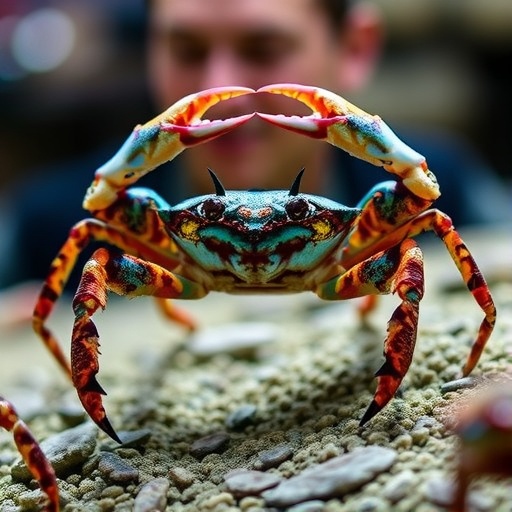
Recent research has illuminated the intricate relationship between differential gene expression, genomic variations, and functional adaptation within various developmental stages of the blue crab, scientifically known as Callinectes sapidus. In an era where marine biology intertwines with cutting-edge genomic technologies, the findings presented by Baldino, Bachvaroff, and Chung in their upcoming article promise to deepen our understanding of crustacean biology and adaptive evolution. Understanding numerous life stages of this commercially and ecologically significant species can pave the way for better conservation strategies and fisheries management.
As the population of Callinectes sapidus plays a vital role in marine ecosystems, their adaptability offers insights into how organisms respond to environmental changes. This research investigates the underlying genetic mechanisms that enable these crustaceans to thrive in diverse habitats and stressful conditions. Throughout their life cycle, blue crabs undergo various morphological and physiological transformations. By examining these transitions at a molecular level, the authors aim to uncover the genetic adaptations that facilitate survival in fluctuating environments, including alterations in temperature, salinity, and prey availability.
By comparing gene expression across different developmental stages, the authors highlight essential epigenetic modifications that influence phenotypic traits. The study employs advanced genomic technologies, including RNA sequencing, to quantify gene expression profiles at each life stage of the blue crab. Through this rich dataset, the authors are poised to illustrate how the interplay between genetics and environmental factors drives phenotypic plasticity in the species. The implications of such findings extend beyond biology; they touch on fisheries management and ecological conservation.
Future climates are bound to impose unprecedented stressors on marine habitats. As such, understanding how marine species like Callinectes sapidus adapt to changes in their environment becomes increasingly critical. Gene expression studies reinforce the concept that biodiversity is largely dependent on genetic heterogeneity. The findings from Baldino and colleagues provide insights into how specific gene sets activate under stress, enabling organisms to make physiological shifts for survival.
The researchers utilized a comparative approach, assessing gene expression at larval, juvenile, and adult stages of Callinectes sapidus. This systematic study showcases the dynamic nature of gene expression as these crabs transition through biological phases. Notably, the study identifies key genes responsible for resilience against environmental stressors such as hypoxia or variations in water salinity, which are predominant in estuarine habitats where these crabs are found. The data suggest that certain genes associated with stress responses are upregulated during critical life stages.
Through bioinformatics tools and techniques, the researchers also mapped out genomic sequences that correlate with functional adaptations. These sequences expose the genetic foundations governing crucial biological functions, such as growth rate, reproductive strategies, and even predator avoidance. Another exciting aspect of this research lies in establishing genome-wide association studies, providing a clearer picture of the adaptive traits present in these crabs.
The study not only sheds light on the importance of genetic research in marine biology but also emphasizes the influence of environmental changes on the future of marine species. Crustaceans exhibit remarkable adaptation capabilities, yet their resilience can be threatened by seawater temperature increases and changing oceanic chemistry. Findings from Baldino et al. highlight the necessity of ongoing research focused on adaptability and the evolutionary potential of marine organisms as we grapple with the effects of climate change.
As Callinectes sapidus has significant ecological and economic value, understanding how gene expression patterns contribute to their adaptability is crucial for sustainable management. Fisheries often rely heavily on knowing how populations respond to environmental fluctuations. With research like Baldino et al.’s, this knowledge becomes increasingly accessible, allowing fisheries to adapt strategies to support healthy populations and thriving ecosystems.
Moreover, the study’s results convey a compelling narrative: the need to conserve genetic diversity in marine populations. Genetic variation serves as a buffer against environmental disturbances, ensuring that species have the tools necessary for adaptation. The authors advocate for conservation efforts that prioritize the preservation of genetic resources, particularly in commercial fisheries, which often focus more on biomass rather than the genetic health of the stock.
In summary, the upcoming article on the relationship between differential gene expression and functional adaptation in Callinectes sapidus promises to be a cornerstone piece in marine genomic studies. The combination of cutting-edge genomic techniques with a focus on environmental factors provides a comprehensive view of how blue crabs not only survive but thrive under diverse conditions.
In conclusion, the implications of this research are manifold, touching on the realms of biology, ecology, and economic sustainability in fisheries. As scientists unravel the complex genetic tapestry of Callinectes sapidus, we gain a clearer understanding of the vital links that bind genetics, environment, and survival in marine ecosystems. We anticipate that this work will significantly contribute to the scientific literature and provide actionable insights for conservation strategies moving forward.
Baldino, A., Bachvaroff, T. & Chung, J.S. Relating differential gene expression and genomic analyses to functional adaptation at various developmental stages of the blue crab, Callinectes sapidus.
BMC Genomics (2025). https://doi.org/10.1186/s12864-025-12344-9
Cite Scienmag News
Juliet Wilcox. (November 28, 2025). Linking Gene Expression to Blue Crab Development. Scienmag. https://scienmag.com/linking-gene-expression-to-blue-crab-development/
Juliet Wilcox. "Linking Gene Expression to Blue Crab Development." Scienmag, 28 November 2025, https://scienmag.com/linking-gene-expression-to-blue-crab-development/. Accessed 4 September 2026.
Juliet Wilcox. "Linking Gene Expression to Blue Crab Development." Scienmag. November 28, 2025. https://scienmag.com/linking-gene-expression-to-blue-crab-development/


